On October 30, 2020, a yellow Tesla Model 3 began working as a New York taxi. Its operator was Drive Sally. For the passenger, the novelty was obvious: a familiar yellow cab with an unfamiliar electric hush. For Sally, the more interesting question lay beneath the paint. Could this car do the work, day after day, at a cost that made sense?
- Sally supplies working cars to professional drivers on flexible rental terms.
- Insurance, maintenance and support are part of the proposition; terms vary by market.
- Its electric experiments focus on the time and money lost between paid trips.
That question explains Sally better than the usual transportation vocabulary. Mobility sounds delightfully frictionless. A working car has tires, paperwork, insurance and a tendency to need attention at inconvenient moments. Someone has to pay for all of it. Sally’s business is to gather those obligations into a rental a professional driver can use.
A financier discovers the driver’s seat
Sally began in 2015, founded by Nicholas Williams and Adriel Gonzalez. Williams, its CEO and co-founder, had worked in structured credit at hedge funds. Gonzalez is identified by financing partner Arcadia as founder and COO. This was an unusually appropriate pairing of business and background. A fleet is a collection of earning assets with bills attached.
In a December 2019 interview, Williams’s company was described as owning and operating rideshare vehicles and yellow taxis, with more than 700 vehicles on the road. Drivers could take flexible, short-term leases. Arcadia says its relationship with Sally began in May 2018. Williams praised its understanding of financing vehicles and newer loan products.

The asymmetry matters. A driver may want a car for a short stretch. The operator must finance and manage an asset whose useful life extends well beyond that stretch. Sally sits between those clocks. Its expertise includes finding a vehicle, putting it to work and carrying the obligations after an individual rental ends.
The week has to add up
The customer is a professional driver seeking access to an earning tool. Sally’s website currently presents rental options in New York, Chicago, Las Vegas and San Francisco. Its services include rideshare rentals and New York yellow taxis. Vehicle choice and platform compatibility depend on the market. An account-management app handles payments and rental administration.
One New York offer on Uber’s Vehicle Marketplace starts at $350 a week plus tax. It includes insurance, maintenance and unlimited mileage, and supplies TLC-licensed for-hire vehicles. The listing requires an active driver’s license and TLC license, at least 500 Uber trips and specified age and accident-history qualifications. Access has a gatekeeper.
Spread $350 across seven working days and the rental alone is $50 a day. Work five days and it becomes $70 per working day. Neither calculation includes energy, tax or other applicable costs. The car keeps its price even when the driver has a quiet Tuesday. Flexibility removes a long commitment; it does not remove arithmetic.
There are practical reasons to accept that bargain. A renter gains vehicle access without purchasing the car and can use a package that includes servicing. But the relevant comparison is the full weekly cost against realistic earnings. A shiny vehicle and a busy app are poor substitutes for money left after the bills.
An electric car needs a working timetable
By December 2020, Reuters described Sally’s fleet as more than 1,000 conventional cars alongside the Tesla taxi. Williams’s verdict on the Tesla was cheerfully direct: “It’s a sexy car, drivers love it.” Attention was useful. The harder operating problem was supplying energy without consuming the hours in which drivers could earn.
“It’s a sexy car, drivers love it.”Nicholas Williams on Sally’s Tesla taxi, December 2020
In June 2021, Sally and Ample announced a partnership around electric vehicles and modular battery swapping for rideshare, taxi and delivery drivers. The premise was commercial: vehicles produce revenue when working, so refueling must fit the work. Their plans named San Francisco, New York, Los Angeles and Chicago, and included service-station concepts with space to rest.
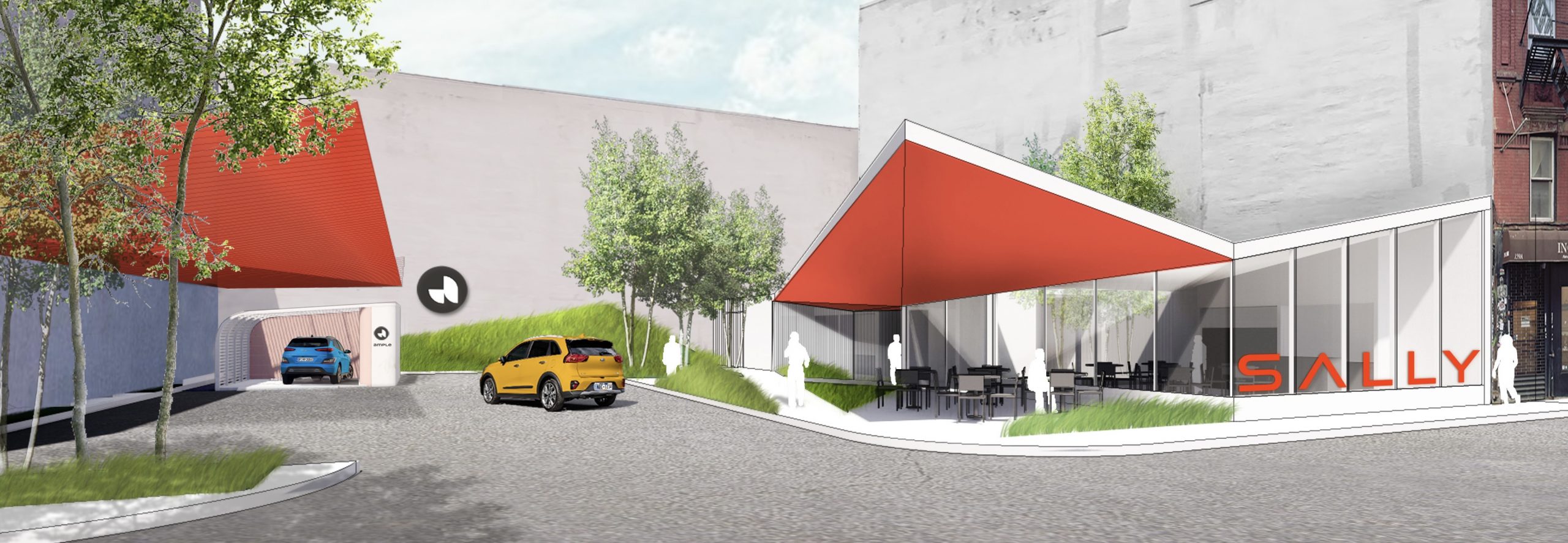
Ample’s May 2023 update described an Uber driver returning to work after a five-minute swap at its next-generation station. It named Sally among the fleet partners that had helped test the technology with real drivers in the Bay Area. That evidence supports an operating experiment. The earlier list of planned cities should still be read as a plan.
The distinction is useful for anyone considering an electric rental. A battery-swappable car needs compatible equipment and accessible stations. A conventionally charged car needs a workable charging routine. The vehicle and its energy supply form one practical decision. An inexpensive mile loses some of its charm if getting it requires a long unpaid detour.
The data business has obligations, too
Sally describes using vehicle information, driver data and public APIs to guide decisions, encourage safer driving and reduce insurance costs. Its software belongs inside a physical operation: cars need repairs, customers need answers, assets need utilization. The app helps administer the relationship. It does not make the underlying fleet weightless.
That approach also creates responsibility. In June 2024, Sally disclosed unauthorized access to its staging database between April 30 and May 1. Its notice attributed the access to misconfigured database settings. The files included personal information such as names, birth dates and driver’s-license numbers. Sally said it contained the incident and enhanced technical security measures.
The useful thing to borrow
Sally competes with rideshare rental programs from companies such as Hertz and Avis, local operators and the option of owning a vehicle. Included maintenance is a comparison point, not an exclusive invention. Sally’s distinctive story is the combination of fleet-financing experience, professional-driver service and practical electric-vehicle experiments.
For another founder, the lesson is to study the customer’s whole working day. Sally’s partnership plans reached beyond the car to energy, repairs and even the bathroom. Each small interruption can matter when the customer earns by completing trips. For drivers, the lesson is equally concrete: check eligibility, coverage, deposits and energy access before comparing the weekly number. The rental earns its place only when the week leaves enough money to make another one worthwhile.