A necklace has a difficult entrance exam. Before anyone asks what it can do, someone asks whether it goes with the shirt. Wei Lyu has built a company around taking that question seriously. After years working on augmented reality products, she is pursuing a computer that must first survive the ordinary, unsentimental judgment of getting dressed.
Her company, Nirva, is developing an AI wearable that can be worn as a necklace or bracelet. Its intended job is to turn the wearer’s everyday context into a personal journal and companion experience. Its other job, inseparable from the first, is to be something a person willingly puts on. An accessory gets no credit for looking impressive in a charging case.
Lyu’s route here includes film, art management, fashion design and product leadership at XREAL and Meta Reality Labs. Read in a straight line, the career changes subjects several times. Put the finished idea on a cord and the subjects begin to look like preparation.
An education with room for a necklace
At Peking University, Lyu studied film and economics. She went on to study arts management at New York University and later took fashion design studies at Parsons. These are unusually relevant credentials for someone asking a computer to join a wardrobe. They put the experience of looking at an object alongside the experience of using it.
Film offers one way into the question. A film makes choices about what to preserve, what to leave outside the frame and which moments deserve another look. A personal journal makes related choices. That connection does not establish how Nirva’s software works. It does explain why the biography deserves more room than a familiar list of technology employers.
The employers matter, too. At XREAL, then known as Nreal, Lyu became head of product. Her responsibilities extended across the glasses and their software. Her work included software and hardware product planning and development, with projects such as the Nebula system and NRSDK. Wearable computing was already a whole collection of interdependent decisions.
At Meta Reality Labs, she led spatial AI product work. The career placed her close to a persistent challenge: a device can be technically capable and still ask too much of the person wearing it. Weight, appearance and the way it fits into a day belong in the same conversation as its features. A specification sheet has never had to meet someone for dinner.
- Film & artPeking University · NYU
- Wearable computingXREAL · Meta Reality Labs
- AI jewelryNirva · founded 2025
The prototype needed another fitting
Nirva’s early days found Lyu building before the current team had come together. She was a solo founder looking for a technical co-founder. She also said she had built the end-to-end prototype herself using AI design and coding tools. Recruiting and building were happening in parallel.
“I’m not waiting to move.”
Wei Lyu, in Nirva’s early founder introduction
There is something pleasingly concrete about that early description. Before the necklace had a place in a funding announcement, it had to become an experience someone could try. The tools made a first version possible. They did not make the first version final.
Mark Jacobstein, an investor at South Park Commons, later described an early prototype with software that needed work, poor battery life and a look closer to cyberpunk than elegance. People in the community wanted one, he recalled, but the appearance appealed to a different audience from the one Nirva hoped to reach.
That is a useful complication in Lyu’s story. The company’s argument depended on wearability, yet its early object still needed a different look and better endurance. A design principle can be clear long before the product obeys it. The process requires tolerating an awkward object on the table while making decisions for the person who might eventually take it home.
A jewelry counter in the electronics hall
Nirva appeared at CES in January 2026. Lyu’s account of the preparation has the compressed timetable familiar to young companies: she left Meta in September, the three founders were working full time by October, and the decision to attend came in December. After securing a booth, they had roughly two weeks for the setup, materials and press work.
The booth photograph tells part of the product story without requiring a demonstration. There are large fashion photographs, pale surfaces and jewelry displayed at the counter. The arrangement asks a visitor to look at something they might wear before asking them to consider the machinery inside it.
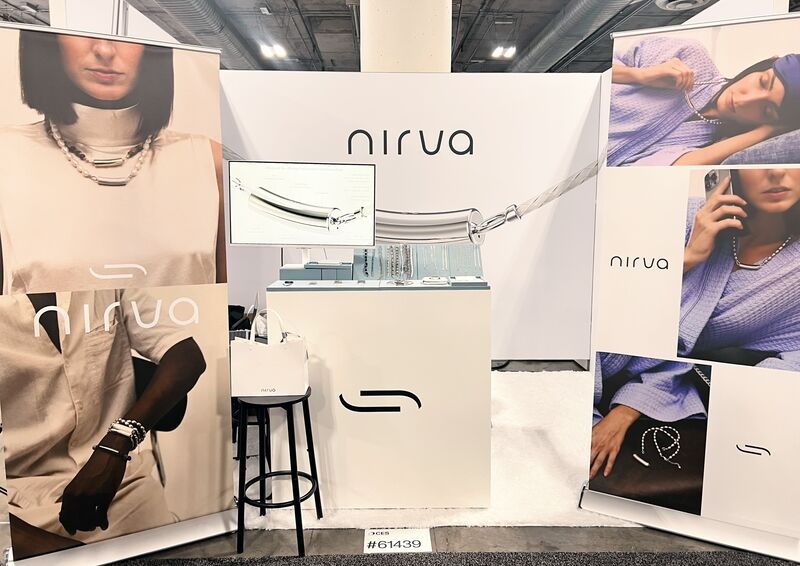
Nirva received a Tom’s Guide Best of CES award. The attention gave the team a public milestone, though an exhibition and an ordinary Tuesday make different demands. At an exhibition, novelty has a receptive audience. On Tuesday, the device must compete with habits, errands and whatever else is already on the dresser.
Lyu’s launch announcement had already described the founding combination as hardware, AI and software, and fashion and design. CES gave that combination a physical setting. Visitors could see the result of treating the accessory as part of the computing idea from the beginning.
A journal that begins before the blank page
The experience Lyu wants to build begins with a familiar desire: keeping some record of a life while being busy living it. Nirva is designed to listen to the wearer’s own voice and turn everyday context into a journal, with a companion that can draw on that history. Those are the company’s intended capabilities, and the ambition extends beyond the pendant itself.
A blank diary has an obvious virtue. You control every word. It also has a rather exacting employment policy: you must show up and write. A product that prepares a record changes where the effort falls. The person can begin with something to revisit, rather than another empty page at the end of the evening.
That shift makes the physical design consequential. If someone removes the device whenever it clashes with their clothes, part of the day goes missing. If the object feels intrusive, it has a different problem. The appeal of a useful journal cannot be considered separately from the conditions under which its material is gathered.
Lyu’s aspiration is for personal AI to have a longer view of someone’s life. Lightspeed describes Nirva’s longer-term direction as an intention engine, able to anticipate what a person needs. It is a substantial ambition for a small object. The distinction between what the team is building now and what it hopes to build over time matters.
Three disciplines, one small object
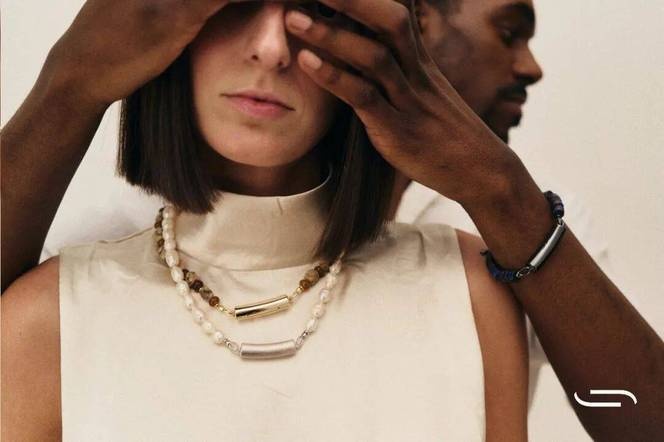
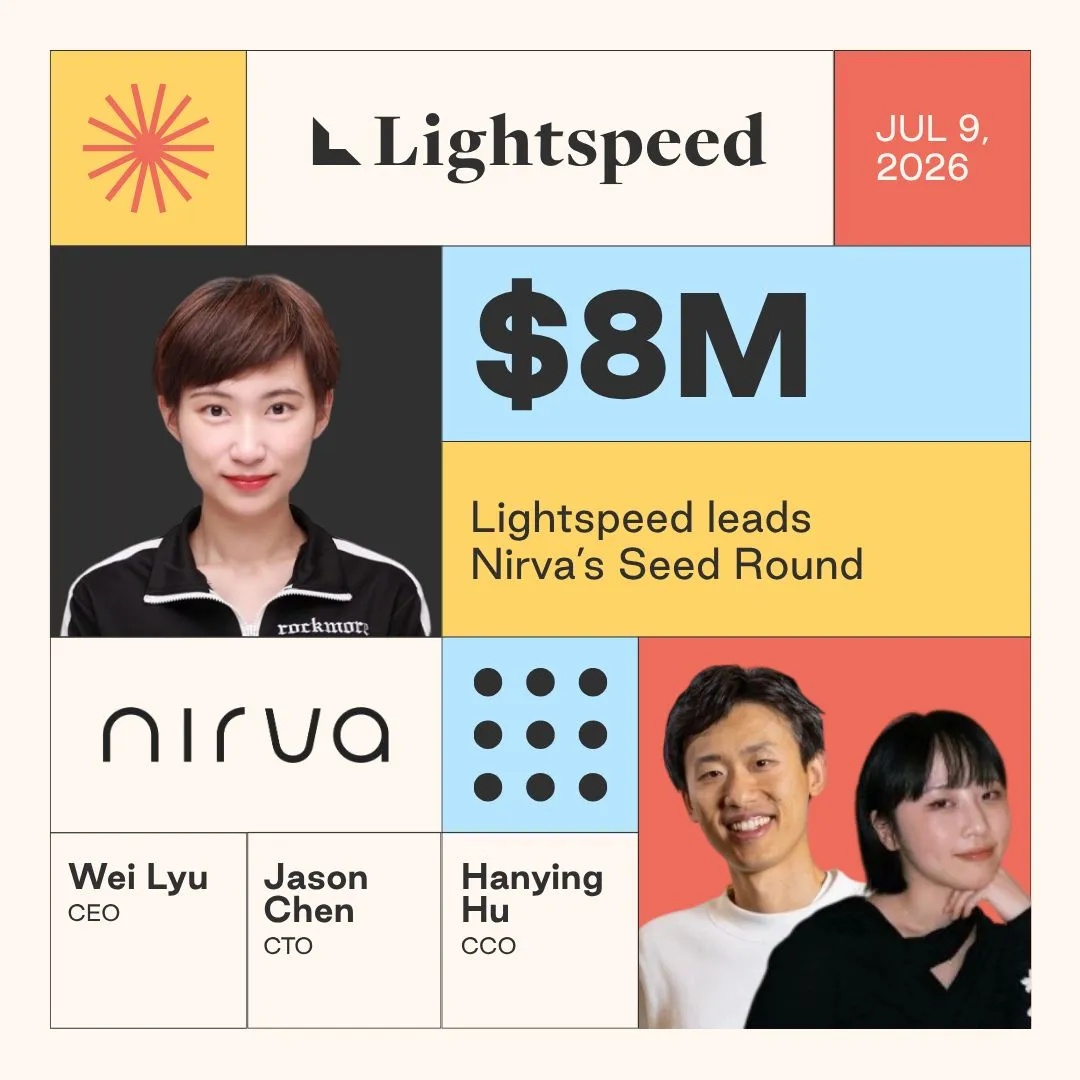
Lyu is building Nirva with Jason, also known as Qianyuan, Chen and Hanying Hu. Chen is the chief technology officer; Hu is the chief creative officer. Chen brings engineering experience from Meta, while Hu founded a jewelry brand and has designed pieces worn by Lady Gaga and BLACKPINK. Lyu brings the product work connecting hardware to the experience around it.
The distribution of experience makes the company’s priorities visible. Jewelry design has a founder at the table. So do the device and its intelligence. A question about how something looks can therefore arrive while the product is being defined, rather than after the electronics have claimed all the available space.
In July 2026, Nirva announced an $8 million seed round led by Lightspeed, with support from South Park Commons. Jacobstein had met the founders through the latter’s Founder Fellowship process. The financing joined an existing community relationship to a new stage of building.
Seed financing announced in July 2026.
Led by Lightspeed, with South Park Commons.
Funding gives the work room to continue. The object still has to be manufactured, its software has to reward repeated use, and the company has to establish a reason to keep coming back. A first purchase and a daily place in someone’s life are separate achievements. Lyu’s product brief requires both.
The place beside the keys
There are smaller glimpses of Lyu’s working life in her public posts. She shared Nirva’s CTO and an engineer playing tennis with the device on. Elsewhere, she proposed a late-night San Francisco workspace with reliable Wi-Fi, an outlet at every seat, coffee and beer. She had tried bars, early-closing cafés and even the line outside a restaurant. The restaurant line, she noted, lacked outlets.
The proposed venue has the practical specificity of a complaint that has been turned into a product brief. Somewhere to sit. Somewhere to plug in. Enough quiet to work. Hours that match the people using it. In that small proposal, the grand language of future computing gives way to an electrical socket.
Nirva asks a related everyday question, on a smaller scale: what earns the right to accompany you? Lyu’s answer draws on years spent among glasses, software and the arts. The next test happens in private, when someone is getting ready to leave. The keys are waiting. The clothes are chosen. There is room for one more thing.