Imagine paying for lunch with a balance that began as bitcoin. To the waiter, it is a card payment. To the customer, it may feel like crypto has finally become ordinary money. Between those two experiences sits a small procession of jobs: holding assets, exchanging currencies, loading a card and settling a payment. Wallex Neobanking built its proposition around gathering those jobs into one account. Its story becomes more interesting when you follow them back out again.
- A documented bundle of crypto custody, exchange, fiat accounts and prepaid spending.
- Different companies provide different services behind the Wallex name.
- Historical pricing and regulatory records deserve as much attention as the app.
The awkward last mile
Founder Simone Mazzuca came from financial consulting. In a 2021 interview with Forbes Italia, he described the initial problem as moving digital assets from exchanges into traditional bank accounts. Then came the larger ambition: let people use those assets in daily life. He imagined an account holding conventional currencies alongside bitcoin and ether. The opportunity lay in the handoff between systems.
Mazzuca’s memorable description of Wallex was a “digital Charon,” a reference to the mythological ferryman. It is an unusually theatrical metaphor for financial plumbing. It also identifies the intended customer rather well: someone who already has value on one side and needs to get it to the other. Businesses receiving crypto payments face a version of the same trip.

A shopping trip, in three moves
The published product catalogue describes a multicurrency account, custodial crypto wallets, virtual IBANs, exchange and transfers. The practical appeal is fewer separate places to visit. A user could receive assets, convert them and prepare them for spending within the same product environment. Auto-conversion, another advertised feature, was designed to turn incoming crypto into fiat rather than leave the recipient exposed to subsequent crypto price movements.
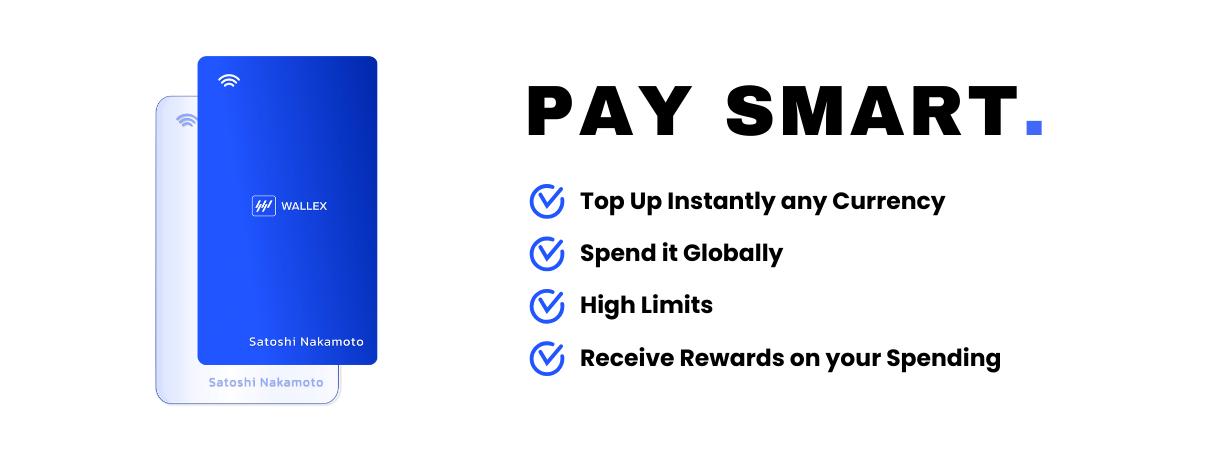
The card guide is more precise than the broad neobanking label. It describes a prepaid debit card operating with funds already available in the user’s wallets. Customers request it through the dashboard after verification and use a top-up function to fund it. The guide also describes freezing the card and changing its PIN. Familiar controls help make an unfamiliar funding source feel manageable.
Convenience has a conversion rate
Wallex’s published whitepaper lists exchanges at an OTC rate plus a 0.25% commission. Its card top-up schedule lists 1% from fiat or stablecoin accounts and 2.8% from crypto accounts. These are historical published figures, rather than a current checkout quote. They reveal a transaction-fee model: the business can charge at different stages of turning a balance into spending power.
On a €1,000 funding amount: €10 versus €28 in listed top-up charges alone. Other applicable charges are excluded.
The useful comparison is the complete journey. A commission percentage tells only part of the story when a quoted exchange rate and a later funding charge also matter. Wallex occupies territory shared with services such as Revolut’s crypto exchange and Coinbase Card’s crypto-funded spending. Its advertised feature bundle is a positioning choice; the bundle alone does not establish better prices or broader permissions.
One screen, several counterparties
“Some functionality, products and services may not be available in your country.”
Wallex Neobanking terms / November 2023
The terms distribute the work. They name Lithuania’s Wallex Custody UAB for digital asset custody and exchange, Canadian entities for payments and prepaid cards, and a Bulgarian company for card-funded fiat top-ups. That division matters because the company holding a crypto balance and the company providing a payment service can carry different responsibilities. A single login can conceal a surprisingly long organizational chart.
Opening the account is also a conventional exercise in identity. Wallex’s verification guide requires proof of address issued within the preceding three months. It accepts utility bills and bank statements, while rejecting screenshots and mobile phone bills. An address that cannot be verified can stop the process. The interface may promise a short journey; the compliance checks still determine who gets through.
Time imposes another boundary. The deposit guide describes wires taking three to five business days and crypto deposits usually taking thirty minutes to two hours. It lists incorrect details, compliance checks, network congestion and insufficient liquidity among possible obstacles. Bringing the steps together does not make their underlying systems run on the same clock.
The beach and the fine print
Wallex’s wider group also sought a much more public stage. Wallex.US became title sponsor of the 2023 U.S. Open of Surfing. The sponsorship put a financial services brand in front of a beach crowd. It was a different kind of introduction from an account-opening screen, and a reminder that consumer fintech needs recognition as well as infrastructure.
Recognition and permission answer different questions. On July 29, 2024, the British Columbia Securities Commission cautioned that Wallex Global was neither recognized as an exchange nor registered as a dealer in BC. A payment-related registration elsewhere does not answer that jurisdiction’s securities question. The warning concerns Wallex Global and the named website; it should not be stretched into a finding about every group entity.
In January 2026, Italian broadcaster Telenuovo reported complaints by Fidea investors alleging their money had been managed through Wallex Bank and repayments remained outstanding. It reported a possible March 31 repayment date attributed to Wallex. Those were reported allegations and a proposed date, rather than a court finding or evidence of completed repayment. They add a consequential test to the wider group’s convenience pitch: access to money when someone wants it back.
Copy the journey. Name the responsibility.
For anyone building a financial product, Wallex offers a useful design question: can the customer complete a real task without assembling several services? Receiving, converting and spending make a coherent task. But the experience also depends on eligibility, processing times, fees and the provider behind each step. The durable lesson is to make responsibility as easy to follow as the buttons. A tidy dashboard earns its place when the journey behind it is equally legible.