Company Profile • Digital Signage / EdTech
The Company Turning Dusty Trophy Cases Into Touchscreens
VitalSigns spent two decades building commercial signage. In 2017 it pointed that machinery at a problem every school shares: too many plaques, not enough wall.
Every principal in America has said the same sentence out loud, usually while staring at a hallway: we are out of room for plaques. The trophy case is full. The honor roll is a laminated poster curling at the corners. A wall meant to celebrate people has quietly become a storage problem. Wall of Fame, a product built by the Dublin, Ohio signage company VitalSigns, is a business built on that exact sentence.
The pitch is simple. Take the crowded plaque wall and the locked glass case, and replace them with an interactive touchscreen that never runs out of room. Put every honoree - in academics, arts, and athletics - into a web-based system that anyone can update from a browser. Then let the whole thing travel: to the school website, to a parent's phone, to an alum three states away who will never again stand in that lobby but still wants to see their name.
01 / The originA boring complaint, engineered into a product
VitalSigns did not start in schools. The company launched in 2001 as a digital-signage shop, building multi-user, multi-site content systems and the software behind them - the unglamorous plumbing of screens in lobbies, hospitals, and offices. That is more than twenty years of knowing how a display behaves when nobody is watching it, which turns out to be the hard part.
The school idea arrived from outside. In 2017, a Central Ohio athletic director walked in with the plaque problem, and VitalSigns pointed its existing machinery at it. The Wall of Fame product went from concept to launch in under six months, because the company was not inventing digital signage - it was aiming a mature toolset at a buyer nobody had built specifically for.
"We dedicate ourselves to bringing your school's legacy to life. We make digital tributes an inclusive and interactive celebration in an ever-evolving, virtual world."
- VitalSigns Wall of Fame02 / The productA screen, a system, and a person
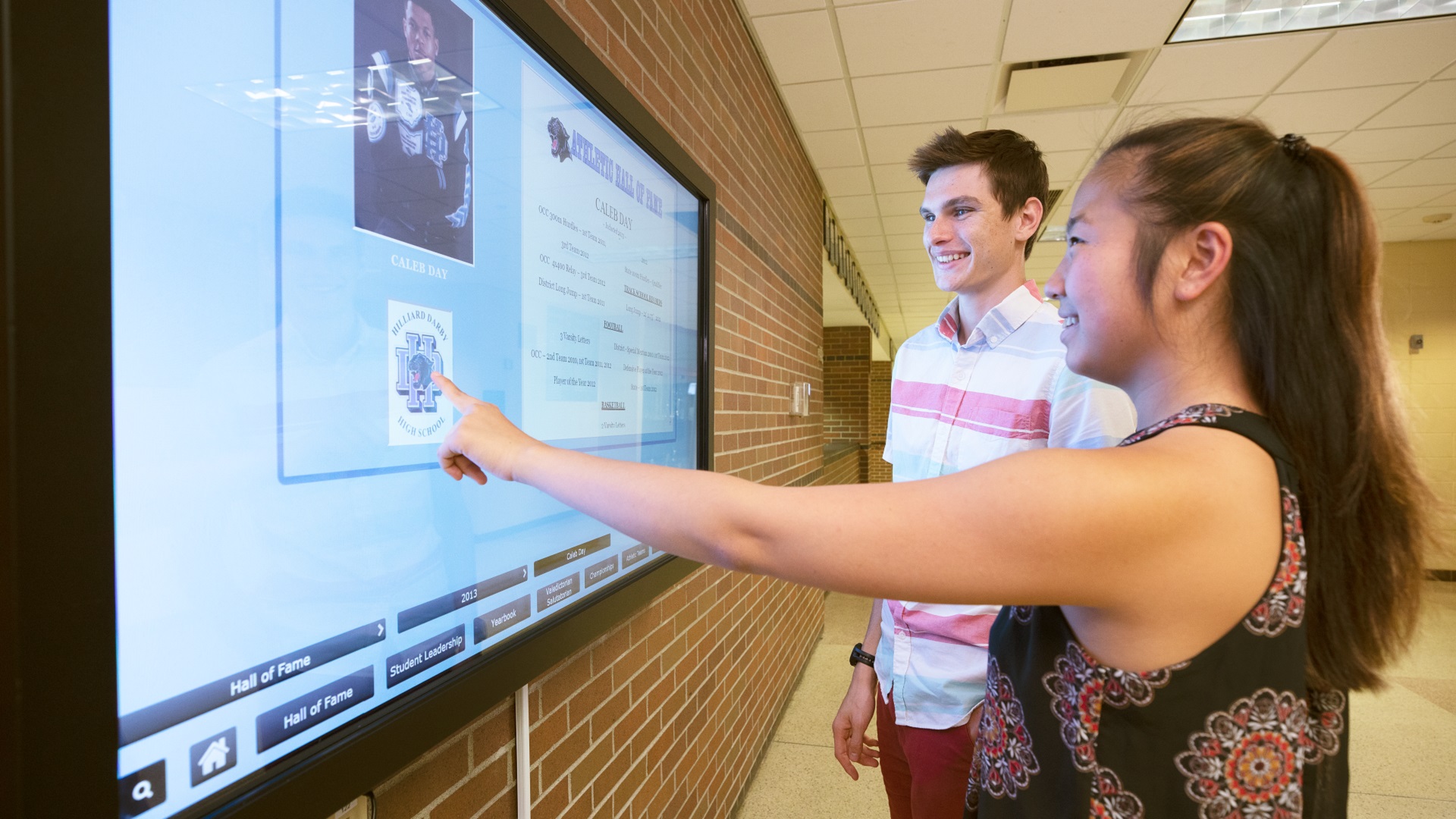
The visible half is the kiosk. Wall of Fame ships as a wall mount, a floor stand, or a branded enclosure, in a range of sizes, so it can bolt into a gym lobby or stand near a front office. On it runs a touchscreen interface where visitors dig through photos, videos, record boards, and stories instead of squinting at a case.
The invisible half is where the company actually lives. Content flows through a web-based management system that opens in any browser, with 20+ templates and 50+ layouts covering pictures, video, text, social feeds, record boards, and flip books. And every installation comes with a lifetime Content Advocate - a human whose job is to keep the wall from going stale after the install crew drives away.
The kiosk
Wall, floor, or enclosure. The screen you see in the lobby.
The CMS
Browser-based. 20+ templates, 50+ layouts, updated by anyone.
The advocate
A named person keeping content current for the life of the wall.
The reach
Same content on web, phone, and tablet - honors that leave the building.
That third piece is the quiet moat. Plenty of vendors will sell a school a screen. Far fewer promise a person will still be helping update it years later. Competitors read that as a tell - if you need a content advocate, maybe the platform is not intuitive enough. Read it the other way and it is a retention engine: the wall stays alive, so the customer stays.
03 / Digital vs. glassWhere the touchscreen wins
The comparison Wall of Fame wants schools to make is against the plaque, not against another vendor. On that axis the math is lopsided - a physical wall has a hard ceiling on honorees and a hard limit on who can see them, while a screen has neither.
Plaque wall vs. digital wall - rough capability
Illustrative comparison of the two formats, not vendor benchmarks.
There is a second, less obvious win: who gets honored. A plaque budget forces triage, and triage usually favors the star quarterback. A screen with 50 layouts does not have to choose. Wall of Fame leans hard into that - its "Content Matters" philosophy is about celebrating academics, arts, and athletics together, so the debate team and the playbill land on the same wall as the state title.
"Content Matters - stories unite us."
- The company's stated promise04 / The marketA crowded lobby, a growing category
Wall of Fame is not alone. The digital hall-of-fame category now includes Rocket Alumni Solutions, Touchpros, Gipper, and Rise Vision, plus every traditional plaque and trophy-case maker it is trying to replace. Competitors argue that recognition is a side product for a signage company, and that its look reads corporate rather than school-native.
The counter-argument is the same twenty years the critics point at. When a screen has to run untouched in a hallway for years, the boring signage heritage is the feature, not the bug. Distribution has also come through partners like the scoreboard supplier Nevco, which puts Wall of Fame in front of exactly the athletic departments most likely to have run out of plaque space. Pricing stays quote-based, which is friction, and the company knows it.
Customers
K-12, colleges, and pro schools - plus alumni groups and boosters.
Model
B2B hardware + CMS subscription + content services. Quote-based.
Edge
20+ years of signage, and a person attached to every screen.
05 / What you can copyThe transferable idea
Strip away the hardware and Wall of Fame is a lesson in finding an unglamorous, universal complaint and refusing to look away from it. The founders did not chase the classroom, where every edtech company is already fighting. They took the hallway - the lobby wall nobody was building for - and they attached a human being to the software so the thing would not rot. Ordinary problem, durable business. The screen is the easy part.