A pair of trousers can get into trouble before anyone puts them on. Someone chooses a colour, predicts a size, approves a quantity and commits to a season that has yet to arrive. By the time the customer appears, the important decisions have been made. Walden Lam has built much of his working life around the awkward distance between those two moments.
He came to fashion by way of consulting, finance and retail strategy. That route helps explain his particular preoccupation. A badly fitting pair of jeans is a customer’s problem. A warehouse full of them is a business problem. Making clothes that nobody buys adds an environmental problem. At unspun, which he co-founded with Beth Esponnette and Kevin Martin, Lam has been trying to get those conversations into the same room.
The proposition begins with a modest change in sequence: find out what somebody wants, then make it. Carrying that through requires software, machinery, manufacturing partners and money. It also requires a rather unfashionable willingness to discuss inventory. Lam appears happy to oblige.
Hong Kong, then the long way round
Lam grew up in Hong Kong, in a family that ran an export candle factory. Making physical things was part of his childhood surroundings. His education took a numerical direction: actuarial science at the Chinese University of Hong Kong, followed later by an MBA at Stanford, where he graduated in 2015. Fashion was hardly the obvious destination.
He had expected a more conventional career in financial services. Instead, graduating into the recession steered him towards consulting work involving governments and utilities and their carbon emissions. The experience put environmental questions beside operational ones early in his career. Supply chains and commercial expansion became subjects he could examine together.
His working history includes OC&C Strategy Consultants, a business-design stint at IDEO and an early-stage investment role at GGV Capital. Eventually he became lululemon’s head of strategy for Asia-Pacific. He learned the apparel business from inside a company whose products people already wanted. Even there, the distance between retail demand and the machinery supplying it remained a problem.
The common thread was the back end of a consumer business. Shops and websites could move quickly, presenting products and collecting information about customers. Production was slower to respond. Lam kept finding versions of the same mismatch: the business facing the shopper had changed faster than the business making the goods.
A founding team, assembled to fit
At Stanford, Lam met Esponnette, whose interests in design and clothing waste had led her towards a different way of manufacturing. She brought knowledge of fibres and apparel that he did not have. He understood the commercial burden of inventory. The overlap gave them a reason to keep talking.
They still needed an engineer. AngelList supplied the introduction to Kevin Martin, and Lam supplied the dating-app comparison, calling it “the Tinder of startups”. For a company concerned with finding the right fit, the joke was almost unavoidable. Martin’s engineering background supplied another necessary piece.
The company’s beginnings unfolded over several years. Esponnette began developing the concept while studying; the founders worked on its direction while holding other jobs. By mid-2017, all three had quit to pursue unspun full-time. It was a division of labour with clear reasons behind it: design, engineering and business.
Then geography intervened. An offer from the hardware accelerator HAX took the founders to Shenzhen, where they could find help with the technical work. Hong Kong provided another useful setting: customers to meet, pop-ups to try and an established network of garment-industry buyers and suppliers. Lam’s home city also had a commercial purpose.
Start with the person in the jeans
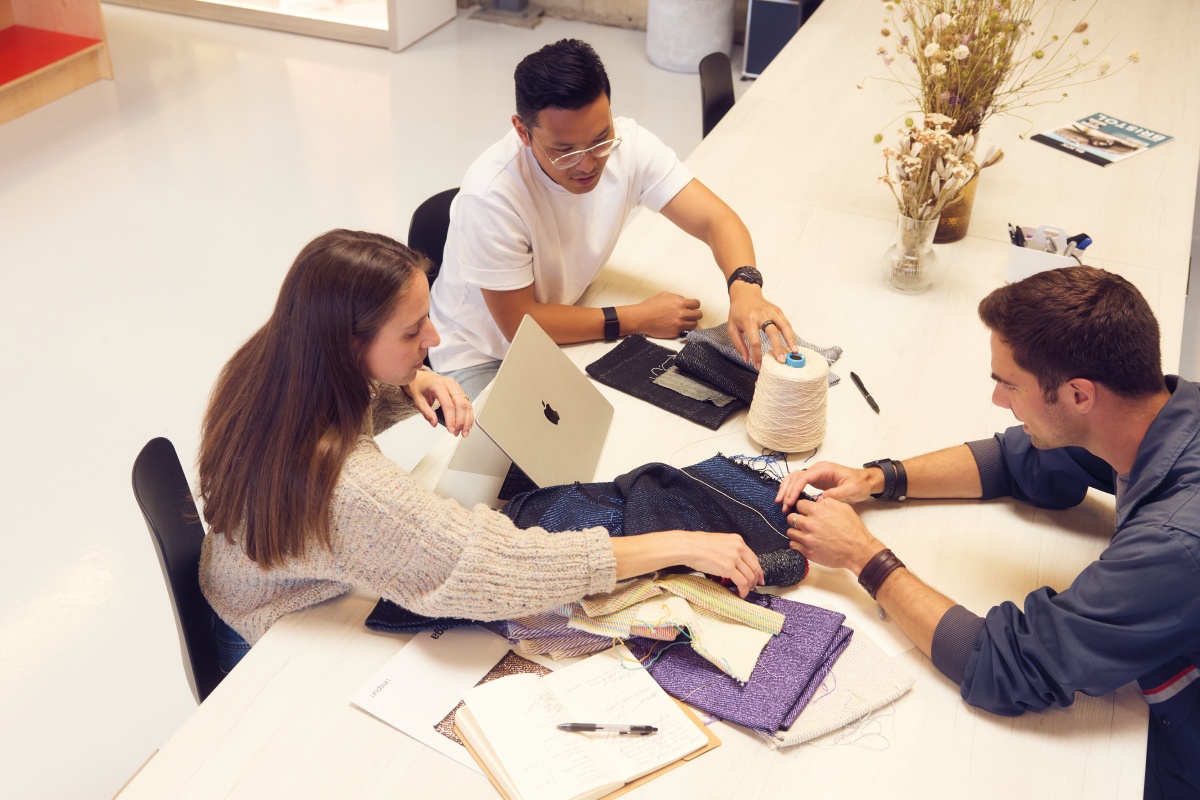
Denim gave the team a specific problem to solve. During conversations with consumers, they heard how difficult it was to find jeans that fit. It was a familiar complaint, with the advantage of requiring very little explanation. Nobody needs a seminar to understand a waistband that has taken against them.
Early unspun customers could choose details of their jeans and have their bodies scanned. Software used the measurements to produce a custom fit. The business made the pair after the order arrived. In a 2019 account, Lam described delivery taking weeks; the early customer experience was about personalisation rather than instant gratification.
That changed the inventory question. A pair began with an identified buyer, rather than a forecast about an anonymous group of people who might eventually turn up. It also gave the founders a way to test whether customers would accept scanning and pay for custom clothing.
There was a less visible learning process, too. The team collected feedback about how the jeans aged and worked with local production partners. For Lam, the relationship extended beyond the moment of purchase. How a garment was used, and what happened to it afterwards, belonged in the manufacturing conversation.
“Fit is a very painful issue for consumers.”
Walden Lam, 2022
By 2022, he was explaining phone-based scanning as a way for customers to order from home. The attraction was convenience with a practical consequence: each order provided information before production began. The customer supplied a body and a preference. The company had something more useful than a guess.
The factory gets a different brief
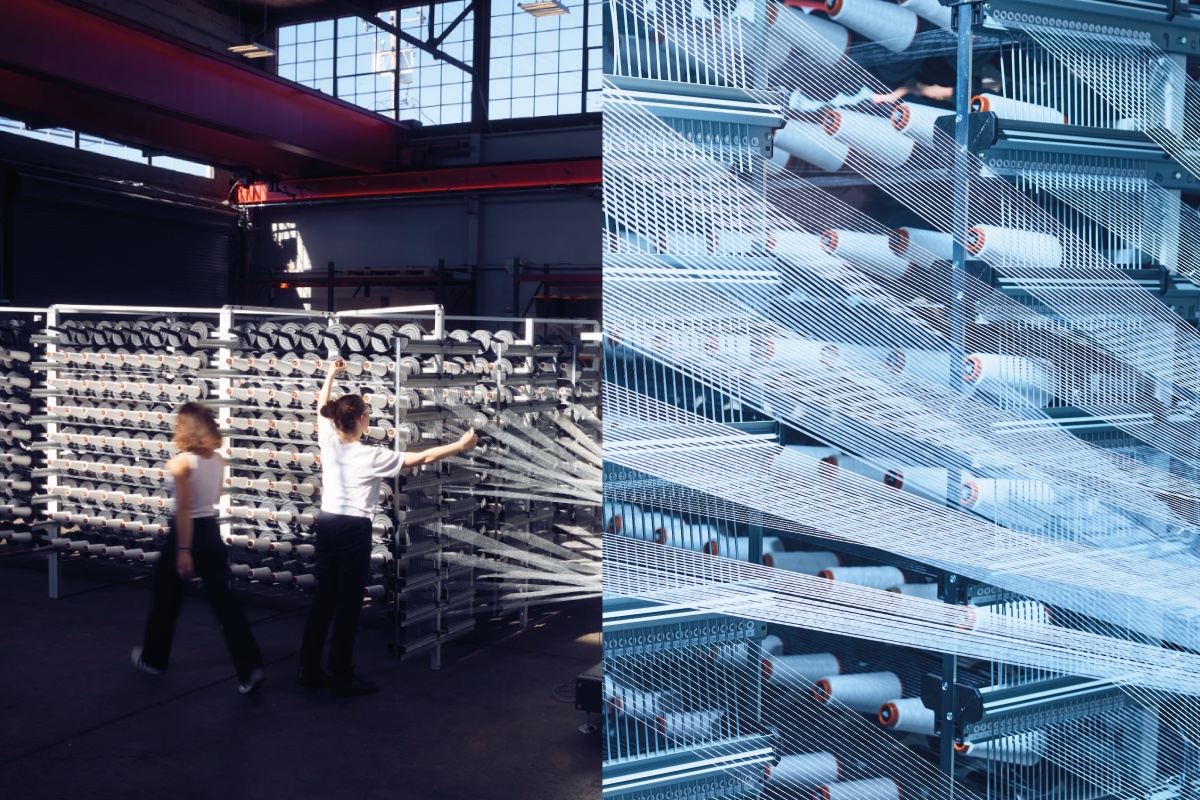
Custom denim was one part of the work. The other was developing machines that could change production itself. Unspun’s 3D weaving technology, introduced as Vega and now called OneWeave, works with yarn to create three-dimensional woven forms. Its industrial promise is fewer manufacturing stages and production closer to the people buying the clothes.
That distinction matters. A made-to-order retail service and a weaving platform are related projects, with different customers and different practical demands. One asks an individual to buy jeans. The other asks manufacturers and brands to consider changing how they operate. Lam’s business role runs across that gap.
In March 2024, Walmart announced a pilot exploring unspun’s technology for men’s chinos. The retailer described a process that could weave garments without the usual leg seams, with labels woven in. It was a test of how the technology might enter its supply chain.
A pilot brings the idea into contact with a buyer’s requirements. A machine must produce something useful at an acceptable cost and quality, repeatedly. Lam’s early work on consumer demand now had an industrial counterpart: persuading a large business to explore a different route to the clothes it sells.
October brought a European agreement. Decathlon Pulse announced an investment and a multi-year offtake arrangement through 2030, intended to help deploy the weaving technology across Europe. An offtake agreement provides a prospective market for production. It connects the factory proposition to someone willing to purchase output.
An argument that has to survive the spreadsheet
Between those announcements, unspun raised a $32 million Series B in July 2024, led by DCVC with participation from Lowercarbon Capital, E12, Decathlon and SOSV. Lam was CEO at the time. The financing was intended to scale the technology and support expansion in Europe and North America.
DCVC’s account of the investment pointed to the founders’ complementary experience, including Lam’s work on lululemon’s Asia-Pacific expansion. That background had a use beyond the biography. Apparel technology needs relationships with companies whose factories, sourcing practices and financial commitments it hopes to change.
Walmart announces a men’s chino pilot.
$32m Series B announced, led by DCVC.
Decathlon Pulse announces an agreement through 2030.
Lam has also been blunt about the appeal of easier subjects. In a 2022 conversation, he criticised fashion’s preference for stories about novel materials over difficult discussions about excess stock and production impacts. A striking fabric makes an attractive campaign. Inventory takes more explaining and reaches into decisions a company may prefer to leave alone.
His recent writing continues that operational argument. A company essay published in July 2026 considers tariffs, sourcing alternatives, automation and local production. The circumstances have changed; his interest in shortening the distance between a buying decision and a manufacturing decision is recognisable.
Today, unspun’s author biography identifies Lam as co-founder and president, responsible for strategy, finance and partnerships. Its leadership directory lists Arne Arens as CEO. Lam’s earlier chief-executive years belong to a longer business-building story, alongside the technical work of his co-founders and their team.
A stranger in the next cabin
There is a personal scale to his ambition as well. Lam has described wanting to notice a stranger wearing unspun on a long-haul flight. He recalled seeing someone in the company’s clothes between London and San Francisco. For all the discussion of industrial systems, that is a satisfyingly ordinary test: someone chose the trousers for a journey.
His interests offer smaller clues to the person behind the business role. He enjoys science fiction involving time travel and bootstrap paradoxes, and recommended Phil Knight’s Shoe Dog in a 2020 interview. Asked about advice, he favoured developing strengths and working with people whose abilities cover your weaknesses. His founding team gives that preference a practical expression.
He has offered another compact instruction: “Try to make cool things.” There is room inside it for an engineering challenge, a commercial calculation and the simple pleasure of wearing something you like. After the forecasts, the financing and the factory plans, the trousers still have to earn a place in somebody’s wardrobe.