- Waitwhile lets a phone hold a person's place in line while staff manage appointments, walk-ins, messages, and resources in one system.
- Its first platform slowed down and suffered outages as it grew. The team rebuilt the server, database, API, and interface instead of polishing the bottleneck.
- The company reports 10,000-plus businesses, 50,000-plus locations, and more than 300 million customer visits.
- Plans run from free to custom enterprise contracts. Allegion acquired the company in July 2025 for an undisclosed price.
A queue is an odd social machine. It converts uncertainty into order by asking everybody to stand still. The person at the front gets certainty. Everyone behind gets a view of someone else's coat. Waitwhile began with the suspicion that the order was useful but the standing still was not.
The product is easy to explain at a restaurant door. A guest scans a QR code, taps a web page, sends a text, uses a kiosk, or speaks to a host. Their name enters a virtual line. Their phone shows an estimated wait and their position. Messages arrive as the turn approaches. The guest can sit in a car, browse a store, or buy a coffee. The line remains; the captivity goes.
Behind that small liberation is a less picturesque piece of software. Staff see who is waiting, booked, being served, or finished. They can route a visit to a salesperson, clinician, room, counter, or other resource. Automated workflows send reminders and status updates. Managers study arrival patterns, service times, no-shows, and location performance. The same machinery can manage a handbag appointment, university office hours, a lab visit, curbside electronics pickup, or the crowd for a glass-floor elevator.
The first thing to fail was the first version
Brothers Christoffer and Jonas Klemming founded Waitwhile in San Francisco in 2017. Christoffer had spent roughly a decade in product roles at Google. Jonas was a coder and repeat founder. Their mission had the charm of a provocation: make waiting in line feel like not waiting at all.
Then the familiar startup compliment arrived in its least flattering form. Too many people used the thing. Waitwhile later wrote that its original platform had never been built for tens of thousands of companies and millions of guests. It became slow. Outages appeared. New features took longer to ship. The queue software had developed a queue of its own.
The response was not a nicer coat of paint. Over two years, the team rebuilt the foundation: a new server and database designed for far greater scale, a much broader API, and a new web application. Version 2 made bookings a first-class part of the product rather than an afterthought. It added a clearer resource dashboard and more reliable booking validation, including protection against two people grabbing the same slot a fraction of a second apart.
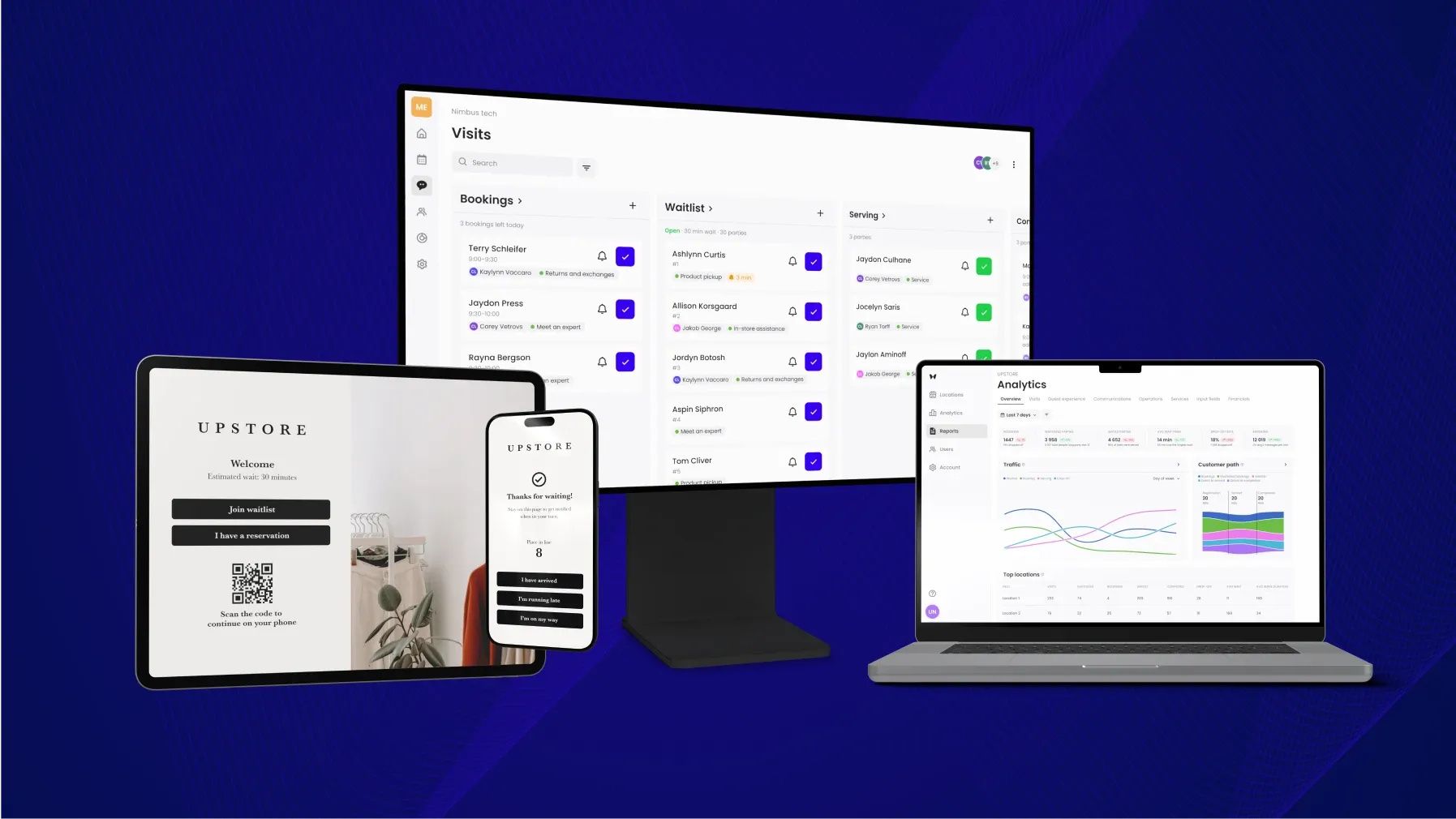
The next change came from listening to the people leaning over the counter. Waitwhile said it spoke with hundreds of frontline workers and its largest enterprise customers. They wanted more than a digital list. They wanted one place for appointments and walk-ins, fewer clicks for staff, flexible public pages, multi-location changes, resource controls, and reports fit for complicated operations. Version 3, introduced in 2023, was the answer: a board for every visit, a faster calendar, drag-and-drop movement, web chat, branded guest pages, account-wide settings, and a report builder.
The customers have almost nothing in common
This is the revealing part. Louis Vuitton has used Waitwhile in global retail spaces since 2017. Best Buy Canada deployed it for queue management and curbside pickup across more than 160 stores. Apple American Group, the largest Applebee's franchisee, used it across 441 restaurants in 23 states. Island Health replaced paper tickets with a virtual waiting room and began collecting service-time data it never had before. Oklahoma State University reported 99.9 percent student satisfaction after changing its appointment and walk-in process.
These organizations do not share an aesthetic, a price point, or even a definition of “customer.” They share a collision between variable demand and finite capacity. Someone wants attention. A person, room, table, or counter is not ready. Waitwhile sits in that gap and tells each side what is happening.
That breadth is also how Waitwhile distinguishes itself in a busy field that includes Qminder, Qless, Qmatic, Wavetec, WaitWell, Coconut Software, and appointment tools. A simple waitlist app may be cheaper and sufficient. A traditional queue-management installation may offer specialized hardware. Waitwhile's bet is the middle: a configurable cloud layer broad enough to combine walk-ins, scheduled visits, two-way messaging, resources, automation, analytics, branding, and integrations without becoming a bespoke infrastructure project.
The price of giving time back
The commercial model begins like consumer software and ends like enterprise infrastructure. A permanent free plan permits up to 50 visits a month. Published Starter pricing begins at $31 a month and Business at $55, with tiers determined by locations or monthly visit volume. Text messaging consumes separate credits. Larger organizations negotiate Enterprise contracts for custom scale, white labeling, SAML and single sign-on, integrations, invoicing, service commitments, training, and dedicated support. Annual self-serve billing is advertised at a 20 percent discount.
The buyer is paying for more than a place-number generator. The value appears when the system reduces interruptions at the desk, evens out work across staff, captures data that paper never could, and saves a guest from abandoning the visit. In 2021, CRV led a $12 million Series A. No later standalone financing has been publicly announced.
A digital line meets the physical door
By July 2025, Waitwhile said it had crossed 300 million visits and 50,000 locations. That month Allegion, the company behind access brands including Schlage, acquired it. The terms were not disclosed. The strategic sentence nearly writes itself: Waitwhile manages when a person should arrive; Allegion's world manages whether and how the door opens.
Waitwhile remains a standalone brand and team. Existing products, plans, contracts, and support did not change at closing. The promised investment areas included AI, regional hosting, deeper integrations, and links between digital service flows and physical access. Weeks before the deal, the company had earned ISO/IEC 27001:2022 certification and renewed SOC 2 Type 2 - unglamorous credentials that matter when hospitals, governments, and global retailers hand a small vendor customer data and operational traffic.
The phone takes a place in line
The Klemming brothers found Waitwhile around a simple virtual-queue idea.
A rebuild replaces the strained original
New infrastructure, API, interface, bookings, and resource tools arrive with Version 2.
CRV leads a $12 million Series A
Capital arrives after more than 80 million guests have passed through the system.
Version 3 widens the job
Waitwhile becomes a broader customer-flow platform for complex and multi-location work.
Allegion acquires the company
The virtual queue joins a portfolio built around secure physical access.
The useful part is available to copy
You do not need Waitwhile to borrow its clearest operating lessons. Separate order from location. Tell people how long the wait might be. Message before they feel compelled to ask. Treat appointments and walk-ins as two tributaries entering the same river. Record actual service times. Make the status of each staff member or room visible. Pilot the flow somewhere forgiving before spreading it across 160 stores.
The model is less persuasive when there is no meaningful wait to manage, when guests cannot reliably receive digital updates, or when the staff system is fiction. An algorithm cannot estimate a queue if employees forget to mark service as started or finished. A phone-first flow can exclude people without compatible devices unless a kiosk or human route remains. Emergency medicine cannot be run as first come, first served. Complex regulated environments may require integrations and controls that belong in an enterprise deployment, not a free account.
The original queue solved a real problem with a bad bargain: fairness in exchange for immobility. Waitwhile kept the fairness, added a stream of information, and handed the person back their feet. Its own history adds a second lesson. Sometimes the software that removes waiting has to stop, rebuild, and catch up with the people already using it.