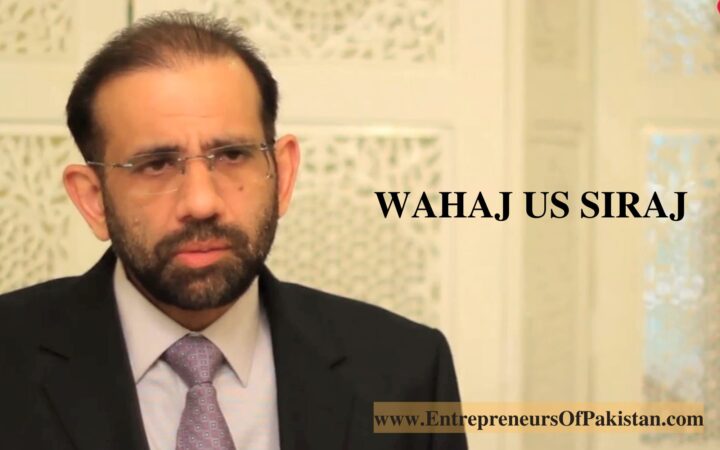
The Story
The Engineer Who Decided Pakistan Deserved Better Internet
There is a particular kind of frustration that either breaks a person or builds something. For Wahaj us Siraj, the frustration was a government paycheck that felt insulting, a bureaucracy that moved sideways when the country needed it to move forward, and the creeping suspicion that the real work - the connective tissue of a modern economy - was waiting to be built by someone willing to do it. In 1997, he walked out of a policy-making job at the Government of Pakistan and pooled everything he had into a plan that started with a hardware shop and ended with Pakistan's fiber backbone.
Today, Siraj runs Nayatel, Pakistan's leading fiber-to-the-home telecom operator. The company laid the first FTTH network in South and Southeast Asia. It introduced Pakistan to HD television and video-on-demand. It partnered with Meta (then Facebook) to expand fiber to eight cities. It now serves over 170,000 customers across 17+ cities with 2,500+ employees. When people talk about the infrastructure that made Pakistan's digital economy possible, Nayatel sits near the top of that conversation.
None of it started with a roadmap or a seed round. It started with a Suzuki car.
Origin Story
A Suzuki Car, a Personal Computer, and 100,000 Rupees
In 1997, Siraj sat down with two colleagues - Saad Saleem and Aqeel Khurshid - and made a list of everything they could bring to the table. Saleem had a Suzuki car. Siraj had a personal computer. Between them, they scraped together 100,000 Pakistani rupees. That was the seed capital. They sold the car, pooled the money, and opened a computer hardware shop in Islamabad.
It is the kind of founding story that gets sanitized in retrospect into something more heroic than it actually felt. At the time, it was just three people who were fed up enough to try. Siraj had spent years watching Pakistan's IT sector drift - plenty of policy meetings, not enough infrastructure. He had studied mechanical engineering at UET Lahore, gone to Australia for a master's in renewable energy, worked as a design engineer in Saudi Arabia, returned to Pakistan, and eventually landed in government. Each chapter added technical depth. The government chapter added something else: a precise understanding of exactly what was broken and why.
ORIGIN POINT
From hardware shop to Pakistan's first DSL operator in five years.
The pivot from selling computers to building internet infrastructure was not a pivot at all - it was a natural extension of seeing what the market actually needed. By 1999, they had acquired a small satellite internet company. By July 2002, Micronet Broadband launched Pakistan's first DSL broadband service.
The DSL launch was not a guaranteed win. Pakistan in 2002 was not a country with obvious broadband demand from consumers or obvious technical infrastructure to support it. Siraj and his team built it anyway. The first physical DSL connection in Pakistan was installed by a field technician named Syed Anwar Mehdi - a detail Siraj later made a point of documenting publicly, writing a LinkedIn tribute to the man who had no formal telecom degree but whose hands made the abstract real. That instinct - to name the people closest to the work - is a thread that runs through how Siraj operates.
Life is a mix of opportunities and difficulties, and it is the job of great professionals to create opportunities from difficulties.
- Wahaj us Siraj
The Company
Nayatel: Digging Up a City to Connect It to the Future
Nayatel was founded in 2004, two years after the Micronet DSL launch. The ambition was different this time - not dial-up upgrades or DSL patches, but fiber optic cable, run directly into homes. Fiber-to-the-home was a technology being discussed in developed markets as a distant future goal. In Pakistan, it seemed like a category mistake. Siraj decided it was a timing advantage.
In 2006, Nayatel launched Pakistan's first FTTH network in Islamabad and Rawalpindi. It was also the first such network in all of South and Southeast Asia. The scale of what that required - laying fiber street by street through a major city with no existing conduit infrastructure - is the kind of thing that gets summarized in a press release and lived for years in spreadsheets, crew schedules, and trench permits.
2002
Pakistan's first DSL broadband service
2006
South Asia's first FTTH network
2011
Pakistan's first HD TV & VOD service
2020
10 Gbit/s XG-PON for corporate clients
2021
Meta partnership: fiber to 8 cities
2024
Google Certified Android TV Box status
The growth numbers from the early Nayatel years are striking. Between 2007 and 2009, the company averaged 81% annual revenue growth. In 2009 alone, revenue grew 1,076%. The AllWorld Network ranked Nayatel second on its Pakistan Fast Growth 25 list. These were not the metrics of a company that was slowly building a market - they were the metrics of a company that had correctly identified a demand that everyone else had underestimated.
Siraj's expansion logic was steady rather than reckless. Islamabad and Rawalpindi first, consolidating the capital region. Then Faisalabad in 2016, Peshawar in 2018. By 2024, 17+ cities. The geographic expansion tracked institutional capacity - each new city came only when the operations model was reliable enough to replicate. It is a discipline that is easy to describe and genuinely difficult to maintain when growth is accelerating.
// NAYATEL EXPANSION TRACK
2021
Meta partnership: 8 cities
Leadership
On Service, Character, and Who Gets to Work Here
Siraj talks about customer service in a way that most executives don't. Where others speak about process and SLAs, he speaks about character. His argument is blunt: if someone is not genuinely helpful in their personal life, they are unlikely to be excellent in a customer-facing role, regardless of training. He looks for the trait first, the skill second.
"If you're not helpful to others in normal life, you've remote chances of success as a leader in customer service."
This is not a philosophy designed for a slide deck. It is a genuine operating principle for a company where the customer experience is the product. Nayatel's reputation in Islamabad is built on reliability and responsiveness - qualities that depend on hiring people who care before they are trained, not after.
Siraj extends this logic to mentorship. He speaks regularly at universities, at IEEE events, at Startup Grind sessions. His consistent message to engineering students: your degree is a passport, not a destination. Apple started in a garage. Microsoft started in a dorm. The credential opens doors, but the work that matters is what you build once you're inside. He inverts the standard advice - instead of telling young professionals to find their passion, he tells them to find what the market actually needs and then build the capability to serve it.
He is a founding member of ISPAK (the Internet Service Providers Association of Pakistan) and a charter member of OPEN Islamabad, the Overseas Pakistani Entrepreneurship Network. Both roles reflect the same instinct: build the ecosystem, not just the company. A healthy telecom sector is better for Nayatel than a dominant Nayatel in a struggling sector.
When Siraj wrote a public tribute to Syed Anwar Mehdi - the field technician who installed Pakistan's very first broadband connection - he took care to note that Mehdi had no formal telecom degree. The point was not humility theater. The point was that the people who make things real deserve to be named. That instinct - recognizing contributors who never end up in press releases - is rarer in executives than it should be.
Beyond Nayatel
The Siraj Foundation and the Long Game
Siraj founded the Siraj Foundation as a separate vehicle for his work outside of telecom. The foundation focuses on education, healthcare, and basic infrastructure for underserved Pakistani communities - the kind of work that does not show up in quarterly reports but shapes the conditions that determine whether a country's next generation can participate in the economy that people like Siraj helped build.
There is a coherent through-line here: Siraj started by seeing a gap (Pakistan had no serious broadband) and building the infrastructure to close it. The foundation applies the same logic at a different level. Digital connectivity without education and healthcare is a partial solution. He is working on both simultaneously.
His TEDx talk, delivered at QAU, is titled "How ordinary people build extraordinary business." The title is characteristically direct. It is also quietly autobiographical - a summary of his own career in six words, delivered to an audience of students who will have to decide whether to do something similarly difficult.
Recognition
Awards and What They Actually Represent
ICT Distinguished National Innovation Award
Pakistan Computer Association - 2018 - For contributions to Pakistan's IT industry
Development Leadership Award
Government of Pakistan - For exemplary services to socioeconomic development
Pakistan Fast Growth 25 - Rank #2
AllWorld Network - During Nayatel's peak growth phase (2007-2009)
Market Disruption Expert
Startup Grind - Featured at Islamabad and Rawalpindi events
The awards tell a specific story about when they arrived. The ICT Innovation Award in 2018 came twelve years after Nayatel launched South Asia's first FTTH network. The lag between doing the work and being recognized for it is familiar to most builders. Siraj's record suggests he was not waiting for recognition to validate the work - he was doing the work while recognition caught up.
Background
The Cross-Disciplinary Path
Siraj's academic background is not in telecom, which is one of the more interesting facts about Pakistan's most influential telecom builder. He studied mechanical engineering at UET Lahore - a rigorous technical foundation, but not the obvious credential for fiber network deployment. He then completed a master's in engineering focused on renewable energy resources at the University of Melbourne. The renewable energy angle never translated into a career in that sector, but the systems thinking it required clearly did.
University of Engineering and Technology (UET), Lahore
Bachelor's in Mechanical Engineering
Est. ~1983-1987
University of Melbourne, Australia
Master's in Engineering (Renewable Energy Resources)
1988 - 1990
He uses his own trajectory as a teaching tool. When speaking to engineering students, he points to the fact that his degree said mechanical engineering and his career said internet infrastructure - and that there is nothing contradictory about that. The skills transfer. The rigor transfers. The domain expertise comes later, from necessity and curiosity, not from picking the right major at 18.
Who He Is
The Character Behind the Company
Siraj describes himself as a man of faith with strong patriotic values. These are phrases that can mean very little when spoken by executives in general terms. In his case, they seem to mean something specific: a belief that Pakistan is capable of building world-class infrastructure, and that the failure to do so is primarily a failure of will, not resources. He has operated as if this is true for nearly three decades.
Servant Leader
Customer-Centric
Long-Term Thinker
Resilient
Faith-Driven
Mentor
Systems Thinker
Patriotic
Humble
The servant leadership element is not decorative. He writes publicly about technicians. He speaks at university events not to be seen but to give students something he could have used at their age. His foundation does not carry the Nayatel brand. These are choices that reflect a particular set of priorities - not the priorities of someone building a personal legend, but someone building something they want to outlast them.
He is also, it should be noted, someone who started a company because he was frustrated and had a car to sell. The origin is not grand. It is practical, slightly accidental, and very recognizable to anyone who has ever started something because the alternative was continuing to watch a problem that you knew how to solve.
Career Arc
The Full Timeline
~1987
Graduated with Mechanical Engineering degree from UET Lahore
1988-90
Master's degree in Engineering (Renewable Energy) at University of Melbourne, Australia
~1990
Design engineer at a multinational company in Saudi Arabia
~1990-97
Policy-making roles in IT/telecom at Government of Pakistan
1997
Left government; co-founded computer hardware store with Saad Saleem and Aqeel Khurshid (funded by selling a Suzuki car)
1999
Acquired small satellite internet company; began building Micronet Broadband
2002
Launched Pakistan's first DSL broadband service as Micronet Broadband (July)
2004
Co-founded Nayatel with a vision for fiber-to-the-home broadband
2006
Launched Pakistan's and South/Southeast Asia's first FTTH network in Islamabad/Rawalpindi
2011
Introduced Pakistan's first HD TV channels and Video-on-Demand service
2016-18
Expanded Nayatel to Faisalabad and Peshawar; received ICT Distinguished National Innovation Award
2020
Launched 10 Gbit/s XG-PON for corporate customers; Charter Member of OPEN Islamabad
2021
Partnered with Meta (Facebook) to expand fiber infrastructure across 8 Pakistani cities
2024
17+ cities, 170,000+ customers, Google Certified Android TV Box - Nayatel continues to expand
Find Wahaj Online
Links & Resources