A pilgrim needs a room. A health practitioner needs to communicate in Arabic. A researcher needs somebody to buy the thing that worked in the laboratory. Wadi Makkah for Technology has built a business around the distance between those needs and the institutions capable of answering them. Its territory includes venture capital, educational materials and university property - an unusual combination until you look at who owns it.
That owner is Umm Al-Qura University. Established in 2012, Wadi Makkah is the university’s wholly owned investment company, with a mandate to put research, talent and physical assets to commercial use. The university supplies more than an address. It gives the company a reason to exist: help knowledge leave the campus in a form that someone outside it can use.
The interesting question is what happens between the research paper and the purchase order. Wadi Makkah’s answer involves separate businesses for startup investment, knowledge services and real estate. Each tackles a different part of the journey. Together, they make this a more complicated company than the venture-capital label on a business database suggests.
A customer problem within walking distance
Its venture subsidiary states a particular interest in smart solutions and Hajj and Umrah technologies. That focus gives an abstract investment mandate a recognizable customer. Pilgrimage brings questions of accommodation, movement, information and service delivery. A founder can begin with a specific task that needs doing, then work backward to the technology.
The university’s June 2020 investment announcement makes the idea tangible. Mabeet connected people seeking pilgrimage accommodation with licensed housing providers in Makkah and Madinah. Sariyah offered guiding services. The same announcement included Matajer, for building online stores, and Dental Carts, connecting medical-equipment agents with customers. The portfolio reached beyond pilgrimage while retaining a local economic focus.
That mix matters. A university investor can get carried away with the novelty of an invention. These examples invite a plainer test: does the product make an existing transaction easier? Finding a room and sourcing equipment are useful places to start because the buyer already has a job to complete. The startup’s challenge is to earn a place in that transaction.
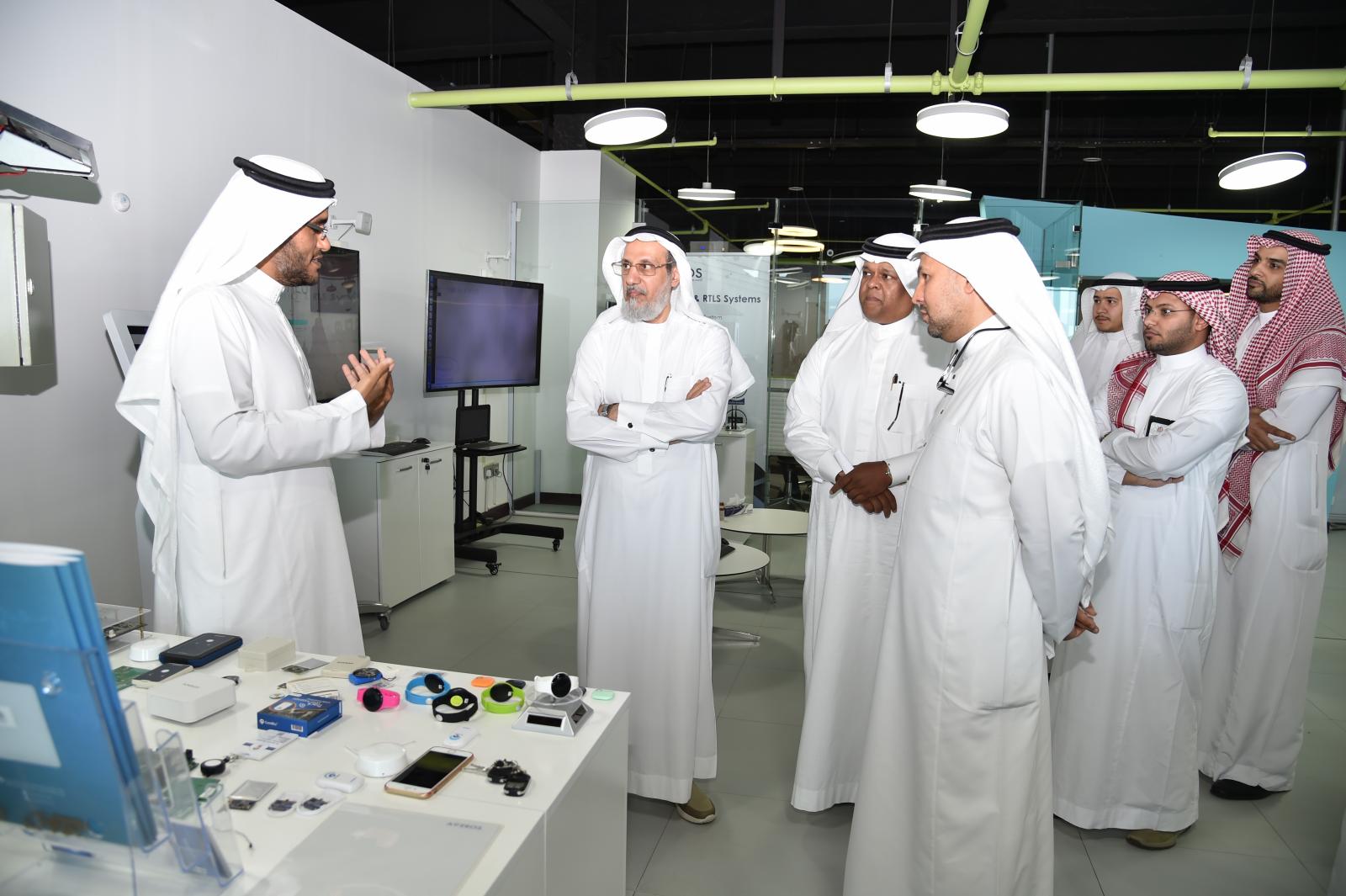
The university gets three commercial doors
Wadi Makkah Ventures combines investment with incubation and acceleration. Its listed services include shared premises, training and modeling laboratories. Those functions address different founder needs: somewhere to work, help building a prototype and capital to develop the company. Bringing them into one institutional setting can reduce the number of introductions an inexperienced team has to make.
The Knowledge subsidiary takes another route. Established in 2017, it offers consulting, testing, assessment, audiovisual production and educational materials. Iqra, Abjad and Maqam appear among its named products. This is a reminder that commercialization does not always require a new piece of electronics. Expertise can become a teaching package, an assessment or a service contract.
Abjad offers a particularly clear example. The Knowledge company describes cooperation involving Arabic training and assessment for health practitioners who do not speak Arabic. Its intended benefit is better communication with patients. That gives a language product a defined institutional use, rather than leaving it as a broad promise to improve education.
The property subsidiary, established in 2014, develops and manages university assets and seeks outside developers and investors. Its stated purpose includes diversifying income and improving the university environment. Buildings and common spaces sit alongside urban development and smart-building services in its remit. The commercial idea is straightforward: the campus has physical resources as well as intellectual ones.
Capital is only one of the numbers
Argaam reported that the parent company was established with SAR 100 million in capital. The venture subsidiary’s own description gives it a separate SAR 12 million capital figure. These are different corporate entities and different accounting facts. Neither number should be treated as the cost of building every business associated with Wadi Makkah.
Operating results require their own labels. In March 2017, the university reported 11 startups, more than 23 technical products, over SAR 15 million in startup revenues and 100 new jobs. In April 2018, it described 15 startups, 29 products and SAR 45 million in startup sales. Those are dated reports about the startup community, not annual revenue figures for the holding company.
Startup sales reported by the university.
Portfolio activity, not parent-company revenue.
By June 2020, the university was reporting 40 venture investments. That adds evidence of activity, but counting investments is different from measuring investment returns. A growing portfolio creates more opportunities and more obligations: founders to advise, products to test and businesses that may need another round of money before they can stand on their own.
The business model therefore needs several lenses. Startup equity offers exposure to future company value. Consulting and educational products create commercial offerings that clients can purchase. Property management and development seek income from physical assets. The appeal is having several ways to put university resources to work; the managerial challenge is judging each on terms appropriate to that business.
The prototype worked. The buyer still hesitated.
One of the most instructive early obstacles belongs to Lucidya, a company that joined Wadi Makkah’s accelerator. In a 2019 interview, founder Abdullah Aseeri described skepticism from local businesses about a Saudi startup’s ability to deliver sophisticated social-media analytics. Even a working demonstration did not automatically settle the buyer’s doubts.
Lucidya responded with free trials, accessible pricing, accommodating payment terms and easy cancellation. The change lowered the commitment required to try the product. Larger customers followed and helped persuade others. “Step by step, the snowball started to roll,” Aseeri said. This was Lucidya’s commercial adjustment, a useful example from the accelerator’s orbit rather than a documented change in Wadi Makkah’s own policy.
“Step by step, the snowball started to roll.”
Abdullah Aseeri, Lucidya founder · 2019
The lesson is worth borrowing carefully. When buyers worry about the supplier, improving the algorithm may leave the real objection untouched. A limited trial can help, provided the supplier can afford it and the customer can evaluate the product meaningfully. A prototype that needs expensive installation or a lengthy institutional decision will require a different path to that first commitment.
“Made in Makkah” needs more than a slogan
In 2017, the company’s five-year plan used the phrase “Made in Makkah” and set ambitions for investment, market value and sales beyond its home geography. The phrasing captures the tension inside university commercialization. Local expertise gives an idea its starting advantage. Selling elsewhere asks whether that expertise solves a problem other customers recognize.
Its physical setting adds another dimension. MODON’s 2021 annual report described the Wadi Makkah Technological Complex on the university campus as covering 431,087 square meters. The report set out a research-and-business environment intended to attract companies and talent. Such a footprint gives institutional ambition a physical scale, although land area alone tells a reader little about the productivity of the businesses using it.
For founders comparing support options, the relevant alternatives include KAUST’s TAQADAM accelerator, a six-month program combining mentorship, funding and networks. Wadi Makkah’s proposition is shaped by its own university, commercial subsidiaries and pilgrimage focus. Fit depends on the obstacle a team is trying to remove. A useful laboratory, a relevant customer introduction and an investment offer are three different kinds of help.
The next test is in the accounts
Recent activity brings the story back to ordinary company-building. In April 2026, Tally announced collaborations with Wadi Makkah, Wadi Jeddah and PLEXUS to support financial awareness and business readiness. The software company also reported establishing an office presence within Wadi Makkah. That puts accounting and operating discipline alongside the more visible business of launching startups.
A business-model workshop reported in September 2026 covered customer discovery, value propositions, cost structures and revenue streams. Those subjects sound modest beside the language of a knowledge economy. They are also the questions that determine whether a founder can keep serving customers after a demonstration, competition or incubation program ends.
International conversations continue too. In December 2025, Wadi Makkah hosted a delegation from the Riyadh Chinese-Saudi education center to explore innovation and entrepreneurship cooperation. The meeting concerned possible joint initiatives and knowledge-based investment. It illustrates an effort to extend relationships beyond the immediate university setting, with the commercial value depending on what subsequent projects deliver.
For an entrepreneur approaching the group, the sensible first move is to describe the next commercial hurdle precisely. A team with a functioning product and no buyers needs a different conversation from researchers still deciding how to package their work. The published subsidiary structure provides a starting point: venture support for company-building, knowledge services for educational or advisory work, and property channels for development opportunities.
The same discipline applies to university managers. Counting workshops can show that a program is busy; it cannot establish that customers value what its participants produce. The more useful questions concern what moved forward after the workshop: a tested proposition, a clearer cost structure or a buyer willing to try the product. Those are practical ways to assess the promise behind an institutional investment arm.
What can another institution copy? Begin with resources it actually controls and problems its community understands. Give a promising product a route to a buyer, decide which support removes the next obstacle and keep the financial measures straight. Wadi Makkah’s structure makes those choices visible. The enduring test is whether a customer comes back when the introductory support has ended.