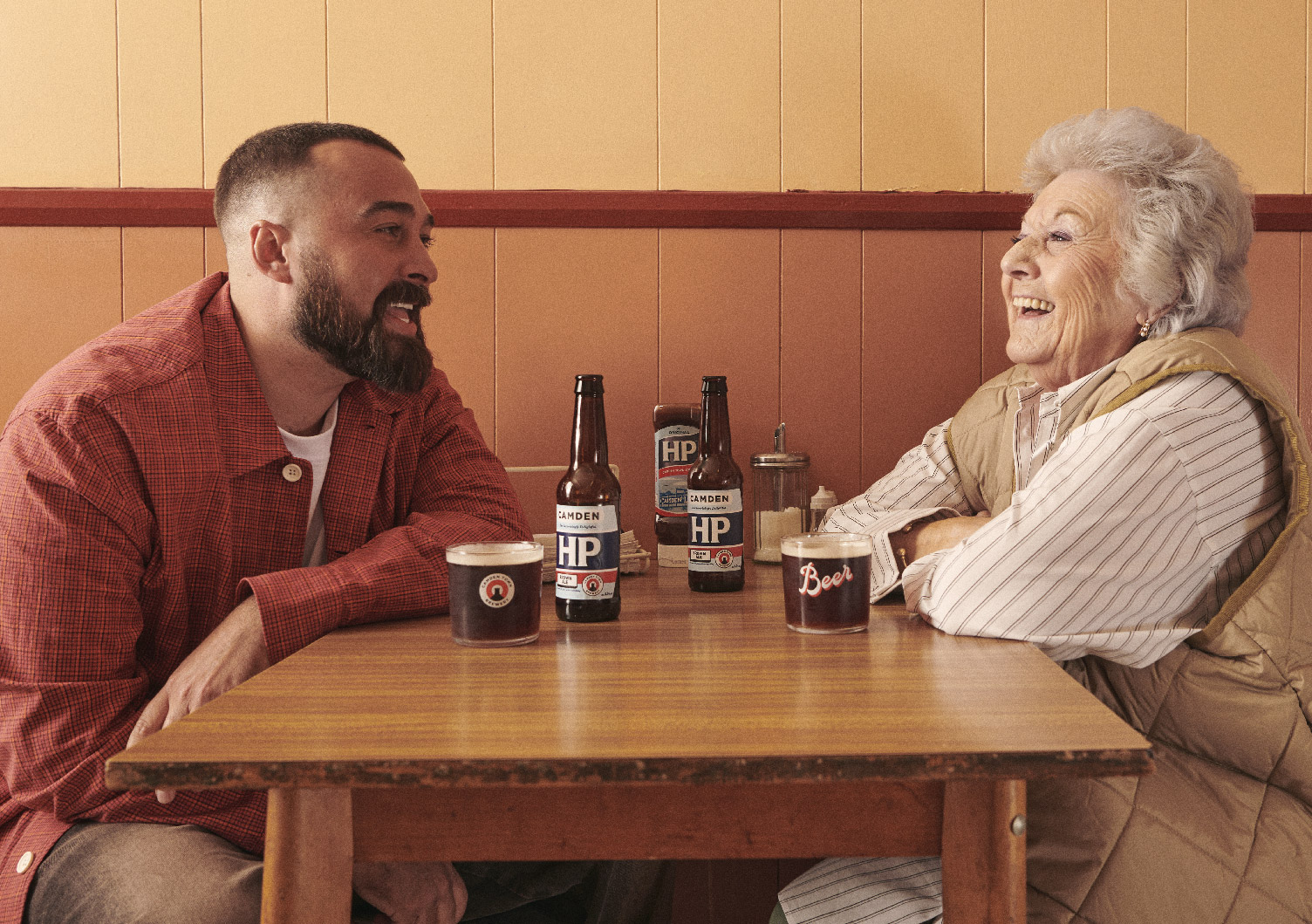
The oddest thing on the table is not the beer. It is the HP Sauce. The brown bottle sits between a young man and an older woman in a café booth, while both hold pints of something labelled Camden HP. Somebody, somewhere, had proposed brewing Britain’s favourite condiment into a beer. Instead of asking whether this was sensible, W Communications appears to have asked the more useful question: would anyone tell a friend?
That distinction is the agency’s business. W is a London-founded communications company that makes brands discussable. Sometimes the mechanism is conventional media relations. Sometimes it is an influencer, a pop-up, a film, a search result, or a bottle that makes two unrelated grocery aisles collide. The deliverable changes. The job remains the same: turn an organization’s commercial problem into a story that can travel through culture.
Coverage is not the same as movement
A press clipping is evidence that a story appeared. It is not evidence that anybody bought, visited, searched, downloaded, or changed an opinion. W’s answer has been to stretch past the old border of PR. Its teams handle earned media, social, influencer work, talent casting, events, graphic design, content production, reputation, crisis counsel, SEO, and the newer discipline of generative-engine optimization. The integrated team is the product.
The customer is usually a consumer-facing brand with something at stake across more than one channel. British Airways, Sony, Unilever, Disney, Tinder, citizenM, McCain Foods, Aston Martin, and POP MART have all appeared in W’s public client lists. Media companies such as The Independent and Secret Media Network sit there too. A startup may need a name and a launch. A mature brand may need cultural relevance, a press office, and a reputational guardrail. W sells projects and retainers around those needs; it does not publish its rates.
“Unite brands with culture to deliver commercial success.”W Communications’ own description of the job
The Balloon Museum is the tidiest proof of the theory. W says the exhibition became the most searched city event on Google. More importantly, the campaign reportedly brought in over 150,000 visitors and £5 million in revenue. Attention had somewhere to go: through a ticket barrier.
The first thing to fail was the old margin
W’s story is unusually useful because the crisis was not theatrical. The company did not collapse, discover a miracle, and rise from the ashes. It faced the flatter, more familiar pressure of a difficult UK economy and agency services that cost plenty to deliver but did not leave enough behind. Traditional PR could still generate coverage; it simply was not the whole commercial answer.
So W replaced lower-margin services with higher-margin work and widened the brief. It built more creative, production, advertising, search, and experiential capability inside the agency. In 2024 it produced a UK television campaign for Tinder in-house. This was not a rejection of earned media. It was a refusal to let earned media become a cage.
The change paid off in public numbers. W reported 14 consecutive years of growth through 2023. Global revenue reached £27 million in 2024, up 7 percent, with a client retention average of 3.5 years. That last figure may be the most revealing. An eccentric stunt can win a pitch; staying useful keeps an account.
Sell the company - to the people inside it
Then founder Warren Johnson made the less obvious move. In 2024, during W’s fifteenth year and while the company was growing, ownership shifted into an Employee-Owned Trust. The staff gained an increasing stake and a greater say in significant decisions. The transaction price has not been disclosed. Nor has W published the cost of the wider strategic pivot. Those omissions matter: employee ownership is not free, and neither is building specialist capability across several continents.
But the sequence is worth noticing. W did not wait for a succession panic. It changed ownership while the machine was working. Salaries rose by an average of 10 percent, the agency introduced private healthcare, EOT bonuses, and tax benefits, and it created a “W Stayover” scheme that lets staff extend a holiday while working from another office. Its “25 by 25” pledge aimed to create 25 PR roles outside London by 2025. Ownership was paired with tangible reasons to believe the word meant something.
The international network followed the same practical logic. London remains the spiritual and strategic hub, with more than 150 people. New York, Singapore, the Middle East, and Reykjavík put teams nearer the cultures they are supposed to interpret. W/Nordic opened with Icelandic partners Instrument and Brandenburg, an admission that local judgment cannot be shipped overnight from Wigmore Street.
The important caveat: an employee-owned trust does not mean every employee independently controls an equal block of shares. It is a structure that holds ownership for employees collectively. The result depends on governance, information, profit, and whether staff influence extends beyond a bonus announcement.
Build an object people can carry
The most portable lesson from W is not “make a strange beer.” It is to give an audience something active to do with the story. Visit the inflated art. Ride the Friendship Bus. Debate the condiment. Search for the event. Photograph the object. The campaign moves because participation is built into the idea, not bolted on after the press release.
- Start with a behavior - the thing a person can visit, taste, share, search, or argue about.
- Make one recognizable idea do several jobs across press, creators, social, events, production, and search.
- Attach a commercial measure before launch: tickets, footfall, qualified search, sales, sign-ups, or retained trust.
- Use local partners when cultural nuance matters more than central consistency.
- Retire services that absorb senior attention without producing either margin or measurable customer value.
This playbook has limits. It is a poor fit for a company that wants cheap commodity press outreach, cannot approve quickly, or has no product truth sturdy enough to support a cultural idea. Integration also creates expense and coordination. A brand that needs one narrow task may be better served by a specialist. And a regulated multinational that requires deep public-affairs coverage in every jurisdiction may prefer the infrastructure of Edelman, Weber Shandwick, Burson, or another large network.
W sits in the middle: more geographic reach and production muscle than a local consumer boutique, less institutional bulk than a holding-company system. Competitors such as The Romans, Hope&Glory, Taylor Herring, Tin Man, and PrettyGreen chase some of the same culture-led briefs. W’s argument is that independence, employee ownership, and an integrated bench can preserve speed without sacrificing scale.
A letter that became a system
There are two versions of W Communications. One is the visible agency: 20 claimed Cannes Lions, industry awards, famous logos, conspicuous ideas. The other is the operating system underneath: a founder willing to dilute his own control, services removed because their economics stopped working, offices opened because clients wanted local intelligence, and outcomes chosen because a clipping book was no longer enough.
That second company explains the first. The HP beer gets photographed because somebody understood that culture likes an object. The Balloon Museum sells tickets because attention was connected to an action. Employees receive a stake because creative businesses walk out of the door every evening. W’s cleverness is not simply in making noise. It is in deciding where the noise should lead.