The prospective customers would not answer the telephone. Smartsupp’s founders had done what the sales advice suggested: let someone try the software, then call when the trial ended. It sounded reasonable. They were selling a way to have conversations, after all. Yet the people testing their little chat window appeared quite content to leave this particular conversation unstarted.
Vladimir Sandera, known in Czech as Vladimír Šandera, remembers the episode with amusement. The useful discovery was that customers wanted to register, try the product and buy it themselves. The telephone’s silence contained an instruction. Make the software easy enough to purchase without a guided tour. For a business built around communication, knowing when to stop talking was a useful qualification.
That small adjustment offers a way into his career. Šandera has spent years working on the awkward distance between somebody needing help and somebody providing it. Remote computer support came first. Then came Smartsupp, the customer chat business he co-founded in Brno. Eventually came a larger software group, ABUGO. Along the way, a familiar question kept returning: what does the person on the other side actually need?
Before the chat window, a computer to fix
At AVG, where he worked in technical support in 2009 and 2010, the other side was often somebody with a troublesome computer. His work included remote assistance, examining logs and handling customer messages. These are practical tasks with a fairly stern test of success. The machine either works properly afterwards or it does not. A polished explanation has limited consolation value.
He went on to build Vronli and its remote support service, Servis Na Klik. His education crossed a similar boundary between technology and business: IT management at Brno University of Technology, with an Erasmus exchange in international marketing and management at IDRAC in Lyon. He also worked a student summer job at a hotel in Beaver Creek, Colorado. Before the executive titles, there was an ordinary assortment of work to do.
The meeting that led to Smartsupp happened through the South Moravian Innovation Centre. Petr Janošík and Dušan Kmeť had worked in custom development. The attraction of a shared product was continuity: improve something, keep improving it, and have the next customer benefit from the accumulated work. A project delivered to one client could become a product offered to many.
A shop with nobody behind the counter
Šandera’s explanation for live chat was pleasingly physical. Imagine walking into a shop and finding nobody there to help. Online stores could reproduce that experience with considerable technical sophistication. The shelves were searchable, the checkout existed, and a customer with a question could still find themselves effectively alone. Sending an email meant accepting a delay at precisely the moment they were considering a purchase.
Smartsupp put a conversation beside the merchandise. A retailer could adapt the chat window to its own colours and decide how to greet a visitor. The people answering remained the retailer’s responsibility. That distinction matters: installing a window does not magically put a helpful shop assistant behind it. Software supplies the opening; somebody still has to make the exchange useful.
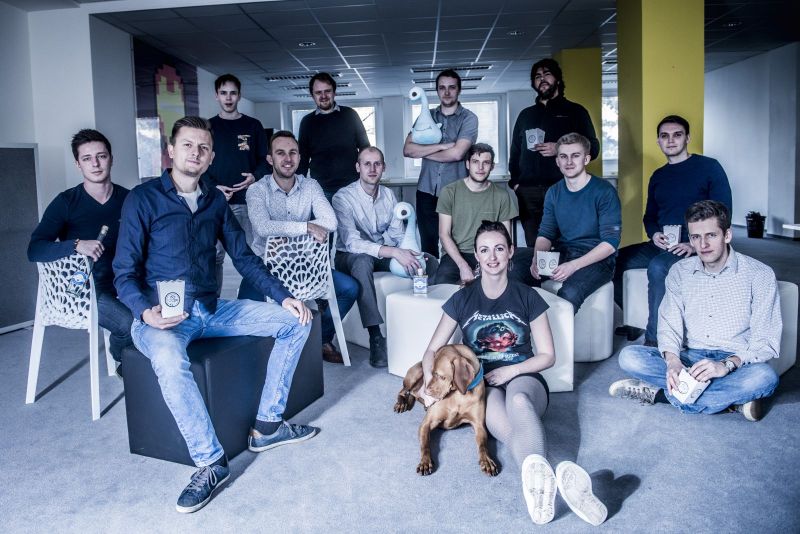
The early economics took patience. There was roughly a year and a half before the project began making money. Then the concerns changed from whether the founders could afford bread rolls to recruiting and managing people. Growth has a habit of answering the first question on a founder’s list by handing over three more. By 2017, the team numbered fifteen.
“Pak jsme zjistili, že nám to nikdo nebere.”
“Then we realised nobody was picking up.”Vladimír Šandera, recalling the early sales calls
English translation
The tiny advertisement that travelled
Smartsupp had another way to introduce itself: its own name at the bottom of the chat window. A shop installed the software; the shop’s visitors saw the branding. Some of those visitors could become users themselves. Free accounts therefore did more than occupy server space. They helped carry the product into places where a salesperson had never made an introduction.
In 2016, Šandera described this as a snowball effect. Most people used the free version, while a smaller group with greater requirements paid for premium features. The arrangement required a slow beginning and enough users to make the paid portion meaningful. A free customer could still contribute distribution. The distinction between the audience and the marketing channel became rather conveniently untidy.
The figures from Smartsupp’s account of 2015 show the movement. Annual revenue rose from CZK 800,000 in 2014 to CZK 4.8 million. At the start of 2016 it reported 6,300 active users, including 1,470 paying users. These are historical snapshots, with their original definitions. They describe a young business finding enough repeat use to support itself.
The same year-end account is unusually domestic. Amid developments in billing, visitor recordings and staffing, Šandera joked about bringing everyone coffee and occasionally cleaning the fridge. Software companies require infrastructure of several kinds. The fridge tends to get less attention in the pitch deck. The business was growing, but the voice still belonged to somebody who knew the office chores.
Brno was the starting point
Going abroad involved more than making the interface available elsewhere. Janošík credits Šandera with helping organise translations, connect with foreign customers and take the business beyond its original market. That work is less visually satisfying than a launch button. It also gives the button somewhere to lead. A product can be technically available around the world and remain rather difficult to buy outside its first language.
By the February 2026 account of the business, Smartsupp operated in eleven languages and received three quarters of its revenue from abroad. The founders had tested conversions as they expanded. The early decision to let customers try and purchase for themselves acquired another purpose at this scale: the product’s introduction had to work without a founder standing nearby to explain it.
Outside investment became part of the story in 2016, when Smartsupp raised CZK 10 million. By 2018, the business was reporting CZK 35 million in revenue, a 70 percent increase on the previous year. These milestones describe different stages and measures of the company. Together they show how far the chat business had travelled from its original problem of getting the first purchases to accumulate.
The feature that became a company
One of the more consequential developments began as an addition to the chat product. Visitor recording let a website operator see what somebody was doing on a page. If a customer reported a problem, support could inspect the behaviour rather than conduct a lengthy guessing exercise. It addressed another version of the same difficulty: useful help depends on understanding what is happening at the other end.
Then the founders noticed that some customers used the recordings without making much use of the chat. That observation opened a separate path. The recording capability became Smartlook, a standalone user behaviour analytics product. Šandera’s career includes a co-founder role there. The important commercial discovery was already present in the usage: customers were revealing which part of the software deserved its own front door.
Cisco completed its acquisition of Smartlook on June 29, 2023. Its explanation centred on digital experience monitoring, with session replay and behavioural insight helping teams understand web and mobile experiences. For Šandera’s story, the connection runs back to a modest product decision in Brno. A tool made to explain a customer’s difficulties had found a much broader audience.
Visitor recording inside the chat product found an audience of its own.
What happens after the visitor arrives?
As Smartsupp developed, Šandera kept returning to what happened inside the shop. In a 2023 discussion of the product, he described live chat as a sales tool as well as customer support. Chatbots could answer recurring questions, guide visitors towards products and offer help while someone was deciding what to buy. Messenger integration brought another conversation channel into the same working interface.
He also explained that Smartsupp did not spend its energy following competitors in detail. The priority was useful software and customer feedback. That is an easy position to announce; the product requirements make it more specific. A retailer needs conversations to reach the right person, repeated questions to consume less time, and enough information to see whether assistance produces a useful result.
In January 2024, his argument sharpened around the cost of attracting visitors. If advertising becomes more expensive, buying more traffic is an uncomfortable default answer. He asked why only two percent of people might buy and what the other 98 percent had been doing. It was a question for merchants, rather than a universal conversion benchmark. The distinction leaves room to examine a particular shop instead of worshipping an average.
Later that year, a webinar on Smartsupp’s Mira AI shopping assistant put him in a practical discussion of prompting, operating costs and pilot experience. The agenda included what merchants valued and where they saw weaknesses. AI had entered the shop, carrying its own bill and its own limitations. It still had to help a customer choose something.
“Co na e-shopu dělalo zbývajících 98 % návštěvníků?”
“What were the other 98% of visitors doing in the online shop?”Vladimír Šandera, January 2024
English translation · an illustrative question, not a benchmark
Four businesses, then a different seat
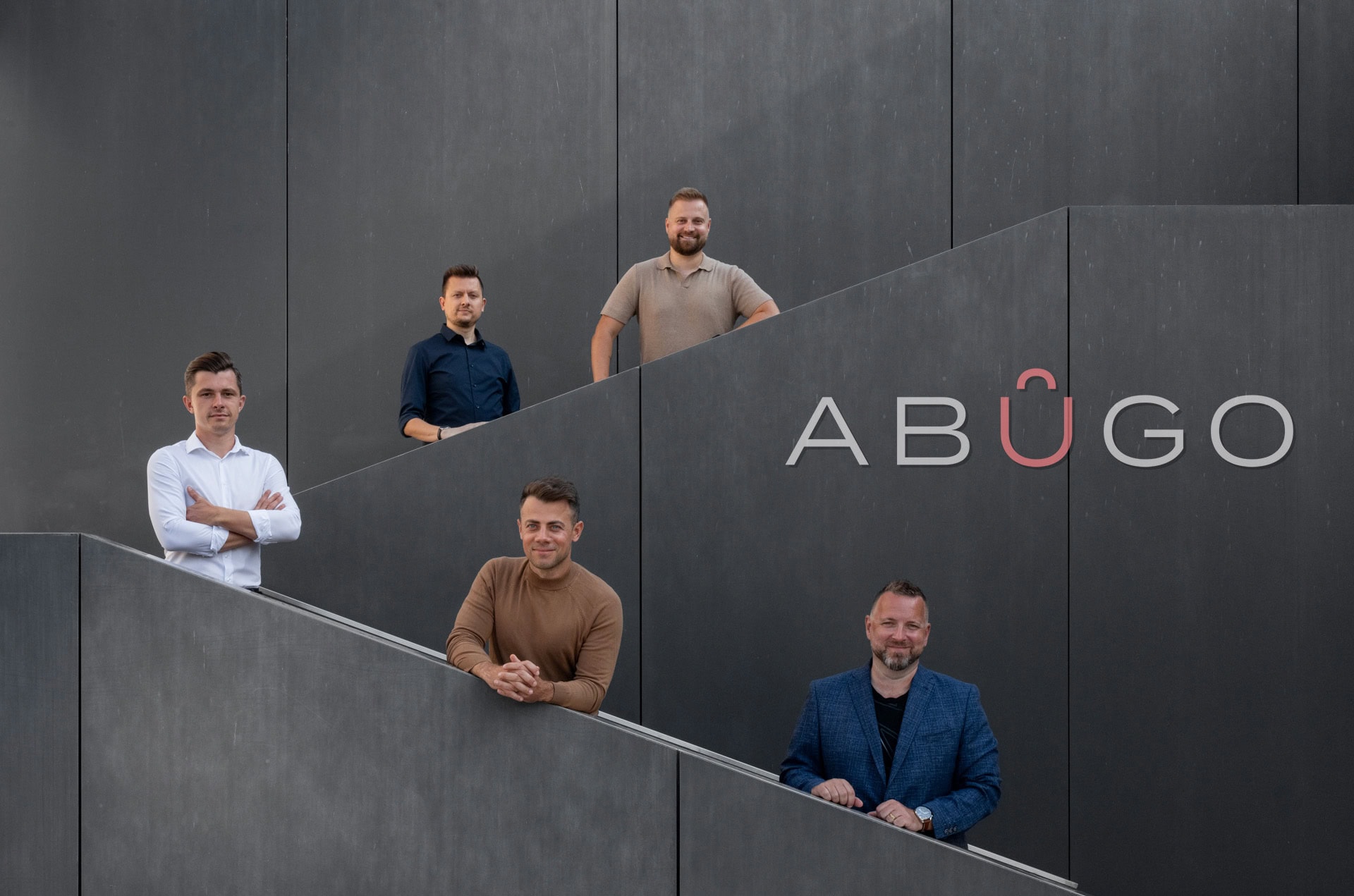
In October 2024, Shopsys, Reservio, Smartsupp and Survio announced ABUGO. The group brought together an e-commerce platform, booking software, customer communication and surveys. The original owners became co-owners of the holding, with Petr Svoboda leading it. Individual businesses would retain decentralised management. Investors Ondřej Fryc and Vít Vrba were part of the group’s backing.
The arrangement widened the canvas from improving one product to connecting several businesses. In February 2026, Šandera was discussing acquisition work at ABUGO. But his more recent announcement described another change. After thirteen years at Smartsupp, he had stepped away from its day-to-day work. He remained an ABUGO shareholder.
He gave an unusually direct reason: managing a forty-person team had become too concerned with processes for his taste. In his retrospective, annual recurring revenue had risen from CZK 16 million to CZK 72 million during his leadership, and fourteen colleagues had stayed more than five years. He could value the company they had built while admitting that the next management job belonged to somebody else.
His announced sabbatical came with interests rather than a new company: robotics, drones, software paired with hardware, and solar, wind and batteries. For now, those are subjects he wants to explore. There is something consistent about the pause. Early on, unanswered calls helped him change his approach. This time, he is giving himself a little room before deciding which conversation to begin.
Keep the conversation going
Interviews are in Czech.
- Vladimir Sandera on LinkedIn ↗
- Vladimir Sandera on X ↗
- Watch: the Robotí podcast conversation, February 2026 ↗
- Watch: Mira AI pilot experience and operating costs ↗
- The early Smartsupp years, 2017 ↗
- A conversation about selling through chat, 2023 ↗
- The question of the other 98%, 2024 ↗
- Šandera’s departure announcement and next interests ↗
- The formation of ABUGO ↗
- Cisco’s Smartlook acquisition announcement ↗
- Smartsupp website ↗