At Carhartt, an Easter egg could contain an instruction to do five squats. Employees hunted for eggs outside a facility, completed the exercises inside and earned wellness points. The workwear company’s local “Champs” had devised the challenge. Somewhere between the plastic egg and the squat sits the premise of Vitality Group: a good health recommendation needs a reason to happen today.
- Employers and health plans buy the program; members earn rewards for verified health actions.
- Points become Status, connecting everyday participation with benefits and incentives.
- Recent acquisitions add human coaching, onsite care and outreach beyond the app.
Vitality operates in the gap between knowing and doing. A screening might matter enormously next year. A reward matters this week. The Chicago-based Discovery subsidiary brings those timelines closer together, using behavioral science, actuarial analysis and increasingly personalized technology. Its customers want healthier populations and more manageable costs. Members want something useful, achievable and worth their attention.
01 / The reward comes first
The original Vitality program began inside Discovery in South Africa in 1997. The U.S. Vitality Group launched in 2007, offering employers and healthcare carriers a standalone version. That distinction matters: the American business sells engagement capabilities and services, while the broader Vitality model also operates through insurers around the world.
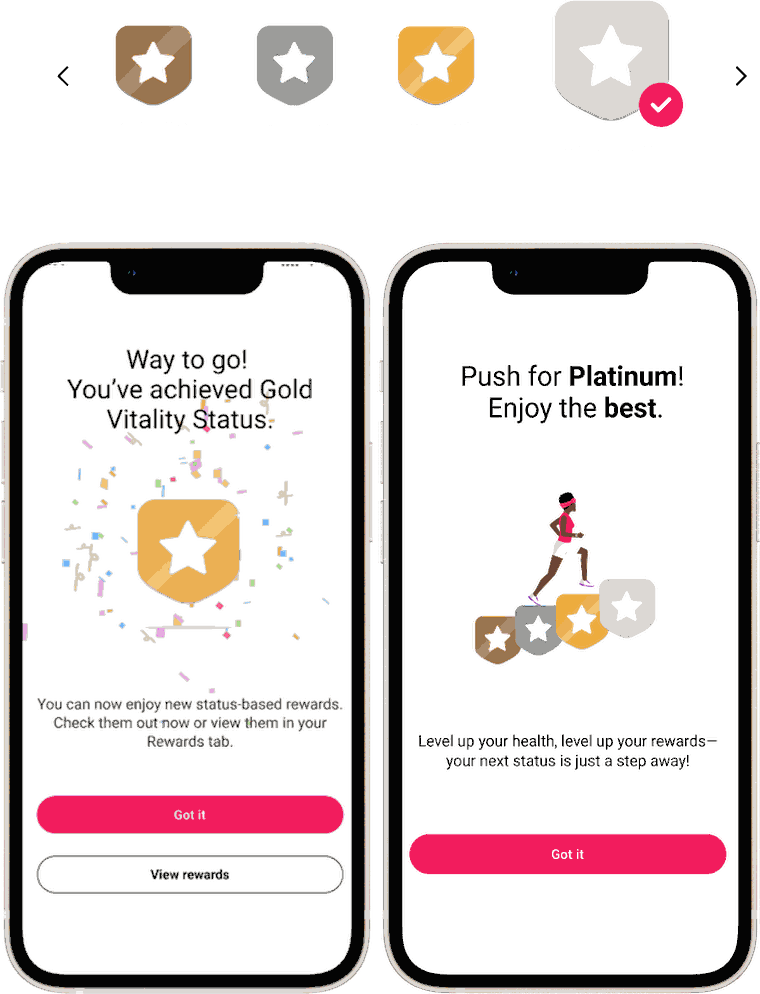
A member completes a health review, connects an activity tracker or follows a recommended health pathway. Verified actions earn points. Points accumulate toward Bronze, Silver, Gold and Platinum Status. Depending on the sponsoring program, progress unlocks rewards or affects benefits. Employers get reporting and a way to connect services that otherwise arrive as unrelated apps, invitations and reminders.
easy to see.
Four familiar tiers turn an abstract health journey into a next step.
John Hancock’s Apple Watch offer makes the arithmetic tangible. Eligible Vitality PLUS members start with $25 plus tax; activity points can reduce subsequent monthly payments over 24 months to zero. Coverage, eligibility and upgrade conditions apply. The device has an immediate use, and the next month’s payment supplies a deadline that a distant promise of better health cannot.
02 / A better average has a catch
In 2018, a Discovery-commissioned RAND Europe study examined 422,643 members across the United Kingdom, United States and South Africa. Taking up the Apple Watch benefit was associated with 34% more tracked activity days per month than Active Rewards alone. The association persisted over the 24-month repayment period.
But the study was observational, not randomized, and its members did not represent entire national populations. More tracked activity does not establish a particular medical saving. The revealing finding concerned initially inactive members with obesity: those taking up the benefit showed larger relative improvements, yet this group was less likely to enroll. An incentive can work for participants and still struggle to reach the people with most to gain.
03 / What the egg hunters changed
Carhartt’s experience makes that design problem concrete. A client since 2013, it serves corporate employees, retail associates and supply-chain workers. Its Champs can invent local activities, welcome new hires and share ideas in monthly meetings. Participation has a human distribution system.
The company’s case study describes an early ceiling: employees were reaching the upper limit of engagement and losing reasons to continue. Feedback from Champs prompted tougher employer incentive requirements and the addition of Active Rewards in 2022. Another adjustment recognized that a smartphone-only approach could exclude nontechnical workers. Printed wellness handouts became another route to participation.
Even the expected audience proved misleading. Older associates engaged at higher rates than younger ones. The lesson for another employer is practical: let local people design activities, collect feedback regularly and offer more than one way in. A clever reward cannot compensate for an inaccessible route to earning it.
04 / Software acquires a human side
Vitality competes with platforms including Personify Health and WebMD Health Services. Its pitch centers on connecting engagement to quantified risk, benefits design and healthcare economics, supported by actuarial expertise. It also increasingly connects the screen to a person who can help.
The WellSpark acquisition in November 2024 added coaching. Ramp Health, announced in March 2026, added onsite clinical care, safety and risk mitigation. September’s Icario acquisition expanded outreach and member activation. Vitality said the combined organization would serve 19 million U.S. members, including relationships with eight of the ten largest health plans. TechCentral reported $27 million upfront for Icario, with contingent payments potentially bringing consideration to $59.5 million.

“Health plans have invested billions in identifying risk, but this is only valuable if members take action.”
Maia Surmava / CEO, Vitality U.S.
Vitality’s own published culture emphasizes intellectual debate, inclusion and commercial prudence. In 2024, the U.S. business appeared among Crain’s Best Places to Work in Chicago, an award informed substantially by employee surveys. It is a fitting concern for a company selling workforce wellbeing: its employees are also a test audience for the proposition that healthier workplaces deserve sustained attention.
Vitality charges for administration and services through organizational contracts. That gives it a different commercial task from selling a fitness subscription: integrate with the buyer’s benefits, sustain participation and demonstrate value across a population.
05 / The reward reaches the benefits bill
Introduced in August 2026, Vitality Funding Flex links medical plan contributions to measurable health-management effort. Employees who engage can contribute less; those who do not engage contribute more. Vitality frames this around controllable effort rather than simply rewarding good health. Fair implementation therefore depends on achievable, individualized pathways.
Qualifying Funding Flex programs carry a three-year net savings guarantee. Eligibility and contract terms apply.
September brought a U.S. expansion of Vitality AI with Google Cloud and a HealthEquity partnership intended to connect health engagement with healthcare financial decisions. The direction is consistent: make the recommendation more relevant, then make following it matter.
For a buyer, the useful questions concern access, completed actions and actual spending. For anyone designing a program, Carhartt offers the copyable part: keep the goal visible, shorten the distance to a reward and listen when participation stalls. Sometimes the next intervention is a clinician. Sometimes it is five squats inside an Easter egg.