The energy-drink maker had learned to live with its payroll system. Recurring problems had become workarounds. When it chose iiPay, the attraction was better reporting, flexibility and service. Then came the awkward discovery: historical figures needed checking, month by month, and old pay elements needed correcting. A three-month implementation became six. Four parallel runs followed. The company’s case study reports an 89% reduction in payroll errors in less than two fiscal years.
The extra months are the revealing detail. They suggest that buying automation starts with understanding what people have been doing by hand.
- The offer: payroll software plus people who run payroll locally.
- The combination: iiPay’s platform inside Vistra’s wider business-services network.
- The lesson: give data cleanup a place in the implementation budget.
The report was a dead end
Consider another iiPay customer, described as a global travel guidance platform. Acquisitions expanded its needs from 14 payrolls in 12 countries to 38 in 25. Its providers delivered incompatible reports, including monthly PDFs that could not be edited. The internal team spent days typing information into spreadsheets. Payroll had been processed; making it useful was another job.
The customer’s explanation of iiPay’s value was refreshingly specific: putting the data and employee records where we can access what we need and when we need it
. Standardisation gave the team something more useful than another finished document: records it could interrogate.
The payslip is the output. The business is everything needed to make that output dependable.
THE OPERATING IDEA
The machinery behind payday
Vistra Global Payroll, powered by iiPay, connects the stages that employers otherwise coordinate themselves. HR supplies employee information. Payroll teams check it, apply local requirements, review exceptions and approve results. Finance needs accounting entries. Employees need their money and documents. A common workflow makes the handoffs visible.
The Global Control Centre tracks milestones and processing status across countries. The integration service accepts APIs, SFTP transfers and flat files, connecting existing HR and finance systems. Workday and HiBob are named partners. The practical attraction is preserving an employer’s HR system while reducing the re-entry of its data elsewhere.
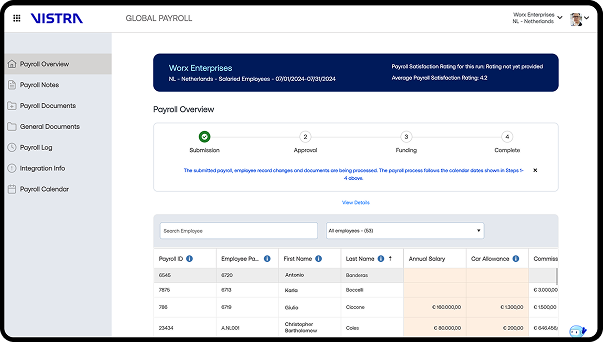
Analytics consolidates workforce costs. Payments handles disbursements in more than 100 currencies, including tax, pension and third-party remittances. Funding can be centralised or local. Those details matter because a completed calculation and a completed payment are separate events.
- 01Employee
data - 02Validate &
process locally - 03Review &
approve - 04Pay &
reconcile
A fashion-chain case shows the intended customer clearly: a retailer with country processes that had developed separately over eight years. iiPay reports centralising payroll in 11 countries in eight months. For its finance team, the requirement included coding payments back from journals and gross-to-net reports. The problem crossed departments before it crossed borders.
An industrial customer offers another scale: 66 payrolls for nearly 10,000 employees. Its case reports seven working days from receiving data to sending a bank file. That gives a buyer a concrete process to inspect. What arrives on day one? Which checks happen before release? What remains with the employer? Those questions make comparisons between suppliers more useful than a list of country flags.
Why Vistra wanted the engine
Vistra announced its agreement to acquire iiPay on 7 May 2025 and confirmed completion on 10 June. The geographic logic was straightforward. iiPay brought outbound payroll expertise across the Americas and Europe. Vistra brought established in-country payroll and advisory capabilities across Asia Pacific and EMEA. The platform supplied another connection between them.
The combination also widened the conversation with customers. An employer entering another country may need entity management, tax, statutory accounting and HR advice alongside payroll. Vistra can offer those services within its broader group. That is a meaningful distinction for a buyer trying to coordinate international operations.

Today the payroll website reports more than 11 million annual payslips across 170-plus countries, with 96% processed in-house. Those are company-reported measures of the combined service. They describe reach and delivery structure; they do not establish how any particular country rollout will perform.
The bill includes the cleanup
The commercial model is business-to-business payroll technology and services. NelsonHall also documents a technology-only middleware option for organisations retaining local payroll management. Managed delivery adds people and operational responsibility to the software. Buyers are choosing how much work to hand over.
Vistra competes in a market that includes ADP, CloudPay, Deel, Neeyamo, Strada and TMF Group, all covered in NelsonHall’s payroll assessment. The alternative can also be an employer’s existing collection of local providers. For a buyer, the relevant comparison is the proposed delivery model: technology alone, managed processing, payments, or a broader bundle of international services. A country count makes a useful opening filter. It leaves the more consequential questions about responsibilities, interfaces and implementation effort to the next conversation.
A useful buying discussion therefore follows the work: which countries, which integrations, who funds payments, and who handles exceptions? Implementation consumes internal attention as well as supplier effort. The energy-drink example makes the time cost tangible. A cheaper-looking proposal can become expensive if the employer has underestimated the condition of its own records.
Historical data repair extended the schedule. Customer case study; one implementation.
Run the old and new together
The supercar customer’s case offers a useful implementation detail. The people who would operate payroll attended meetings with the implementation team before the handover. The project moved through due diligence, implementation and shadow payrolls, then go-live. Knowledge travelled with the work.
Readers can copy that sequence without buying this product. Inventory the inputs. Agree what each pay element means. Name the approval owners. Run the systems in parallel and investigate differences. Bring the future operators into the room while decisions are still being made. A dashboard is easier to demonstrate than a handover. The employer still needs someone empowered to settle disagreements about the inputs; outsourcing processing does not make those decisions disappear.
The supplier has its own coordination assignment. NelsonHall’s October 2025 assessment named Vistra a multi-country payroll Leader, while identifying the complexity of integrating iiPay GPMS and OverseasConnect. Buyers should ask how their proposed service fits the product roadmap. For an employer with straightforward domestic needs, a simpler local service may also deserve consideration.
The payslip at the other end
The employee encounters something smaller. The Vistra + iiPay mobile app provides payslips, year-end documents and payment history to employees of participating clients. Its App Store history records a November 2025 launch and an update adding 11 languages in May 2026.
That modest screen is a useful place to judge the whole undertaking. Can the employee find the document? Can the payroll team explain the number? Can finance trace the payment? The value of the global platform becomes concrete when those ordinary questions have ordinary answers.