A job offer looks wonderfully simple until it has to cross a border. There is a person, a position and a salary. Then come the questions. Who signs the contract? Who runs payroll? Who knows what the local rules require? The offer has acquired a supporting cast. Tan Lin has built a business around the work that cast must do, and the difficulty of getting everyone to perform the same play.
Lin is the founder and CEO of PIO, formerly PayInOne. Its business joins international employment and payments in a software platform. But the interesting part of his career begins before the payslip. He worked on Amazon’s transaction and storage systems, founded a data software business called Hooli, and later turned to global employment. Read together, those jobs suggest a recurring interest: making complicated operations easier to follow.
There is a temptation to give a founder’s career the tidiness of a railway map. Every stop leads inevitably to the next; even a delay looks strategic in retrospect. Lin’s path deserves a less obliging reading. The markets changed. The products changed. Yet the awkward space between a decision and its execution keeps appearing. It is a useful place to look for him.
The engineer and the customer
Lin joined Amazon in 2012. He later described the demands of being on call and the influence of its customer-first culture. By 2016, he was running Hooli in China, working on log data and analysis. These are unglamorous materials with unusually revealing properties: records of what a system actually did can be more useful than a confident explanation of what it should have done.
That earlier venture also exposed a limit of engineering certainty. Lin spoke about learning to negotiate and compromise with customers and markets. A machine can reject an invalid input. A customer usually expects a conversation. Founders who arrive from software have to learn that distinction while somebody else is waiting for an answer.
Consider the difference between fixing a technical fault and selling a product that prevents one. The first has a relatively clear test. The second requires a buyer to understand the risk, trust the supplier and decide that solving it belongs in this year’s budget. The distance between those two tasks is where a considerable amount of entrepreneurship happens.
For Lin, this makes the move toward employment services intelligible without pretending it was inevitable. Payroll and hiring have systems, records and repeated processes. They also have people whose circumstances resist neat categories. A successful calculation is useful. A process that the customer can understand and rely on has a different, broader job to do.
A border is also an inbox
PayInOne began in late 2020 with global payroll and employer-of-record services. An employer of record provides the local employment arrangement for a client’s staff. In practical terms, Lin entered the stretch of international expansion where a company’s enthusiasm meets the administrative machinery needed to employ somebody.
His diagnosis was specific. Employers hiring across countries had to coordinate local service providers, with employee information and pay arrangements moving through emails, telephone calls and separate conversations. Scale made that choreography harder. A new market could mean a new set of relationships before it produced a settled routine.
The problem is easy to underestimate from a headquarters conference room. A country appears on a slide as a label or a colored region. For the person arranging the hire, it becomes a sequence of actions. Each action needs an owner. Each owner needs the right information. The slide remains admirably uncluttered throughout.
- 01HireAgree the role
- 02OnboardArrange the contract
- 03PayRun the payroll
- 04ManageKeep records aligned
PIO’s proposition is to organize those activities through a common service and platform. The appeal is partly arithmetic: fewer separate arrangements to coordinate. It is also psychological. A business entering an unfamiliar market wants to know which question comes next, who will answer it and whether the answer has reached the person doing the work.
This is an unusually practical subject for a technology founder. Nobody frames a correctly processed monthly salary and hangs it in reception. Its value is that people can get on with their lives. The same is true of much operational software: success can look suspiciously like nothing happening.
The advice begins before the software
Lin’s February 2025 writing on global teams starts with strategy, then budgeting and the intended pace of expansion. Only after those decisions does he turn to employment arrangements and technology. The order matters. A tool can make a chosen process faster; choosing the wrong process quickly remains an expensive accomplishment.
His framework links the kind of team a company needs with the kind of expansion it intends. A short project and a lasting presence demand different commitments. Budgeting belongs before the hire. So does deciding how quickly to grow. These sound like ordinary management questions because they are. Their ordinariness is part of the point.
For a founder selling software and services, beginning with those questions gives the argument some welcome friction. It asks the customer to decide what they are doing before choosing how to administer it. A hiring platform cannot supply a missing business purpose, however elegant its dashboard.
That sequence also helps explain why Lin’s subject extends beyond payments. The payroll record sits downstream from earlier choices: the market, the role, the candidate and the employment arrangement. If those choices are disconnected, the eventual administrative work inherits the gaps. Following the problem upstream leads naturally toward recruiting.
When the payslip became too small
In July 2025, PayInOne introduced the PIO identity, expanding its stated direction toward an intelligent people platform. The new name stood for people, intelligence, all in one. It gave Lin’s business room to talk about the employee lifecycle beyond its original payroll and employment focus.
A wider name is easy to announce. A wider product has to earn the extra territory. Recruiting asks an employer to trust a platform earlier, while they are deciding whom to hire. Payroll asks for dependable execution after a decision. Combining them promises continuity, but also places more of the relationship inside one provider.
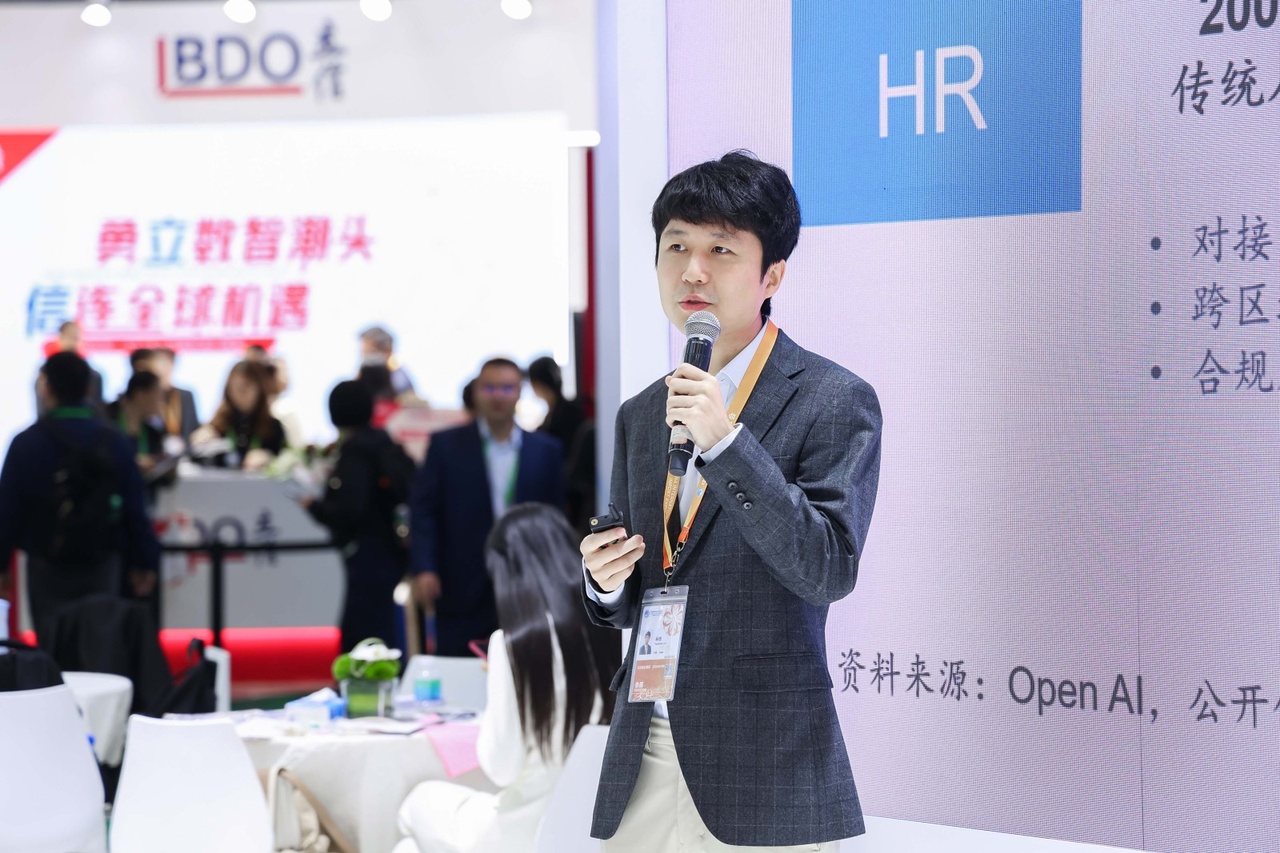
That November, PIO unveiled Foundire at the China International Import Expo in Shanghai. The recruiting platform connected stages including screening, interviews, reviews, offers and background checks. Lin positioned it alongside PIO’s existing employment, visa and payroll services. Recruitment would become another connected part of the employer’s journey.
The distinction is useful when considering his ambitions. This is an attempt to serve more of a particular process, following the same employer from a candidate decision into the work of employing and paying someone. Whether the connections prove useful depends on what survives the journey between those stages.
The missing reason
Lin addressed that question directly in a December 2025 essay about fragmented hiring software. He described himself as a former investor who had favored buying separate specialist tools. His newer argument concerned the context that can disappear when work moves between them.
“APIs move fields, not the ‘why.’”
Tan Lin, The End of Fragmentation, 2025
A candidate’s name can arrive intact while the reason someone selected them falls out along the way. The distinction gives Lin’s argument its force. An interview makes more sense when it can test the original reason for interest. Otherwise, a process can become very good at moving a person forward while becoming less clear about why they are there.
His proposed direction is shared context across the hiring workflow, with humans remaining responsible for final decisions. That is a design ambition, and should be read as one. It offers a concrete standard by which to judge the product: can the next stage use what the previous stage learned?
The question travels well beyond recruiting. Any business with several systems and several teams knows the moment when someone asks for an explanation that was already given elsewhere. The data arrived. The explanation did not. A colleague becomes a detective, searching messages for the sentence that makes the record intelligible.
A small tool, the same irritation
In a later LinkedIn post, Lin described building AskCode because internal documentation kept becoming stale. Questions traveled from support to product to engineering, losing meaning on the way. His tool let colleagues ask a code repository questions in ordinary language. He said he was making it available as open source.
The anecdote is revealing because of its scale. Beside a global employment platform, an internal question-answering tool sounds modest. Yet the irritation is familiar: useful knowledge exists, but reaching it requires a relay. This time Lin tackled the relay inside his own organization.
There is something appealingly direct about that response. A founder can spend a great deal of time discussing the future of work. Here was a smaller piece of work, in the present, that annoyed him enough to build something. It brings a broad product argument back to the daily experience of a colleague waiting for an answer.
Lin’s next chapter will be judged through such experiences. Does a recruiter retain the reason behind a candidate choice? Does an employer understand the next step in an overseas hire? Does a teammate receive an answer while it is still useful? Those questions give his ambitions a human scale. The work between steps is where his story continues.