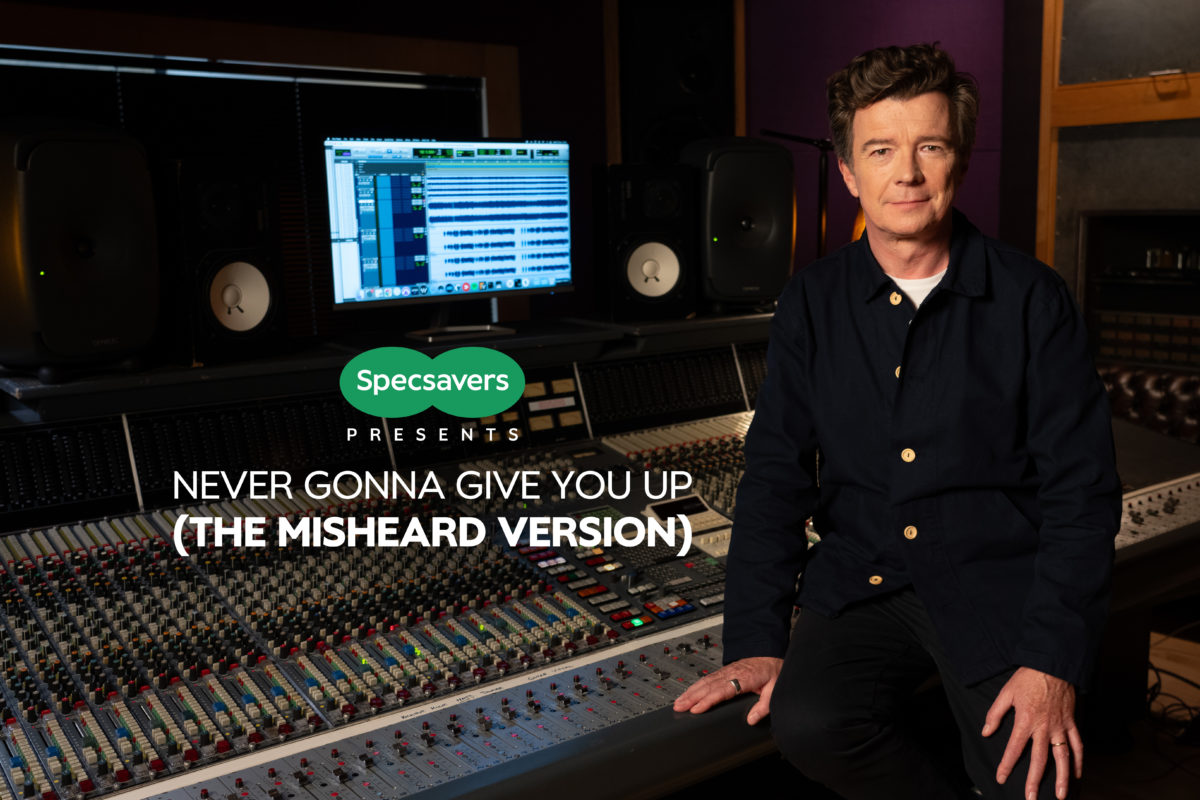
The recording studio is an odd place to diagnose a public-health problem. Yet there sat Rick Astley, patron saint of the internet bait-and-switch, singing Never Gonna Give You Up incorrectly. Not badly. Incorrectly. He replaced the lyrics with the versions people commonly believe they hear. A familiar pop song became a small trap: if the listener did not notice the mistakes, perhaps it was time to check their hearing.
The campaign was called The Misheard Version. Specsavers wanted to be known for audiology, not only spectacles, and hearing loss carried the usual baggage - age, anxiety, denial and the suspicion that a medical test would be both serious and dull. Virgo Health's answer was to hide the test inside the joke. Astley teased the recording on social media, the reveal invited people to compare what they heard, and educational material plus a radio spot completed the route from amusement to action.
The result was more than a celebrity attachment. Virgo reports a 66 percent increase in hearing-test bookings, a 138 percent rise in search traffic identifying Specsavers with audiology, more than 28 million in social reach and 400 pieces of coverage. Astley's teaser collected eight million organic views in 48 hours. The useful unit here is not fame. It is fit: mishearing is the symptom, the joke and the diagnostic prompt all at once.
The narrow bridge between a lab and a living room
Virgo Health occupies a precise part of the market. It does not discover medicines, run clinical trials or sell care. It translates. Its clients include pharmaceutical and diagnostic companies, consumer-health brands, hospitals, professional bodies, patient groups and charities. Their problem is rarely a shortage of facts. It is that facts arrive wrapped in technical language, legal constraints and institutional caution, while the intended audience arrives with a busy life.
The agency sells strategy, public relations, consumer-health campaigns, medical education and scientific editorial. Its in-house creative studio, mischievously named The Pharmacy, adds design, digital work, animation and film. Medical-education teams work across a product's lifecycle; communications teams handle corporate reputation, media, disease awareness and public health. The bill is generally a project fee or retained account, not a software subscription. Public rate cards do not exist.
That mix matters because healthcare creativity has a peculiar failure mode. A clever idea can attract attention while trivializing a condition; a perfectly compliant idea can vanish on contact with the public. Virgo's stated distinction is that it places healthcare specialists beside consumer strategists and makers. Its network ownership adds reach: London, New York and Chicago offices are connected to Golin and the wider Interpublic Group, allowing campaigns to travel across more than 50 markets with local language and regulatory knowledge.
The agency's product is not content. It is confidence that the science will survive the creative idea - and the creative idea will survive the science.
A boutique name with a holding-company passport
Angie Wiles and Sarah Matthew founded Virgo in London in 2003 after careers in pharmaceuticals and large agencies. Their mission was blunt: raise the bar in healthcare communications. By 2012 the company had 60 people and three core units covering medical PR, medical education and consumer health, plus a strategic consultancy. GolinHarris bought it that year. The price was not disclosed, but the operating bargain was visible - Virgo kept its name and leadership while gaining a large international network.
That arrangement can create muddle. A specialist risks becoming one more logo in a holding-company deck. Virgo instead used the network as a passport. By its twentieth birthday it employed more than 90 healthcare specialists, worked on UK, European and global accounts, and had expanded its corporate, media-relations and medical-affairs offers. Industry reporting put its fee-income growth above 40 percent across 2022 and 2023, with a 25 percent margin, a 71 percent pitch win rate and more than $3.5 million in new business in 2023.

What failed first
The revealing part of an agency story is usually not the award shelf but the work that disappeared. Virgo's latest consultancy award case says three important clients suffered asset failures, budgets contracted and two high-value projects closed. In pharmaceutical communications, an “asset” can be a medicine or development program around which years of planned work were organized. When it fails, the communications revenue can fail with it. Virgo forecast a flat year.
Its response was operational rather than theatrical: hunt for business more effectively, deliver with deeper expertise and make innovation useful. More than 90 percent of the team came to use AI regularly. Virgo says it then recorded a fifth consecutive year of growth and its highest new-business win rate in three years, while helping launch EURneffy, supporting Moderna's first British mRNA manufacturing facility and growing one pharmaceutical client's social audience by 39,000 in a month.
The model works when specialists meet early
A regulated campaign cannot bolt medical review onto the final draft. The advantage disappears if the creative team lacks access to evidence, patients and subject experts - or if the client wants cheap volume rather than behavior change.
This is also the clearest answer to what changed their mind. The old binary - cautious science on one side, consumer flair on the other - became less useful as audiences moved across social feeds, congresses, clinics and patient communities. Virgo expanded medical affairs, global media relations, corporate health and integrated consumer work. AI was treated as a capability inside the agency rather than a product to sell. The through-line stayed the same: rigorous enough for review, recognizable enough for a person.
The thing worth copying
Do not copy the celebrity. Copy the structural joke. Virgo's stronger campaigns make the requested behavior native to the experience. In The Misheard Version, listening closely is both entertainment and self-assessment. In Time to Unite, a breast self-check event kept cameras off, respecting privacy while 3,800 people participated. In Putting Parkinson's in the Picture, four people affected by the disease worked with illustrator Nate Kitch to show more than its visible motor symptoms. The subject is not decoration; it controls the form.
- Start with friction. “People need awareness” is not a brief. Fear of a test, embarrassment or feeling unseen is.
- Let the behavior shape the medium. Listening belongs in a song; a private check belongs in a camera-off event.
- Use experts as builders. Compliance works better when it helps form the idea, not when it arrives as a red pen.
- Count action. Reach is pleasant. Bookings, searches, checks and downloads reveal whether the idea traveled anywhere useful.
There are limits. The method depends on credible evidence, patient insight and enough production budget to execute the cultural object well. Humor becomes dangerous when the disease is poorly understood, the audience carries fresh trauma or the gag makes the brand the hero. Global reach also creates local risk: a reference that is instantly legible in Britain may be meaningless elsewhere. Under those conditions, the human touch is not a tone of voice. It is restraint.
Virgo's phrase for all this is “Being Human,” also the name of its internal culture. The language is soft; the numbers are not. Industry reporting has cited 77 percent retention, 93 percent employee recommendation and 96 percent approval of hybrid work in 2023. Later award material said 95 percent of employees called Virgo the place to be. Flexible work, learning programs, employee groups, volunteering days and transparent salary practices are not incidental perks in a knowledge business. They are how the people who translate complexity stay around long enough to get good at it.
A Rickroll will not fix healthcare communication. It did expose a useful truth about it. People rarely object to medical information because it is too accurate. They object because it arrives in a form that demands attention before earning any. Virgo Health's neatest trick was to reverse that sequence: begin with something people already wanted to hear, then let them discover why listening mattered.