A medical advisory board is a peculiar social machine. Put a dozen accomplished clinicians around a table, give them a difficult question, and then add the one ingredient least suited to difficult questions: a clock. The extrovert answers first. The cautious expert edits herself in real time. Someone notices that lunch is late. By the time the best thought arrives - perhaps in the lift, perhaps on the train home - the flip charts have been rolled away.
Impact Communication Partners, Inc., a medical communications agency based in West Hartford, Connecticut, has built much of its business around this gap between what experts know and what a meeting manages to capture. The firm says it has more than 40 years of experience. Its public record dates the company to 1981. In an industry fond of declaring every PDF a transformation, longevity is the more interesting credential: Impact has watched medical education travel from print-heavy programs to congress screens, virtual rooms, and persistent online discussions.
The company works for pharmaceutical and biotechnology teams across medical affairs and commercial functions. It plans strategy, develops scientific content, supports congress activity and field teams, creates digital and print materials, and runs peer-to-peer education. In plain English, it helps a drug company explain complicated evidence to the people who must interrogate it, teach it, or use it. The audience is often a healthcare professional; the hoped-for destination is a better patient outcome.
The first thing to fail is airtime
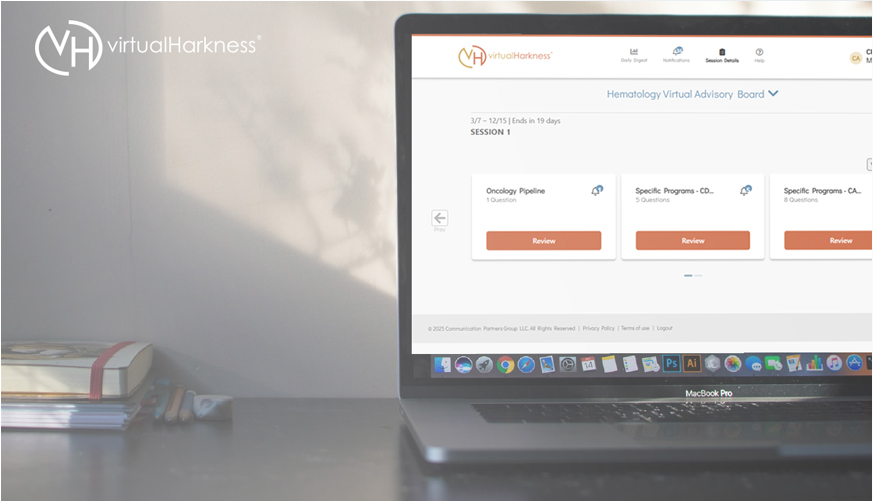
Impact's most distinctive product is virtualHarkness, an online engagement platform for gathering expert insight. A session stays open for a defined period. Participants review materials and answer questions in a blinded fashion before seeing what everybody else said. Then they can respond to peers and moderator prompts. Impact closes the loop with a summary and strategic recommendations.
The mechanics matter. Blinding the first answer creates a small pocket of independence before consensus begins to exert its gravity. Asynchronous access gives a participant time to consult notes, reconsider a claim, or formulate the answer she did not produce on command. The conversation becomes a record rather than a recollection. None of this guarantees wisdom, but it changes the conditions under which wisdom has a chance to appear.
“Impact is the Central Nervous System of the program.”Client testimonial published by Impact
That testimonial is revealing because a central nervous system is not the headline act. It is the connective tissue. Medical communications agencies are often mistaken for content factories, but the harder work is orchestration: clinicians, scientists, editors, designers, compliance reviewers, logistics staff, client teams, and busy external experts must all hand information to one another without blunting the science or missing the date.
A company of unlikely adjacencies
Impact advertises the usual medical-communications disciplines - clinicians, scientists, editors, strategists, educators, former medical science liaisons, and biovisualization specialists - then cheerfully keeps going. Its people, the company says, also include ballroom dancers, race-car drivers, coaches, novelists, musicians, scuba rescue divers, and stand-up comics. It is clever recruiting copy, but it also states a theory of the work. Scientific accuracy and audience attention are separate problems. Solving both takes people who know the molecule and people who know the room.
The firm calls this “High Science, Human Touch.” The phrase risks becoming wallpaper until you look at the operating model. Impact sells bespoke agency engagements, not a standardized software subscription. A client brings a scientific or commercial problem; a mixed team designs the strategy, content, format, and logistics. virtualHarkness is the repeatable component inside that custom system.
Public pricing is not available, which is unsurprising for custom agency work. The invoice will depend on therapeutic complexity, number of markets and participants, content volume, live or asynchronous formats, technology, logistics, and the layers of medical and legal review. The sensible buying question is not “What does a meeting cost?” but “What decision must this engagement improve?” A beautifully managed advisory board that produces no usable decision is an expensive room.
Small enough to customize, large enough to travel
Impact is a member of The Bloc, a global health-native agency network. That relationship gives it a useful market position: the company can present itself as a focused specialist with an entrepreneurial pace while drawing on The Bloc's regional and local knowledge, creative resources, scientific expertise, and behavior-change framework. Clients that want one accountable med-comms team across markets may find that combination attractive.
The alternative set is broad. A client might hire another specialist agency, a global healthcare network, a research vendor, an event producer, a virtual-meeting platform, or build the program internally. Impact's argument is that none of those labels alone describes the job. The work lives between scientific strategy, education, experience design, facilitation, and production. Its difference is less a magic ingredient than a particular assembly of them.
What a smart client can copy tomorrow
You do not need Impact's platform to borrow the principle. Ask participants to commit an initial view privately before opening discussion. Separate information gathering from consensus building. Leave enough time between prompt and deadline for reflection, but not so much that the session loses energy. Use a moderator to probe contradictions rather than merely police the agenda. Most important, define the decision that the final synthesis must support.
That last step is where minds actually change. A useful engagement does not celebrate participation as an end in itself. It lets a participant see the range of independent answers, encounter a peer's reasoning, revise a position, and leave a trace of why. For the client, the product is not a wall of comments. It is a clearer map of agreement, uncertainty, and the next question.
Where the format earns its keep
Asynchronous discussion works best when the prompt rewards reflection, participants can read and write comfortably, and the moderator actively shapes the exchange. It is a poor substitute for hands-on training, urgent decisions, emotionally delicate conversations, or groups with limited digital access. It also fails quietly when questions are vague: more time cannot rescue a prompt that asks nothing precise.
Impact's long history does not prove that every program works, and a proprietary platform does not abolish the social physics of groups. It does suggest something modest and useful. In medicine, the quality of an answer depends partly on the evidence and partly on the room built around it. Change the room - who speaks first, what others can see, how long thought is allowed to ripen - and you may change the answer.
The meeting, in other words, was never just the hour in the calendar. It was the architecture of attention. Impact Communication Partners has made a business out of redesigning that architecture, one careful prompt at a time.