There is a peculiar moment in the life of a new medicine. The experiments have been run. The plots look persuasive. The adverse events have been tabulated in fonts so small they could hide a minor republic. And then someone in a conference room asks the question that turns science into commerce: So what is the story?
That question is easy to dislike. Science is not a fable, and a patient is not a plot device. But evidence has to travel. It moves from researchers to regulators, from medical-affairs teams to outside experts, from a specialist at a congress to a physician with seven minutes, and eventually to a person wondering what happens next. At every transfer, meaning can wobble.
SIMPSON Healthcare works in that wobble. The Old Lyme, Connecticut agency helps pharmaceutical, biotechnology, diagnostics and medical-device companies organize clinical evidence into brand strategy, scientific narratives, advisory boards, expert engagement, publications, training and creative content. It does not discover the molecule or write the prescription. It helps the people between those acts understand one another.
A bench scientist notices the missing profession
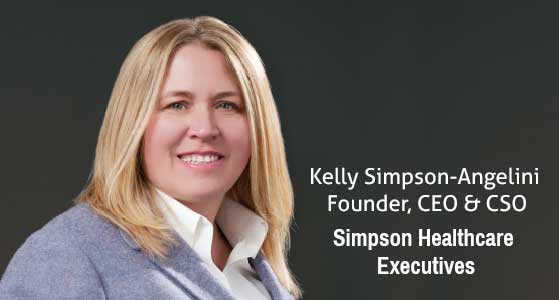
Kelly Simpson-Angelini began her career as a research scientist at Pfizer. In 1998, she founded Simpson Healthcare Executives. That biography matters because it supplies the agency's central instinct: the science is not decorative material handed to a creative department after the clever people have finished. The science is the raw material.
The company built a deliberately mixed cast: strategists, doctors, marketers, software engineers and designers. That list explains more than an org chart. A medical writer can protect precision. A strategist can decide what matters. A designer can show a mechanism without turning it into soup. A software engineer can make the explanation behave on a screen. The deliverable may be one video, but the useful product is agreement among those disciplines.
“We craft content. We connect people.” The second sentence is the business; the first is how it invoices.02 / The machine
One story, then many forms
On paper, Simpson's menu looks like a standard medical-communications catalog: strategic brand planning, KOL identification and profiling, advisory boards, real-world evidence analysis, publication planning, scientific writing, workshops, speaker training, podcasts, webcasts and mechanism-of-action videos. The more revealing detail is how those pieces fit.
An advisory board is not merely an event with name badges. It is a place to discover which part of the proposed story collapses when an oncologist, a payer or a patient advocate pushes on it. Publication planning is not a content calendar. It is the sequence in which evidence reaches congresses and journals. A mechanism-of-action animation is not a small film about molecules having adventures. It is a test of whether the mechanism can be made visible without becoming less true.
This is where the first failure usually appears: alignment. Medical affairs emphasizes one implication; commercial teams remember another; outside experts introduce caveats; the creative brief quietly removes all the verbs. Simpson's stated approach begins earlier, with insights, evidence and narrative, then pulls the communication through to the right audience and channel. It is a sensible order precisely because organizations are forever tempted to reverse it.
03 / The marketA specialist shop with a global parent
The agency sits in a crowded market. OPEN Health, Envision Pharma Group, Oxford PharmaGenesis, Fingerpaint and dozens of specialists compete for similar medical-affairs and commercialization budgets. Simpson's distinction is not any single item on its menu. It is the attempt to keep scientific depth, brand strategy and creative production in the same conversation.
Editorial positioning, not audited performance data. The point is the overlap: scientific agency, strategic consultancy and creative studio under one roof.
Joining IQVIA altered the scale around that overlap. Simpson now sits inside IQVIA Health Communications Group alongside specialist agencies in medical communications, creative marketing, experiential learning and independent medical education. IQVIA brings data, technology, commercialization infrastructure and international reach. Simpson brings a compact agency habit: start close to the evidence and keep asking what the story means for the patient.
The customer is still the life-sciences organization - typically its commercial or medical-affairs team. The users are more varied: internal brand teams, key opinion leaders, healthcare professionals, field teams, patients and caregivers. The company earns money as an agency and consultancy, through scoped programs and continuing client relationships rather than a self-serve product. In 2026, its network described the offer as integrated creative and scientific commercialization and launch support for both small and large pharma.
04 / The lessonWhat anyone can copy - and where it stops
The portable Simpson idea is not “tell more stories.” Most companies already tell too many. It is to build one evidence-led narrative strong enough to survive translation. Start by deciding what changed in the world because of the evidence. Invite skeptical experts to attack that interpretation. Identify the decision each audience actually faces. Only then choose the format.
A four-question brief worth stealing
- What does the evidence allow us to say?
- Who must believe or act on it?
- What would make that audience hesitate?
- Which format removes that hesitation with the least distortion?
There are conditions. Narrative cannot rescue weak evidence. A beautiful video cannot settle an unresolved safety question. Expert engagement becomes theater if the plan is already immovable. And an integrated agency model loses its advantage when legal, medical and regulatory review enters only at the end, after every sentence has become emotionally expensive.
The company itself has changed shape. It began as a founder-led Connecticut scientific agency, accumulated workplace and leadership awards, developed a “futuring” practice for thinking through long-range scenarios, adapted live work to virtual forums, and then entered IQVIA's much larger system. By 2026, founder Simpson-Angelini had closed her 27-year chapter with the agency. The institution carried on, now led publicly by Scott Algiere as CEO and CFO and by Neil Malloy as head of agency.
And the original problem carried on too. Somewhere, this morning, a team is looking at a statistically persuasive chart and failing to agree on the sentence beneath it. That gap is small enough to miss and expensive enough to build a company around.
Explore