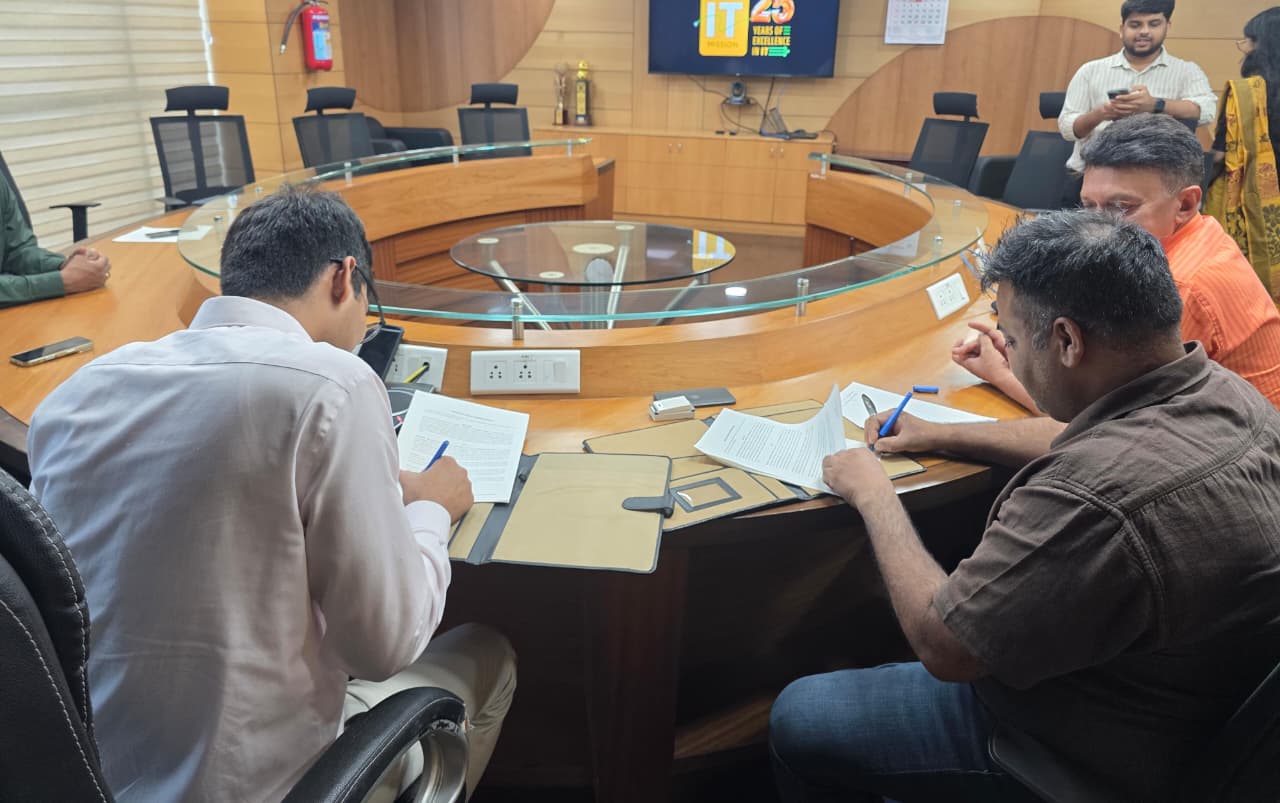
One acre is an unusually tangible unit for a software entrepreneur. Code occupies repositories. Customers occupy calendars. An acre requires somewhere to put the building. When Vipin Vindal signed an agreement with Technopark for a proposed Quarks campus in Thiruvananthapuram, the business he had built acquired a different sort of outline: a place on a map, a plot of land, room for people to work.
The agreement covers one acre at Phase IV. Vindal signed for Quarks; Sandip Kumar, Technopark’s chief executive, signed for the park. The photograph records the rather uncinematic business of expansion: two people at a conference table, pens on paper. A company can sell digital transformation and still need a perfectly ordinary signature.
For Vindal, founder and CEO of Quarks, the scene sits inside a larger question. How does a group of people who know how to make software become a company capable of growing across countries? And how does its founder preserve the judgment that made the original group useful?
A badminton medal before the boardroom
Vindal studied at the Indian Institute of Technology Delhi from 2002 to 2006. Alongside that familiar credential are two less predictable details: he represented the institute’s music team and won awards, and took a gold medal in the departmental badminton tournament Antarang in 2005. The engineering graduate had also spent time performing with others and chasing a shuttlecock.
Neither detail needs to be pressed into service as a secret explanation for business success. A badminton medal does not write a sales proposal. Music awards do, however, give the undergraduate years some texture. Before the executive biography and its catalogue of ventures, there was a student whose activities extended beyond his academic timetable.
Today, he is based in Noida. His professional identity remains attached to engineering, although the work around it has widened: organizing teams, developing partnerships and helping businesses turn their requirements into working systems. The distance between those tasks and writing an individual piece of software is considerable. The customer still expects the thing to work.
When the team becomes the system
Quarks describes its beginnings as a small group of software specialists. Quarks dates its founding effort to 2012. It now presents itself as a digital engineering, data engineering and enterprise solutions business. That progression changes the founder’s job. A small team can settle a difficult question by gathering around a desk; a larger organization needs ways for the answer to travel.
The company’s overview reports more than 800 employees, more than 400 delivered projects and more than 225 clients. These are Quarks’ published figures. Each measures a different kind of responsibility: people to organize, work to finish, relationships to maintain. None can substitute for another. A long client list cannot debug a release.
Vindal’s leadership biography emphasizes alliances and customer success. Those are ordinary executive phrases, but they describe a real change in the work: getting people outside the company and people inside it to agree on what should happen next. In software, the apparently simple word “done” can sustain an entire meeting.
Several companies, several sets of rules
Quarks is the central business in Vindal’s public career, but he is also a co-founder of Mulberri in the United States, Jombone in Canada and UNIZON Fintech in India. Those affiliations make his career broader than the story of a single services company. They place him on the founding side of other businesses, too.
Jombone describes its work around hiring and staffing, bringing employers and workers together through its platform. That is a useful counterpart to the engineering business. Software has to accommodate the particular routines of the organization using it; hiring software has to accommodate the people trying to find work and the employers trying to fill it.
The distinction matters when describing Vindal. A co-founding connection establishes involvement, rather than day-to-day control of every venture. His current public role at Quarks is CEO. The other ventures show where his entrepreneurial activity has reached, without making every product decision in those companies a personal decision of his.
The website has to open
Vindal’s public writing often starts with practical business needs. In a November 2022 essay on startups, he considered who should take responsibility for application development and how a young company should choose an outside development partner. The underlying concern was concrete: an enterprise can have an idea and still struggle to build the machinery needed to offer it to customers.
He argued that developers should understand the business they are serving. Design, usability and a consistent online presence belonged alongside the technical work. For a founder selling engineering services, this is also an explanation of why a customer might hire his company: technical choices have commercial consequences.
There is something pleasantly unfashionable about returning an entrepreneurial conversation to whether the website functions. A pitch can soar for twenty minutes without encountering a login screen. A customer usually encounters one much sooner. Vindal’s writing locates part of the developer’s value in making that encounter useful and coherent.
Music, machines and room to experiment
His June 2023 essay on AI and creativity ranged into territory beyond enterprise systems. He wrote about algorithms generating music, images and films, and about designers using computational tools to explore alternatives. The student who had participated in IIT Delhi’s music team was now discussing software’s place in creative work.
The emphasis was on widening access to experimentation. Open tools could let more people try techniques that had previously been difficult to reach. Designers could automate portions of a workflow and devote more attention to decisions requiring their judgment. It was an optimistic account of what people might do with another instrument at hand.
Read alongside his startup writing, the essay reveals a recurring interest in tools that help someone act. The setting changes from a young business to a designer’s workspace, but the question stays recognizable: what becomes possible once the necessary technical work is within reach?
The awkward question inside an AI answer
By May 2024, Vindal was discussing AI in financial technology in terms of customer service, fraud detection and models trained for particular businesses. He described a chatbot for an unnamed neobank and a fraud-detection model for an unnamed payments platform. He described these projects as ways to improve service and reduce losses.
His interest in explainable AI was especially revealing. A recommendation becomes more useful when the client can understand the reasoning behind it. A model’s answer can look impressively decisive while leaving the person responsible for acting on it with further questions. Vindal wanted that person to understand why the recommendation had been made.
“We can’t afford to be complacent in this field.”
Vipin Vindal, May 2024
He described continued learning as part of the work. Taken together, his comments favor adaptation to a customer’s circumstances over a universal product claim. The important part of the story is his stated approach: learn the business, use its data, and make the resulting advice intelligible to the people who have to use it.
A machine that stops is a business that waits
Another piece of his writing moved the discussion onto the factory floor. In August 2024, he examined predictive maintenance: using operating data to anticipate equipment problems and plan intervention. He discussed heat patterns, acoustic signals and vibration as ways to understand what machinery is doing before a breakdown interrupts production.
The attraction of that subject is easy to see. Data engineering can sound remote until a conveyor stops. In his account, the information serves an identifiable operational decision: when should someone inspect or maintain a machine? The useful result is time recovered and disruption avoided.
His February 2024 comments on greener cloud computing took a similarly operational route. He discussed efficient hardware, workload allocation and gradual migration from older infrastructure. Sustainability, in that discussion, involved choices about resources and the practical difficulty of changing existing systems. Even the cloud has an electricity bill.
Building room for the next version
People require infrastructure, too. Discussing remote work in 2023, Vindal advocated frequent feedback, recognition, communication tools and a culture of trust. Those recommendations put responsibility on the employer to make collaboration work when colleagues are apart. Installing software supplies only part of what a team needs.
More recently, Quarks described a Bengaluru office visit during which Vindal spoke with employees about growth and opportunities. The company highlighted two ideas, Know Your Quarks and Idea Tree, intended to help colleagues connect and contribute suggestions. Their names are cheerful; their purpose is familiar to any growing organization trying to hear itself think.
At the end of 2025, Vindal reported Quarks’ largest deal to that point, worth $8 million, and a $6 million campus registration. He also set out an ambition for at least twofold growth in revenue and team size in 2026, with an organizational structure able to support tenfold growth. Those were his reported milestones and forward-looking targets.
Revenue and team growth
targeted for 2026
Growth capacity envisaged
for the organization
The interesting word in that ambition is structure. Bigger numbers require decisions to move through more people. The proposed acre in Thiruvananthapuram gives the expansion a physical address; the harder task is making the organization inside the buildings function. Vindal’s career has brought him from being one engineer among others to taking responsibility for that arrangement. The pens have done their part. The company has work to do.