In a garage near Sacramento, Vikram Aggarwal looked at an inverter. Outside, the day was hot and sunny. Inside, a newly built house was comfortably cool. Panels on the roof were producing the electricity. The equipment was doing its job so quietly that the most interesting thing about the visit was how little there was to see.
For Aggarwal, the scene carried a particular charge. He had grown up in India with unreliable electricity and a view of a coal-burning power plant that supplied Delhi. Here was another way to power a home, without the familiar smoke. Years later, he remembered that visit as the beginning of his affection for solar.
Yet the company he eventually founded would concentrate on something less photogenic than the panels: the business of choosing them. EnergySage began with a practical question. If solar worked, why did buying it require so much detective work?
The investor asks for the bill
Aggarwal came to solar through finance and construction. He earned an MBA at Northeastern University, became a CFA charterholder and spent roughly fifteen years at Fidelity Investments. His work included private equity investing and strategy consulting. That background gave him a way of examining a roof that involved considerably more arithmetic than most people bring to a roof.
During his years in finance, he kept a running list of business ideas. He wanted something he cared about, something that could grow and something that would make a difference. The list was a holding pen for possibilities while he carried on learning how other businesses operated.
His exposure to builders brought clean energy into focus. Contractors wanted help with more efficient homes and solar equipment. Aggarwal began researching the sector and looking at potential investments. The questions were becoming concrete: what would people buy, what would it cost, and what would make them comfortable signing?
In 2007, he saw operational solar panels while evaluating investments. He later described recognizing an opportunity in the gap between the technology's promise and the industry's ability to explain it. An environmental case could get a conversation started. A household still needed a reason to commit its money.
This is the useful tension in Aggarwal's story. He cared about the destination, but his professional training kept bringing him back to the transaction. A good idea could lose a customer somewhere between the sales presentation and the contract. He chose to work in that awkward interval.
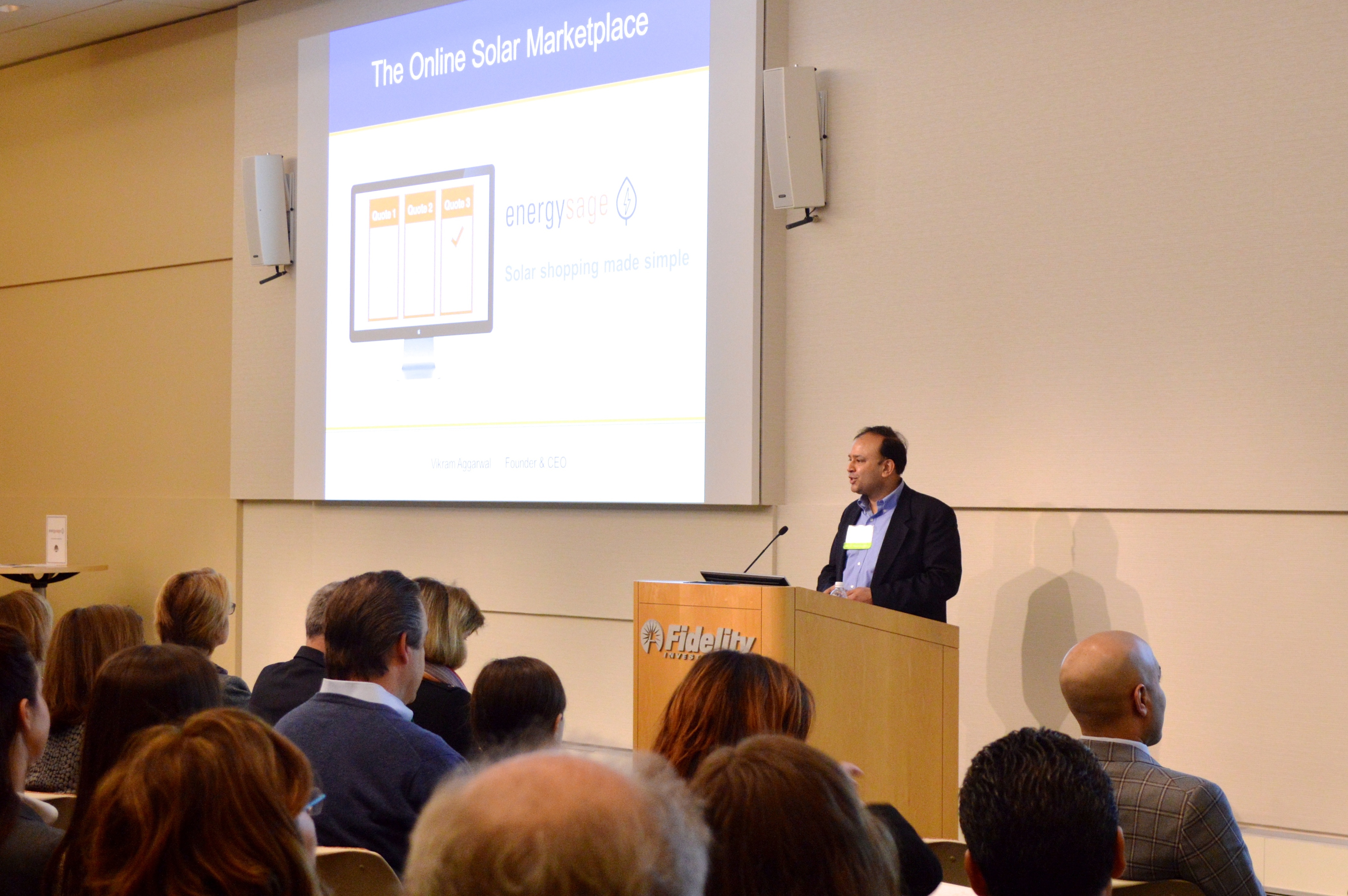
Three quotes, several different languages
EnergySage was founded in 2009. Its early educational website followed in 2010, explaining efficient energy technologies and their economics. Then prospective customers started asking for help comparing solar proposals. Contractors presented different information in different ways. Aggarwal built spreadsheets to make the choices intelligible.
It was an unusually revealing request. These people had already moved beyond general curiosity. They wanted to evaluate offers, and the offers resisted evaluation. A spreadsheet was a small intervention, but it showed where a business might fit. The comparison itself had value.
“I’m a student of business.”
Vikram Aggarwal, 2016
The buying problem extended well beyond price. A homeowner had to assess equipment, decide how to pay and choose an installer. A cheaper proposal might use different panels. A monthly payment might conceal a very different overall commitment. Even an attentive customer could struggle to put everything on the same footing.
In a 2013 interview, Aggarwal described the shopping process as complicated and confusing. His proposed remedy was a platform that brought information and competing offers together. Learning about solar, comparing systems and finding a contractor would become connected parts of a purchase, rather than separate errands.
The design expressed a view about customers: give people enough information to exercise judgment. A homeowner could consider expected generation alongside equipment quality and financing. The decision would still belong to the buyer. The platform's task was to make that decision easier to understand.
EnergySage organized a complicated purchase around three questions a buyer could actually ask.
The government buys an idea some time
In 2012, the U.S. Department of Energy awarded EnergySage $500,000 to develop its comparison platform. The target was solar's “soft costs”: expenses around selling and delivering a system, beyond the hardware. Customer acquisition was part of that burden. Installers spent time educating people who might never buy.
The grant addressed both sides of the same conversation. Buyers needed understandable quotes. Installers needed a more efficient way to reach interested customers. A marketplace could potentially reduce the work of finding each other, while making competing offers visible.
Further federal awards followed in 2013 and 2017. Aggarwal credited the initial support with providing validation that helped attract investors. Building the site and convincing other people to back it were related problems. The public award gave him something tangible to point to while solving both.
“We really could not have done this without DOE. Investors were looking for that outside validation.”
Vikram Aggarwal, 2022
His company also turned the shopper into a subject worth studying. In 2015, Aggarwal presented a conference session called “The Emergence of the Solar Shopper.” The title captured the person EnergySage expected to serve: someone researching independently, seeking several quotes and asking for transparency before making a purchase.
That sounds ordinary when the purchase is a flight or a hotel room. In residential solar, making comparison shopping ordinary was the work. The appeal lay in bringing a familiar consumer habit to an unfamiliar, expensive decision. A buyer should be allowed to browse without becoming an apprentice electrician.
Answers first, an audience later
Aggarwal's public work followed the same practical bent. He wrote for Inc. about the business case for commercial solar. EnergySage published market reports and installer surveys. The company was accumulating information from the transactions it helped arrange, then turning that information into something other people could use.
The surveys brought another set of voices into the discussion. Its 2019 installer survey was produced with the North American Board of Certified Energy Practitioners and reflected the company's relationships with hundreds of installation businesses. A marketplace depended on understanding the people doing the work as well as the people buying it.
By 2021, the survey covered more than 500 solar companies across 43 states, Washington, D.C., and Puerto Rico. It reported concerns about supply constraints and trained labor. Those findings widened the picture beyond a homeowner comparing proposals. A good buying interface still sat inside an industry with practical limits.
There was room for a plainer conversation, too. Aggarwal appeared on The Weather Channel with Josh, a homeowner who had used EnergySage. They discussed the costs and benefits of going solar. The pairing suited the enterprise: a founder explaining the proposition, and a customer describing what it meant to go through with it.
In a 2022 video interview, he discussed how educational content helped build EnergySage and the resistance he encountered when pitching the marketplace to solar companies. The business required suppliers to accept a setting where customers could compare them. Transparency was a consumer benefit; persuading sellers to participate was part of the founder's job.
Solar and battery purchases through EnergySage in 2021.
Transaction value on the platform, not company revenue.A bigger company, the same household questions
By the time Schneider Electric bought a controlling stake in February 2022, EnergySage had grown to more than 70 employees. It had raised about $8 million in private capital, alongside government grants. Customers had purchased more than $600 million of solar and battery storage through the platform in 2021.
The acquisition gave Aggarwal's broader ambition more room. Solar could lead people to consider batteries, electric vehicles and other equipment. Some customers were already thinking about future electricity demand when sizing a solar system. The roof was becoming one decision within a series of household investments.
The deal announcement promised resources for expansion into efficient heating and cooling, smart home devices and other clean energy services. It also said EnergySage would continue operating independently and remain agnostic about products and providers. That commitment mattered for a business whose appeal rested on helping people evaluate choices.
The breadth of the ambition had been present early. Aggarwal had described wanting an energy comparison destination that reached beyond solar. Expanding such a service meant taking on more categories of equipment, each with its own contractors, costs and questions. The consumer's need for a clear explanation remained much the same.
In October 2023, Schneider Electric announced that Charlie Hadlow would lead EnergySage. Hadlow had worked closely with Aggarwal and overseen marketplace growth. After fourteen years, the founder was stepping away to pursue other opportunities. The business would continue with someone else responsible for its next set of decisions.
Still on the customer's side of the table
Aggarwal's later work keeps him close to the industry. In March 2024, his appointment to Conductor Solar's board was announced. Enact lists him as a strategic advisor. These roles extend his involvement beyond the company he founded, into other businesses working on the practical mechanics of solar.
His professional profile also lists mentoring at Cleantech Open and MassChallenge, and advisory work with Northeastern's NUImpact investment fund and Brookline's Zero Emission Advisory Board. The subjects run from young companies to a town's transition away from fossil fuels. They offer different places to apply experience accumulated in one long company-building effort.
The garage near Sacramento explains why the technology caught his attention. The spreadsheets explain what he did with that attention. Between those two moments sits the part of the story that feels most characteristic: an investor finding a reason to believe, then helping a customer decide whether to buy.
A solar panel can be impressive while doing very little to announce itself. A useful comparison can be equally undramatic. Aggarwal built a business around giving that quiet piece of work a place in the purchase.