In 1999, Vijay Pullur gave a presentation that helped change someone’s address. Ramesh Loganathan, then working at Informix in Silicon Valley, encountered him while the company was considering Pramati’s application server. Loganathan was preparing to return to India, with Bengaluru in mind. The prospect of joining a team building software infrastructure in Hyderabad altered the plan. He moved there in June 2000.
It is a small episode beside the acquisitions that would follow. It may also be a better place to begin. A software company has to persuade customers to buy what it makes. Before that, it has to persuade people to spend their working lives making it. Pullur’s pitch reached at least one person on both levels.
Nearly three decades after he and his brother Jay founded Pramati, Pullur leads WaveMaker, an application development platform now working with AI. Along the way, he has helped build companies whose technology and teams moved into Autodesk, Accenture and UKG. The recurring interest is the workshop: who gets inside, what tools they receive, and how much freedom they have once they arrive.
Hyderabad, with its own product
The brothers started Pramati in 1998. Vijay had spent eight years at Wipro in software development and technical leadership. They were entering a market occupied by companies such as BEA, IBM and Oracle, with an application server of their own. Infrastructure is a demanding place to make an introduction. A customer may admire your ambition; its business still has to run on your software.
Vijay’s responsibilities included building the US sales organization and establishing OEM relationships with companies including Tibco, EMC and Progress Software. That put him at the point where engineering had to become a business. The product needed to work, and other organizations needed a reason to trust the people behind it.
The early Pramati team made its case through Java standards and performance. Its application server achieved early J2EE certification, and its history includes a win in the ECPerf performance race. Years later, Pullur recalled a cartoon showing Pramati on a scooter overtaking racing cars. Enterprise middleware seldom provides a natural opening for comedy. A scooter apparently helped.
The road was rougher than the cartoon. Growth plans ran into the downturn of the early 2000s. The founders kept the business going, added product development services and continued making products. The eventual company would contain more than a single answer to a single technology cycle.
“Build products that our customers love.”
Vijay Pullur, 2007
That early statement of purpose was plain enough to survive changes in vocabulary. In 2007, Pullur was explaining Dekoh, a platform intended to bring desktop and web experiences closer together, including access when an internet connection disappeared. He wanted developers to use familiar technologies rather than learn a proprietary set just to participate. The concern was recognizably practical: help people build, and help their applications remain useful under ordinary working conditions.
Make a company that can make companies
Pramati gradually developed a second kind of product: a way of creating businesses. An idea could begin inside the company, receive a team and technical support, acquire customers, and become an independent venture. Shared finance, legal and other functions removed some of the chores that can consume a new founder’s day before any customer has seen the product.
Its investment philosophy included a question about affordable loss: how much could the business commit to an experiment? That is a useful question in a room full of engineers with ideas. It gives curiosity a budget. The model also made independence explicit. A successful team could develop its own leadership and direction rather than remain a project indefinitely.
- 01An ideaA need worth solving
- 02A teamCapital, tools, shared support
- 03A businessCustomers, then autonomy
A simplified view of Pramati’s incubation model.
Infinity, Pramati’s internal innovation challenge, gave employees a route into that process. Pullur described looking for ideas that matched a market opportunity, then carving out a team to pursue them. The arrangement placed a specific obligation on the parent company: provide enough help for a venture to start, and enough room for its leaders to take responsibility.
The outcomes addressed quite different working problems. Qontext developed enterprise social collaboration software. In October 2012, Autodesk acquired its technology and development team to expand collaboration in its cloud services. An idea grown within Pramati would become part of the tools used by designers and engineers elsewhere.
Imaginea brought product engineering skills to cloud transformation. When Accenture announced its acquisition in February 2021, the business advised more than 200 global clients, and the transaction was set to add roughly 1,350 cloud professionals. The scale matters because it puts people back into a story that can otherwise dissolve into company names and transaction dates.
SpotCues approached another gap: frontline workers who rarely used, or lacked, corporate email. Its Groupe.io platform connected employees with colleagues and company information. UKG announced its acquisition in February 2022; the 50-person team had joined in January. Building around people’s actual working circumstances had produced a different kind of enterprise tool.
The acquisition that became a workshop
WaveMaker entered this story through a purchase. In May 2013, Pramati announced that it had acquired WaveMaker assets from VMware. The software offered visual tools for building Java applications with less hand-written code. Pullur saw a fit with Pramati’s Java experience and cloud development work. The product had a history before the company he now leads.
There was substantial rebuilding ahead. Deepak Anupalli, now WaveMaker’s co-founder and chief technology officer, had come from Pramati’s application server team. His account of the early years describes replacing the acquired studio’s aging JavaScript foundations and reworking it for a changing web. Sharad Singh Solanki, whose career had moved from furniture design into user experience and web development, led the initial UI effort.
That detail deserves room. A platform promising to simplify development was itself being rebuilt by people who had learned to cross professional boundaries. A visual tool is only as useful as the decisions behind its apparently simple surface. Someone still has to do the complicated work that allows the next person to avoid repeating it.
WaveMaker’s present team includes Anupalli, chief operating officer K V Prasad and chief commercial officer Vikram Srivats. The company serves customers in 17 countries. Its stated emphasis remains professional developers’ ownership and control of their code, alongside faster delivery. For Pullur, that means selling a productivity tool to people who will also have to maintain its output.
An old compiler enters a new argument
In February 2026, WaveMaker launched its agentic application generation system. Pullur marked the moment by looking back over 35 years in technology. His account was enthusiastic about AI’s possibilities and candid about the difficulty of building dependable enterprise software while the underlying technology kept changing. Experience, in that telling, did not confer immunity from having to learn again.
His technical argument reaches back to multi-pass compilers. In WaveMaker’s two-pass approach, AI interprets intent and produces an intermediate representation. A separate generator turns that representation into application code. The ambition is to confine uncertainty to a smaller part of the process, leaving developers with output they can understand and maintain. It is an engineering proposal with a customer’s budget attached.
Pullur has also pressed a business argument. In March, he urged IT services companies to build proprietary software assets as AI changes their market. He put the target succinctly: “Products that clients cannot simply replace with a prompt.” The position fits a career spent trying to turn technical capability into products with a continuing reason to exist.
On April 21, Accenture and WaveMaker announced their strategic intent to collaborate on application modernization and development, particularly for growth-focused organizations with annual revenue up to $3 billion. Five years after Imaginea’s acquisition, Accenture was again part of Pullur’s business story. This time, the proposed relationship joined a software platform with engineering expertise and industry reach.
In May, WaveMaker published customer accounts from Colruyt Group, the State of Geneva and KX as it reported early trials of the new system. Those are company-reported accounts, with the familiar enterprise concerns running through them: integration, control, useful interfaces and the cost of getting work done. Pullur’s audience still has applications to ship after the excitement subsides.
A room where the conversation can continue
Another part of his work involves giving people somewhere to begin in a literal sense. Pullur serves on the USA board of OSAAT, One School At A Time, which rebuilds rural schools in India and supports digital learning infrastructure. His public support includes encouraging donors and volunteers. The concern with access has a concrete expression: a classroom and the means to learn inside it.
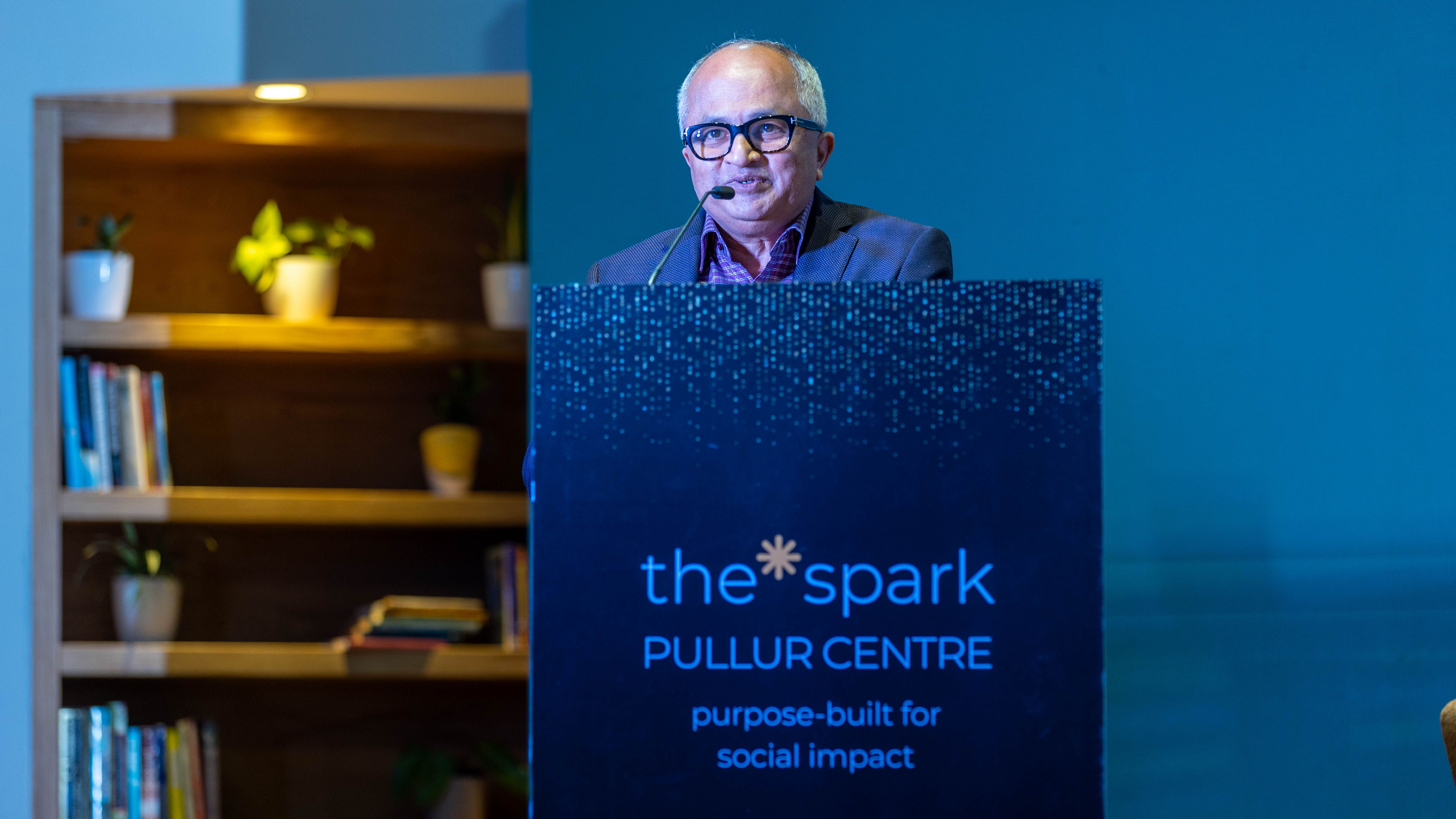
On February 14, 2026, The/Nudge Foundation inaugurated the*spark | Pullur Centre in Whitefield, Bengaluru. Vijay and Nirmala Pullur, Jay’s wife, are its founding patrons. The centre occupies 20,000 square feet and includes a coworking space called Venture Commons and an event space called Dialogues Arena. Social entrepreneurs, funders and practitioners are meant to meet repeatedly, with enough continuity for relationships to become useful.
Room for social entrepreneurs to work near one another, and keep the conversation going.
Pullur’s explanation of the centre emphasized the refinement of ideas through sustained discussion and shared learning. It is easy to see the connection to his earlier work: the team around a product, the support behind a venture, the people who stay close enough to help it improve. Here the infrastructure includes desks, shared rooms and other founders within talking distance.
The 1999 presentation helped bring one engineer to Hyderabad. The Bengaluru centre offers many more people a place to arrive. Between the two lies a career full of software, companies and changing technologies. Pullur keeps returning to the conditions in which someone else can get to work.