Vic Richey returned to Western Kentucky University in 2017 with an invitation that amused him. The business school wanted him to talk about leadership. He had studied political science. Nearly four decades after graduating, he was coming back as a visiting chief executive, carrying a set of lessons whose origins lay elsewhere on campus: in military science and ROTC.
By then, Richey was chairman, president and chief executive of ESCO Technologies, the St. Louis industrial company whose businesses worked on problems involving aircraft, electric utilities and radio-frequency testing. His audience could reasonably have expected a lecture about business. He gave his talk a title that redirected the credit: Everything I Learned about Leadership I Learned in the Army.
The title was expansive. The underlying idea was quite practical. Richey described an education that combined being held accountable with knowing someone would support you. That balance makes a useful starting point for a career involving six years in military intelligence, decades inside one corporate family and, eventually, the deliberate transfer of authority to somebody else.
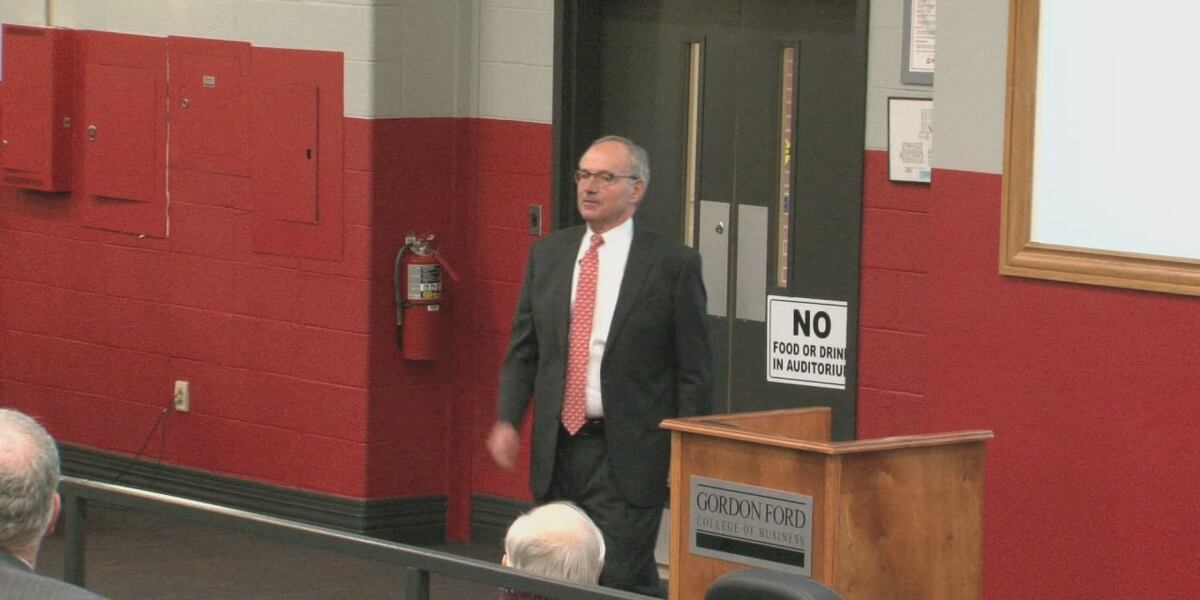
The political science student at the lectern
Richey graduated from WKU in 1979. His involvement in military science gave him an early setting in which leadership meant responsibility for people. He then served in the United States Army from 1979 to 1985, working as a military intelligence officer. The experience preceded both his industrial career and his graduate business education.
When he returned to campus, Colonel Greg Lowe, who had known him during his student years, introduced him. Lowe remembered an effective, unshowy cadet. There is something pleasantly disarming about a corporate leader being introduced by someone who knew him before the corporate titles arrived. A long résumé suddenly has a witness to its opening pages.
Richey’s account of ROTC emphasized the combination of pressure and support. People expected him to learn to lead, and they backed him while he learned. By 2017, his own explanation of leadership still paired consideration for people with difficult decisions. The two belonged in the same conversation. A comfortable environment alone would hardly meet the demands of an industrial business.
“I want people to understand there are no secrets.”
Vic Richey, on leadership during his 2017 WKU visit
That is a notably economical promise from a visiting executive. Business audiences are often offered a proprietary formula, preferably with enough initials to fill a slide. Richey located the work in how people were treated, how decisions were made and whether employees had room to excel. Anyone could understand the assignment. Carrying it out was the harder part.
Seventeen years before the corner office
In 1985, Richey entered the business that became his long professional home. His work included marketing and general management at subsidiary and corporate levels. ESCO emerged from Emerson as a public company in 1990. Richey was therefore present before the independent company acquired the identity with which his name became associated.
He earned an Executive MBA from Washington University in St. Louis in 1995. The sequence matters: military service, operating experience, then a graduate business qualification. He was learning business while already inside it. In 2001 he became president and chief operating officer; in 2002 he became CEO. ESCO described him as its third chief executive since the Emerson spinoff.
Seventeen years separated his arrival in 1985 from becoming CEO. That interval is easy to compress into a sentence, but it changes the shape of the story. His authority developed through jobs within an existing organization. He was neither ESCO’s founder nor a newcomer recruited to make a sudden entrance. His later decisions came with a long acquaintance with the business.
A company of things that have to work
The ESCO he led was a collection of specialist industrial businesses. Its products included filtration and fluid-control equipment for aviation, Navy and space applications, composite products, utility diagnostic instruments, and radio-frequency shielding and electromagnetic compatibility testing equipment. The catalogue is easier to understand through its customers’ tasks than through a single consumer product.
An aircraft component, a power-system diagnostic instrument and a test enclosure have different jobs. They also put engineering expertise close to the reason a customer buys. Richey’s corporate task involved deciding which of these specialist capabilities belonged together, where to invest and how to give the group a workable financial structure. Portfolio management can sound bloodless. Here it meant choices about actual operating companies.
One consequential choice arrived in December 2007, when ESCO completed its $319 million purchase of Doble Engineering. Doble supplied diagnostic testing solutions to electric utilities. Its existing management stayed in place, and it operated as a separate subsidiary. Richey presented the acquisition as a way to deepen ESCO’s utility exposure and support more reliable power delivery.
The arrangement also reveals an important distinction between buying expertise and replacing it. ESCO acquired the business while retaining the people already leading it. For a group built from specialized operations, that is a concrete example of how corporate ownership and operating knowledge can sit at different levels.
Buying is only half the job
Richey’s tenure also included selling. In March 2014, ESCO completed the divestiture of Aclara Technologies to an affiliate of Sun Capital Partners. Gross cash proceeds were approximately $150 million. ESCO said the money would pay down a substantial portion of its revolving-credit debt, while available financing supported further investment around its remaining businesses.
Place the Doble purchase beside the Aclara sale and the work becomes more legible. Acquisitions added capabilities; disposals changed the balance sheet and the perimeter of the company. A long tenure gives an executive time to do both. It also makes any tidy description of permanent corporate identity a little suspect. The company Richey left had been assembled through decisions over many years.
By the time ESCO announced his CEO retirement in September 2022, its structure centered on three profitable segments: aerospace and defense, utility solutions, and RF shielding and test. The emphasis had become more focused. Behind those labels were separate markets and technical disciplines, held within one publicly traded group.
Making room for the next person
The eventual successor was Bryan Sayler, who had led the Utility Solutions Group since 2016. He had joined ETS-Lindgren, ESCO’s shielding and test business, in 1995. His route to the top therefore crossed more than one part of the group. During his utility leadership, six acquisitions helped more than double the segment’s size and extend it into renewables.
The board’s succession process considered candidates from inside and outside the company and used an executive search firm. It selected someone with a substantial internal record. Richey praised Sayler’s ability to integrate acquisitions and build a cohesive team. Those were relevant credentials for a company whose shape depended on joining specialist businesses without losing their usefulness.
The handover had dates and stages. Richey retired as CEO and president on December 31, 2022. Sayler took over on January 1, 2023, while Richey became executive chairman. On June 30, Richey retired from the board, the executive-chair position and employment with ESCO. Independent director Robert Phillippy became board chair.
This gives his departure a clear ending. For six months, experience remained available inside the organization while executive leadership changed. Then the former chief executive left its formal structure. After roughly two decades running the company, the transition required him to do something very different from running it: allow the next arrangement to become complete.
The old lesson, passed along
Richey had already found another way to help people through a change of role. In 2013 he was an employer host for veterans connected with Washington University’s Olin Business School. The school’s veterans association arranged workplace visits and other opportunities to introduce students to civilian business. Richey understood the strength of the military’s shared purpose and the difficulty of finding an equivalent elsewhere.
His willingness to help was direct: “Anything I can do to aid in that transition, I will do.” It is a modest sentence, but it links the Army officer, the business-school graduate and the employer. He had made the journey himself. Opening a workplace to someone following a similar route was a practical use of that experience.
There is a connection between that outreach and the campus visit four years later. Both put him in contact with people still working out the relationship between education and a job. At Olin, military veterans could encounter a civilian employer. At WKU, students could hear from a graduate whose career had taken a route beyond his undergraduate subject. Richey brought the experience of moving between those settings. He could discuss a management career from the perspective of someone who had first learned to accept responsibility in uniform, then spent years finding out how it translated inside an industrial organization. The chronology gave his advice a specific foundation.
His own post-ESCO chapter remained connected to industrial companies. A Nordson director since 2010, he became its board chair in March 2024 and chairs its executive committee. He joined Thermon’s board in December 2023. After CECO Environmental acquired Thermon in June 2026, he joined CECO’s board, where he serves on the audit committee.
These are different responsibilities from the CEO job that made him familiar in St. Louis. They draw on experience in operations, acquisitions and corporate oversight. The continuity is easy to see: organizations still have to choose leaders, evaluate decisions and make space for expertise. Richey’s classroom has changed several times. The question he brought back to WKU - how to equip people to lead - has proved portable.