In 1999, Venkat Rangan had a wish that would have fitted comfortably into a furniture catalogue: a bunk cot. He and his fellow founders were putting together Yodlee, a service intended to gather the wandering pieces of a person's online life. Accounts were multiplying. Sleep was having rather less success. “Eight hours a day to us was half a day,” he said. For a professor entering the Internet business, the timetable had become unusually elastic.
The product promised something pleasingly domestic. Email, shopping, travel and bank accounts would come together on a single page. A user could spend less time making the rounds. Rangan, Yodlee's co-founder and founding CEO, was helping build a business around an irritation that anyone with several accounts could understand. Behind the convenience sat the harder task of getting different websites to surrender information in a usable form.
There is a thread running through his work that makes this episode more than a detour into the dot-com years. At the University of California, San Diego, he studied how separate streams of digital information could behave as a coherent experience. At Yodlee, the separate pieces belonged to a customer's life. Later, at Amrita Vishwa Vidyapeetham, his attention would turn to bringing research, students and institutions into working relationships. The scale changed. The problem of coordination kept returning.
Before the browser tabs, the moving pictures
Rangan earned his B.Tech. in electronics at IIT Madras in 1984, receiving the President of India's Gold Medal, and went on to doctoral study in computer science at Berkeley. By 1996 he was a full professor at UC San Diego. The university laboratory he founded worked on multimedia systems, a field whose plain name conceals a considerable amount of housekeeping. Pictures have to arrive. Sound has to arrive. Ideally, they should agree about when.
In a 1991 paper with Harrick M. Vin, Rangan addressed file systems for digital video and audio. Ordinary storage and retrieval did not cover all the demands. Continuous media needed continuous delivery, and multiple streams needed synchronization. Their work related the characteristics of storage devices to recording rates and considered when a system could accept another request without spoiling the service already promised to someone else.
The paper used the idea of a “multimedia rope”: individual strands of media tied together by timing information. It is an unusually helpful image for a technical abstraction. A video conference can contain all the right bits and still be a thoroughly irritating experience if they turn up in the wrong relationship. Rangan's research concerned the arrangements that let the user forget those arrangements exist.
He also helped give the field places to meet and publish. He chaired the program of the first ACM Multimedia conference in 1993 and was founding editor-in-chief of Multimedia Systems. In 1998 he became an ACM Fellow. Years later, the multimedia research community would recall his role in organizing that first conference. His contribution included building a community around the engineering problems.
One screen, then a different sort of customer
Yodlee made the coordination problem visible in another way. Its founders came from different corners of the technology industry and research world. Alongside Rangan were Sam Inala, Ramakrishna “Schwark” Satyavolu, Sukhinder Singh and P. Sreeranga Rajan. The business brought together experience from Microsoft, Amazon and Junglee, Stanford Research Institute and the university laboratory. By October 1999, it had raised a $16 million venture round led by Accel and Sequoia.
The early ambition extended beyond money. The service could combine account activity from the web's various personal errands. That breadth matters: the familiar financial aggregation business grew out of a wider attempt to organize online life. Bringing information together was only part of the commercial puzzle. Someone still had to persuade people that the gathering place deserved their confidence.
By April 2000, the business was working on that question through banks and other established service providers. Anil Arora had joined as CEO in February, with Rangan moving into the chief technology officer role. The change was already visible in Yodlee's pitch: it could help financial institutions give customers a consolidated view, making the bank's own website a more useful destination.
The shift required an accommodation with the organizations whose information was being collected. Banks had reasons to worry about customer relationships and the arrival of aggregation services. Yodlee offered a way for those institutions to use the technology themselves. The company could do the engineering while a familiar name stood in front of the customer. For a founder, accepting that arrangement meant letting the product travel under somebody else's sign.
Program chairman
Founding CEO
Vice chancellor
A useful place behind the curtain
By July 2001, Rangan was explaining the value of that position. Yodlee supported financial services companies including J.P. Morgan Chase, Citibank and American Express. Security mattered, but so did the recognition attached to the institution on the screen. Technical capability could take the company only so far if customers were reluctant to entrust a new name with their financial lives.
He described the chosen role as “the engine behind the curtain.” The phrase has a slightly theatrical charm for such practical work. An engine is judged by whether things move; a curtain permits someone else to take the bow. The arrangement allowed Yodlee's software to become useful inside relationships that banks already possessed.
His university experience followed him into management. He spoke about a collaborative, collegial approach and the need to keep capable people focused when their instinct was to tackle everything. The professor's problem had acquired customers and deadlines, but assembling a group of bright people still required choices about where to direct their attention. A long list of possible inventions was a poor substitute for a working service.
“The engine behind the curtain.”Venkat Rangan on Yodlee’s role, 2001
The university becomes the undertaking
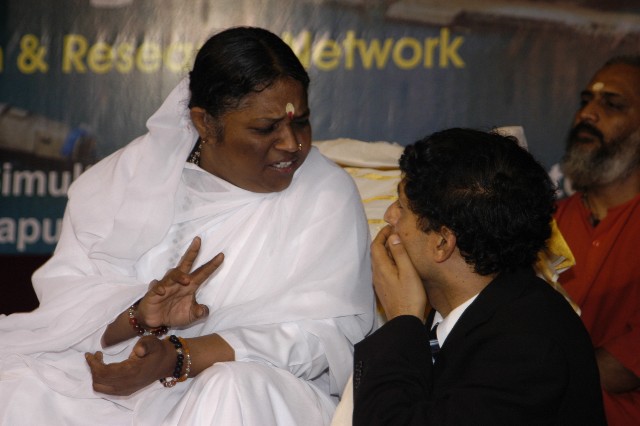
In 2003, Mata Amritanandamayi, Amrita's chancellor, appointed Rangan vice chancellor. The move placed him in another institution-building role, this time in India. He had founded a laboratory and helped establish a company. A university brought a different set of responsibilities, with teaching, research and the development of other people's careers all extending beyond the horizon of a product launch.
His connection with the chancellor preceded the appointment. In a 2012 talk, he recalled meeting her in Los Angeles in 1992 and described her influence on how he thought about his work. He also offered students a warning with the economy of a good computing joke: “Don't treat humans like computers and computers like humans.” The sentence makes room for both technical enthusiasm and the limits of applying it to people.
He urged those students to accommodate other people's ideas. That advice sits comfortably beside the collegial management style he had described at Yodlee. Across these different settings, collaboration appears in his own explanations as a daily practice: listening, choosing a direction and allowing other people to contribute. It is harder to put on a balance sheet than a patent, and rather difficult to run a university without.
Take the experiment outside
At Amrita, Rangan argued for research with a practical destination. In a 2014 interview, he discussed students spending time in rural settings, learning about problems firsthand and working on projects that addressed them. Students and faculty could receive academic credit for that engagement. The idea gave a village a role in the curriculum and gave a student a reason to question assumptions formed in a classroom.
He also defended the ability of private universities to make decisions quickly. “We have freedom to innovate fast,” he said. His argument paired autonomy with a call for public and private institutions to work together. Research funding mattered, but he wanted the choice of problems to remain connected to energy, water, the environment and other practical concerns.
Wireless sensing offered one concrete example. In 2009, an Amrita team led by Rangan developed a landslide-detection system that became operational in Munnar, Kerala. The work involved students and collaboration with the European Commission and ISRO. Here, a network's usefulness depended on its ability to observe conditions in the physical world. The engineering had moved a considerable distance from a video server while retaining a familiar concern with getting information where it could be used.
Connections that students can walk through
International collaboration also took tangible forms. At a 2015 University at Buffalo graduation gathering on Amrita's Bengaluru campus, Rangan recalled a relationship that began in 2003 when Buffalo's then-provost, Satish Tripathi, met the chancellor. Alumni of the institutions' dual-degree programs were among those present. A relationship between university leaders had become something students could experience through their education.
A 2016 agreement with Genpact brought another kind of connection into view. The plan included developing analytics talent, faculty engagement, additional training and joint research. It complemented Amrita's business analytics relationship with the University at Buffalo. Rangan's stated concern was that students acquire knowledge relevant to the industry they would enter. The partnership gave that concern a specific organizational form.
These arrangements are useful measures of university leadership because they describe what a student or researcher can actually do. A collaboration becomes consequential when it opens a course, a project or a working relationship. The administrative task is to make the connection survive the ceremony at which it is announced. Rangan's career has repeatedly placed him close to that less photogenic part of building things.
What belongs on the next screen?
In May 2026, Rangan was discussing a wider set of expectations among students: research experience, employability, entrepreneurship, international opportunities and social impact. He also drew attention to the growing role of cities beyond India's largest metropolitan centers. As vice chancellor, he was addressing a generation for whom a degree could be judged by the opportunities and experiences surrounding it.
That is a larger brief than the one Yodlee began with, though the resemblance is appealing. A useful screen brings scattered information into reach. A useful institution brings people into contact with work they can undertake, teachers they can learn from and problems that deserve their effort. The connections have to lead somewhere. Otherwise, even an impressive network can leave its users doing all the travelling.
Rangan's story runs through the machinery underneath those connections: storage systems, a financial data business, research groups and academic partnerships. The bunk cot belongs to an earlier chapter, when a new company was consuming the hours. The question behind the work has lasted longer: how do you bring separate things together so that someone else can get on with their day?
Follow the connections
- Amrita faculty profile ↗
- Archived UC San Diego homepage ↗
- Yodlee’s beginnings, 1999 ↗
- The CEO transition, 2000 ↗
- The multimedia research paper ↗
- His approach to university education ↗
- A 2012 talk about computers and people ↗
- Higher education discussion, May 2026 ↗
- LinkedIn ↗
- X: Vice Chancellor’s office ↗
- YouTube: Vice Chancellor’s office ↗