The uncomfortable moment in a sales call usually arrives as a short sentence. Too expensive. Bad timing. We already have someone. Imagine a new rep hearing one of those objections and remembering an entire training course except the part that would help right now. Vender’s proposition starts here: give the salesperson somewhere to practice before the conversation has money attached to it.
- Sales fundamentals, games, and AI chat form the product’s three-part menu.
- The website displays a $9.99-per-user offer, with an annual discount.
- The useful buying question: does rehearsal improve the next real conversation?
That makes Vender an interesting small company to examine. Its pitch asks us to consider the distance between understanding a sales technique and using it while another person waits for an answer. The first can happen in a lesson. The second calls for rehearsal. Putting those activities together is the product idea.
A curriculum that answers back
The public website divides the experience into Training, Games, and AI Chat. It describes a curriculum spanning prospecting, objection handling, negotiation, and closing; personalized learning paths and adaptive assessments; and interactive simulations. In other words, information, exercises, and a chance to try the conversation. Those are different jobs, even when they appear on the same screen.
Consider an illustrative objection: the buyer thinks the price is too high. A lesson can explain how to communicate value. An assessment can check whether the rep recognizes a reasonable response. A simulation can let the rep attempt that response. The exercise becomes more useful when someone asks what happened next: did the seller investigate the concern, or simply recite a better-sounding pitch?
“Ramp faster.”Vender’s LinkedIn tagline
The appeal is easy to understand. Rehearsal gives an awkward answer somewhere to go. A learner can stop, reconsider, and try again. For a manager evaluating Vender, the practical question is whether its exercises expose the particular weaknesses that appear on the team’s calls. A broad sales curriculum and a useful practice session are related, but each needs its own scrutiny.
A subscription small enough to try
Vender’s website presents a per-user subscription, a free-start invitation, and cancellation at any time. It displays $9.99 alongside monthly and annual billing choices and advertises 50% off annually. That is the advertised offer. A buyer should check the selected billing period and final checkout price before treating the figure as a budget.
There is also a mobile product. Apple’s public listing identifies Vender AI as an English-language business app for iPhone and iPad, with Matthew Ward as developer and in-app subscriptions. App directories record a July 2024 release. The distribution choice matters: a salesperson can encounter this proposition as an individual app purchase, rather than first meeting it through a company-wide training rollout.
One early user account gives that small-screen proposition some texture. In an August 2024 US App Store review, a reviewer writing as enholiday described using the sales bot for objections and strategy. The reviewer also reported encountering a bug, submitting a ticket with a screenshot, and receiving a fix within 24 hours, followed by a message from the founder. It is one customer’s account. Still, the sequence offers a useful miniature of the purchase: a person wants help, tries the tool, hits friction, and judges the response. For an individual learner, getting back to practice can matter as much as the original promise.
The interesting cost is therefore larger than the subscription. A manager must choose what to practice, give it time, and decide what improvement would sound like. A cheap tool that sits unused buys little. A narrowly chosen exercise that helps a rep ask a better question could justify attention. That is a buying hypothesis to test, not a result to assume.
The familiar objection has competition
Vender operates in an established aisle of sales software. Hyperbound markets AI sales roleplay and coaching. Second Nature offers simulated conversations and enterprise training capabilities. Human coaching, colleague roleplay, and conventional courses are alternatives too. A buyer has several ways to obtain instruction or a practice partner.
Vender’s visible proposition combines fundamentals, gamification, and conversational practice with a displayed per-user price. That combination gives a prospective learner a straightforward way to understand the offer. It does not establish that the underlying simulations outperform another vendor’s. The sensible comparison begins with the buyer’s actual task: learning basic technique, rehearsing a particular call, or administering training across a large organization.
Those tasks create different purchase decisions. An individual trying to get comfortable with objections may value easy access. A training leader may care more about assigning exercises, reviewing performance, and fitting practice into existing systems. The right evaluation asks the vendor to demonstrate the required workflow with a realistic example, rather than awarding points for a long feature list.
One objection. One better question.
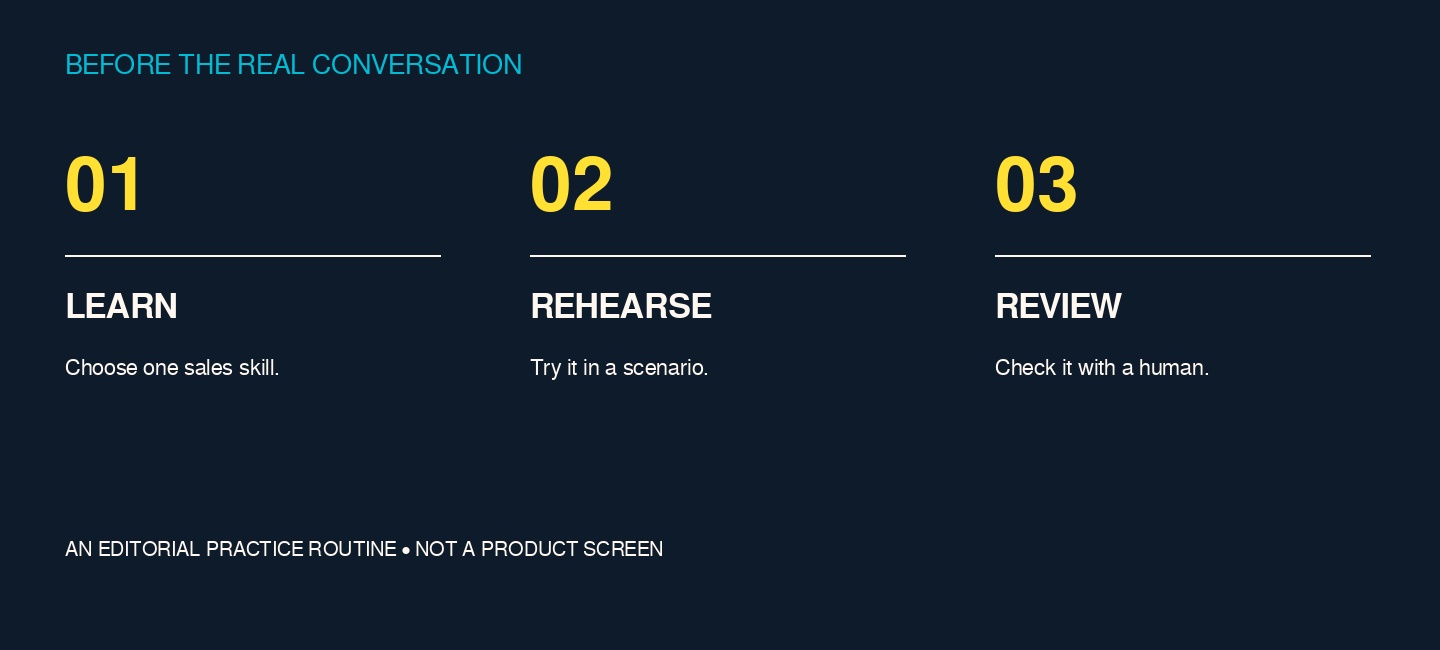
A reader can copy the underlying practice idea without copying anyone’s software stack. Start with a single recurring objection. Write down what a useful response must accomplish. Rehearse it. Then have a knowledgeable person review the answer against those requirements. This is a suggested evaluation routine, not a description of Vender’s internal training methodology.
For the pricing example, the goal might be to discover what the buyer is comparing, clarify the consequence of the problem, and avoid promising an unauthorized discount. That produces something concrete to listen for. The manager can then ask whether the next real conversation contains those behaviors. Completion alone is a weak substitute for that observation.
The conditions matter. A generic exercise may be a poor fit for a specialized product or a regulated conversation. If the practice rewards a polished answer that misstates the product, repeating it could make the problem worse. A manager should check scenarios against actual product knowledge and approved claims. Sensitive customer details also deserve a deliberate data-handling decision before they enter a training chat.
Vender’s promise is appealing at this modest scale: a place to work on selling before a live buyer supplies the feedback. Its lesson for the reader is equally practical. Pick the conversation that keeps going wrong. Make time to rehearse it. Listen for one improvement when the real person answers.