A medicine has two lives. There is the one we imagine: a molecule, a discovery, a patient getting better. Then there is its administrative life. Someone must record what happened in a trial, preserve the evidence, control the manufacturing instructions, and approve what a sales representative can say. The second life is less photogenic. It is also where Veeva Systems found its business.
The useful bits / 30 seconds
- Cloud software for the work around medicines: trials, approvals, safety, quality, and customer engagement.
- A focused start in pharma CRM grew into connected applications, data, and consulting.
- The current wager: move CRM onto Vault and put AI inside regulated workflows.
01The industry was the feature
Founded in 2007, Veeva brought cloud software to pharmaceutical companies with unusually particular needs. Peter Gassner understood enterprise platforms from Salesforce and PeopleSoft. Co-founder Matt Wallach knew life sciences software from Siebel. They started with customer relationship management, or CRM, for pharmaceutical teams.
The distinction mattered. A pharmaceutical representative needs more than an address book. Customer records sit alongside rules about samples, approved content, and interactions with healthcare professionals. Veeva made those requirements part of the product. Its expertise combined cloud engineering with the vocabulary and processes of a regulated industry.
The first obstacle was trust. Wallach later recalled that legal, compliance, and IT teams worried about security and validation in the cloud. Generic applications also lacked the required industry detail. Veeva had to make a new delivery model feel dependable while giving customers a practical reason to leave familiar systems.
02Seven million dollars. Three million used.
Gassner has said Veeva raised $7 million in private capital and used $3 million of it. That is capital consumed, not the total cost of building the company. Customer revenue could finance work too.
Building on Salesforce helped Veeva reach early customers sooner. The 2008 financial crisis encouraged caution, and the founders aimed for profitability rather than assuming another round would arrive. Gassner described pressure to invest more during the following years. He and Wallach preferred to keep the profitable business focused on customers.
The company went public in 2013. By fiscal 2026, ended January 31, its annual revenue had reached $3.195 billion. Subscriptions contributed $2.684 billion; professional services and other revenue supplied $511 million. Recurring software revenue pays for the continuing product. Services help customers put it to work.
$3.195billion
Annual revenue. About 84% came from subscriptions.
$2.684BServices + other
$0.511B
“a profitable business could be built relatively quickly.”
Peter Gassner, reflecting on Veeva’s early mindset, 2016
03A document is rarely just a document
Veeva introduced Vault in 2011 as a regulated content management system. PromoMats, released that October, shows the logic neatly: connect a promotional claim to its supporting references, route the material through medical, legal, and regulatory review, distribute the approved version, then withdraw it when appropriate. A file has a history and a set of permissions.
That logic now extends across clinical operations, regulatory affairs, safety, quality, medical affairs, and commercial work. An electronic trial master file preserves essential trial documents. CTMS tracks trial operations. EDC captures clinical data. Regulatory information management organizes registrations and submissions. QualityDocs controls regulated documents, while QMS manages quality processes.
The buyer might be an emerging biotech, a global pharmaceutical company, or a contract research organization. Veeva reports more than 1,500 customers. In one published customer example, Merck estimated a 30% reduction in time spent finding, importing, and processing documents with eTMF. That is a customer estimate, not a promise for every deployment.
For a customer, the purchase is also an organizational project. A team has to decide which records move, who may change them, how old systems connect, and what users need to learn. The subscription buys access to software. A successful rollout also requires decisions about how people will work together once that software arrives.
Commercial applications add approved communications, content, reference data, and analytics. Service partners including Accenture support implementation. Veeva organizes the operational work around medicines; scientific results and regulatory decisions belong to others.
02 / Follow the record
04Eventually, Veeva changed the foundation
In December 2022, Veeva announced that CRM would move from Salesforce’s platform to its own Vault platform. Management’s explanation was straightforward: owning both the application and its foundation would improve the customer experience and give commercial and development applications a common platform. The earlier partnership had helped Veeva start. Its ambitions had grown.
Veeva wanted more control. Its filings acknowledge the price: migrations take time and money, can disrupt customers, and create openings for competitors. A trusted system becomes harder to replace precisely because people depend on it.
Salesforce now offers its own Life Sciences Cloud. Medidata’s Rave competes in electronic data capture. Other alternatives vary by department. Veeva’s case is the breadth of its industry applications and their connections. Buyers still have to weigh integration benefits against migration effort, existing contracts, and dependence on one supplier.

Borrowed platform. Enduring industry focus.
05A different set of company instructions
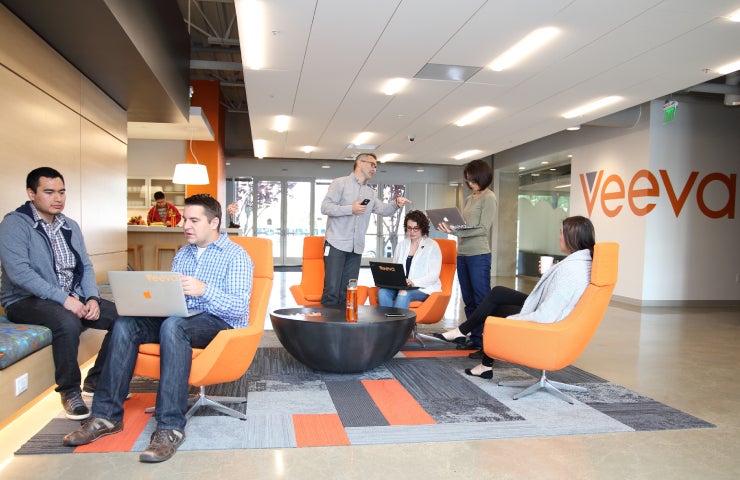
In February 2021, Veeva converted to a public benefit corporation after approval from 99% of voting shareholders. It remained a for-profit company, with a charter requiring stakeholder interests and its public benefit purpose to be considered alongside shareholder interests. Productivity in the industries it serves and high-quality employment became part of that purpose.
The employment policy has a revealing detail. Work Anywhere allows employees to choose home or office on a given day, but keeps predictable core working hours. Product teams operate around regional hubs. Flexibility comes with coordination. The four stated values are doing the right thing, customer success, employee success, and speed.
06The rival becomes a customer
On October 13, 2026, IQVIA selected Veeva’s CTMS, eTMF, Study Startup, and Site Connect as enterprise standards for its clinical development studies, expanding an existing EDC partnership. IQVIA competes with Veeva in parts of life sciences technology and data. Here, it chose to use Veeva. Industry relationships do not fit tidy scoreboards.
AI is the next test. Veeva is embedding agents in its applications and building Falcon for work across clinical, regulatory, and safety processes. The useful question is specific: which task improves, with what human checks? The same demand for evidence that shaped the original business will shape adoption of its new tools.
Other builders can copy the sequence: choose a costly, recurring workflow; learn its awkward details; borrow infrastructure to reach customers. This needs shared requirements and buyers willing to pay for specialized software. Veeva found both between a promising medicine and a dependable record.
Keep following the work
Explore the products and the founder’s decisions.