She found a protein shape on a computer that the body keeps hidden until it gets sick. Now she is selling the blood test that catches it.
For most of a career, Valerie Daggett watched proteins come apart. Not in a wet lab, but on screens - millions of frames of atoms unfolding, simulated on supercomputers borrowed from the Department of Energy. Somewhere in that flood of data, her group spotted a fold that should not have been there. They called it the alpha-sheet. It does not show up in healthy proteins. It shows up when things go wrong.
That observation is the seed of everything she does now. As founder and CEO of AltPep, the Seattle biotech that spun out of her University of Washington lab, Daggett is turning a quirk of computational biophysics into a commercial platform - one aimed at the toxic protein clumps behind Alzheimer's, Parkinson's, type 2 diabetes, and more than fifty other amyloid diseases.
The bet is contrarian. Most of the field has spent decades chasing plaques after they form and symptoms after they appear. Daggett's argument is that the damage is done earlier, by small soluble oligomers carrying that strange alpha-sheet signature, and that if you can see them in a drop of blood years ahead of time, you change the entire game from treatment to prevention.
Her team designed a synthetic alpha-sheet peptide that behaves like molecular flypaper: it grabs the toxic oligomers floating in cerebrospinal fluid or blood, then standard methods confirm what stuck. The assay is called SOBA - Soluble Oligomer Binding Assay. The Alzheimer's version, SOBA-AD, earned FDA Breakthrough Device Designation and flagged trouble in people who were still cognitively unimpaired but later declined.
What makes her unusual is the order of operations. The alpha-sheet was predicted in simulation first, then confirmed at the bench - computation leading biology rather than chasing it. In a discipline that often treats models as decoration, she treated hers as the hypothesis worth betting a company on.
The detail worth sitting with: alpha-sheets bind to alpha-sheets. Two of these unusual structures recognize each other. That single property is the whole hinge. If a disease-born oligomer carries an alpha-sheet, then a lab-built alpha-sheet can find it, hold it, and report it. A quirk of geometry becomes a diagnostic, and potentially a therapeutic, because the same handle that lets you detect the toxic clump might let you neutralize it. Daggett's group has reported inhibitory compounds that worked across the disease systems they explored.
It is a long way from where she started. Daggett took a B.A. from Reed College in 1983, then a PhD in pharmaceutical chemistry at UC San Francisco, advised by two giants of computational chemistry, Irwin Kuntz and Peter Kollman. Her postdoc put her in Michael Levitt's lab at Stanford. Levitt would go on to share the 2013 Nobel Prize in Chemistry for developing the multiscale models that made it possible to simulate complex chemical systems - precisely the toolkit Daggett spent the next thirty years pushing to its limits.
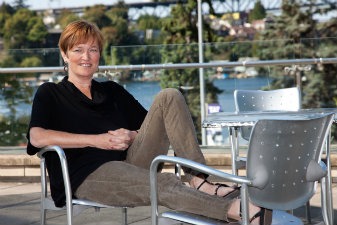
"We are finding that many human diseases are associated with the accumulation of toxic oligomers that form these alpha sheet structures."Valerie Daggett, on what SOBA actually sees
Healthy proteins fold into familiar shapes. When amyloid proteins misfold, the small clumps they form carry the alpha-sheet - a conformation Daggett's lab predicted before anyone found it. The trick: alpha-sheets stick to alpha-sheets.
Amyloid proteins begin clumping into small soluble oligomers, not yet visible plaques.
Those oligomers adopt the rare alpha-sheet shape, largely absent from healthy proteins.
A synthetic alpha-sheet on the test surface binds the toxic oligomers from blood or CSF.
Standard methods verify the captured oligomers - signal years before symptoms.
Before AltPep, there was Dynameomics. Daggett set out to simulate the native-state dynamics and unfolding of representatives for essentially every known protein fold - and got to roughly 95% of them. The result is hundreds of terabytes of motion: the largest collection of protein simulations and structures in the world, with custom databases and mining tools built just to make sense of it.
It was not a vanity database. Watching that many proteins move is what surfaced the alpha-sheet in the first place. The company is, in a real sense, an application layer sitting on top of decades of simulation. Microsoft Research helped on the high-performance computing side; the Department of Energy fronted the processor-hours, including a 2005 award that was renewed in 2006 for nearly two million processor-hours.
The leap from database to company was not obvious. Spinning a startup out of a faculty lab means turning a research finding into something a regulator, an investor, and eventually a patient can trust. AltPep raised a Series B - reported around $52.9 million - on the way to well over $100 million committed against the program. Daggett went from principal investigator to chief executive, which is its own kind of unfolding: the same person who modeled how proteins lose their structure had to build a new one around herself.
She still teaches. Computational Protein Design and Biochemical and Molecular Bioengineering remain on her course list at UW, which means undergraduates are learning to design proteins from the same person trying to commercialize one. She holds the David and Nancy Auth Endowed Professorship in Bioengineering, with adjunct appointments spanning biochemistry, chemical engineering, and biomedical informatics - the kind of cross-listing that happens when your work refuses to sit in one department.
The recognition followed the output. She is a Fellow of the American Institute for Medical and Biological Engineering and the Biophysical Society, and in 2024 was elected to the Washington State Academy of Sciences. She holds the Lise Meitner Visiting Professorship at Lund University and serves as Senior Editor of Protein Engineering, Design and Selection, with editorial-board seats at Biochemistry, Structure, Current Opinion in Structural Biology, and eLife. The startup world noticed too: GeekWire named SOBA-AD its Health Innovation of the Year in 2023, the same year the NIH spotlighted the test among promising medical findings.
The center of gravity in Alzheimer's research has long been the plaque - the visible, late-stage deposit. Daggett's whole premise is that by the time you can see a plaque, you are watching the aftermath. The action is upstream, in the small soluble oligomers that carry the alpha-sheet, and those circulate quietly for years before memory falters.
That reframing is why the SOBA-AD data drew attention. In her group's reported work, the test caught toxic oligomers in samples from people in a control group who were still cognitively unimpaired - and who, records later showed, went on to develop mild impairment. People who stayed well lacked the signal. If that holds at scale, the value is not just a cleaner diagnosis. It is a window. A window means trials can enroll the right people earlier, and any disease-modifying treatment gets a shot at working before too much is lost.
And because the alpha-sheet is a shared signature across amyloid diseases rather than a single-protein trick, the same platform points toward Parkinson's, type 2 diabetes, and the long tail of more than fifty conditions in the family. One structure, many diseases, roughly a billion people in the aggregate. It is an audacious frame, and Daggett has spent three decades and hundreds of terabytes of simulation earning the right to make it.
The alpha-sheet barely exists in normal, healthy proteins. It is a structure largely born of disease - which is exactly what makes it a clean target.
She trained under Michael Levitt, who later shared the 2013 Nobel Prize in Chemistry for the kind of computational modeling she built her career on.
Dynameomics has been described as the largest collection of protein simulations and structures anywhere - hundreds of terabytes deep.
She runs a biotech and still teaches a course literally called Computational Protein Design.