Vaisagh Viswanathan was looking through a set of résumés. The prose was tidy. The verbs were strong. The careers had been arranged into satisfying little arcs. Then the interviews began, and the differences appeared somewhere the documents had failed to capture: in how people thought. One candidate questioned the problem itself. Another wanted to discuss execution. Someone changed their mind during the conversation. The applications had presented a pleasing uniformity. The people were considerably more interesting.
That episode, which he described publicly, gives a useful introduction to the CEO and co-founder of impress.ai. He builds recruitment technology, yet keeps returning to the information that a neat document leaves out. When AI helps everyone sound competent, he argues, the revealing material emerges in the exchange: what someone notices, what they pursue, what they reconsider. A polished résumé can open the conversation. It cannot contain the whole person.
Before candidates, crowds
Long before the hiring funnel, there were simulated crowds. At Nanyang Technological University in Singapore, Viswanathan’s doctoral work examined behaviour in agent-based simulations. His professional account describes a research life crossing machine learning, psychology and sociology, developing computational models and even modifying Minecraft. A game built from blocks became part of an inquiry into people. It is a pleasingly concrete detail in a career whose vocabulary could otherwise float away into abstractions.
He went on to work as a research fellow at TUMCREATE, studying transport systems and the effects of electromobility. His published work includes a 2015 paper on how real-time traffic information influences the transport system receiving it. The research used an agent-based model to examine what happens when drivers have access to information. Giving individuals more knowledge can change the behaviour of the whole network. The map participates in the traffic it describes.
A 2016 co-authored paper examined traffic-state estimation using floating-car data. These were specific research problems involving movement, observation and the relationship between individual actions and collective conditions. It would be too tidy to claim that a road network and a hiring process are interchangeable. Still, the resemblance is interesting: both contain many participants, partial views and decisions whose consequences extend beyond the person making them. Read together, his research and business work invite that comparison.
A product, then a company
His move into business began part-time. In 2013, he started working with Sudhanshu Ahuja and Amrith Dhananjayan on Ideatory. The enterprise changed direction several times, from research-and-development services to innovation platforms. A request to evaluate data scientists brought the team towards recruitment. The opportunity arose from an awkward mismatch: demand for technical specialists was growing, while recruiters did not necessarily know how to assess the field.
The first impress.ai product work followed in 2016, before the 2017 founding date used in later company biographies. Early experiments ran through existing chat platforms; a working chatbot and a basic recruiter dashboard arrived before the more developed enterprise product. DBS Bank became the first customer through the founders’ earlier business relationship. There is something instructive about that sequence. A new product still depended on trust accumulated while doing older work.
Viswanathan, usually called VT, left research to commit to the venture. In an early interview, he described himself as someone who preferred plans and did not think of himself as a natural risk-taker. He managed uncertainty with task lists. Entrepreneurship, in this telling, had room for a person who enjoyed crossing things off. The stereotype requires a founder to leap. His account allows the founder to make a list first.
The engineer leaves a paper trail
Look at his public code and the work becomes smaller, clearer and more tangible. CheckTypos, a project in his GitHub account, flags recurring mistakes in LaTeX documents. Its checks include repeated phrases, punctuation spacing and capitalisation. It marks the trouble so the writer can inspect it. A researcher writing technical documents has plenty of opportunities to appreciate such a tool. Even an ambitious career has commas to attend to.
Another repository accompanies a seminar on building a Django-based bot server with WebSocket connections. It offers sample code and instructions for getting a simple front end working. The README acknowledges the examples it borrows from. This is the unglamorous, useful side of a technical founder’s public record: something another developer can run, understand and adapt. It leaves fewer mysteries than a slide about innovation.
His Medium writing from early 2017 addressed chatbot intelligence, storytelling and server architecture. The topics belong together. Building a conversational interface means dealing with code, but also with what the conversation is supposed to accomplish. His public self-description lists programmer, scientist and geek. The articles and repositories give those words some substance. They show a person explaining the machinery while the business around it was taking shape.
“Be ruthless about prioritization.”
Vaisagh Viswanathan, 2018
The title changed. The coordination problem grew.
In January 2024, Ahuja announced that his full-time executive journey with impress.ai had concluded. He said he had handed leadership to Viswanathan about seven months earlier and would continue as a non-executive director. He praised his co-founder’s grasp of AI and hands-on leadership. The announcement was unusually explicit about the transition: Ahuja’s own needs had changed, and he supported the person taking the company forward.
The succession moved a founding technologist into responsibility for the whole enterprise. Today the company’s team page identifies Viswanathan as CEO and co-founder, alongside Dhananjayan as COO and co-founder. Such a change expands the number of conversations a leader must connect. Engineering decisions, client expectations and delivery commitments start arriving at the same desk. The product still has to work, while the organisation that produces it needs direction too.
An earlier team account makes the scale of that work visible. For one enterprise launch, the founders described roughly 140 roles, a project team of more than 40 people, training for hundreds of recruiters and hiring managers, several kinds of audits and extensive documentation. Those are company-reported details of a particular delivery, rather than a universal measure of performance. They reveal the distance between demonstrating a bot and putting software into a large organisation. The paperwork has a speaking part.
When the team questions the request
One of Viswanathan’s public anecdotes concerns a consultant joining for a short project. During onboarding, the consultant asked for access that was reasonable but unusual for a contractor. Questions reached Viswanathan and Dhananjayan from engineering, product and operations. People wanted to know whether the permissions were properly scoped and what the implications might be. Several parts of the company noticed the same ambiguity.
Viswanathan apologised for the friction. The consultant welcomed it, interpreting the questions as evidence that the system was functioning. In Viswanathan’s account, the episode changed how he thought about readiness for enterprise customers. Written policies and formal audits mattered, but so did the habit of asking questions when a situation fell between the rules. An onboarding delay became a small demonstration of organisational judgment.
The story is revealing because it resists the founder’s temptation to make himself the quickest person in the room. Here the useful behaviour was distributed across teams. People paused, compared the request with their responsibilities and raised a concern. For a business selling systems that help others evaluate evidence, that is an apt episode to remember. The organisation benefited from colleagues who did more than simply process the request.
Everyone needs the same map
In his writing about Savos, Viswanathan compares hiring with a cooperative multiplayer game. A recruiter may know the candidate’s journey. An interviewer knows a single conversation. A colleague arriving later sees only a few notes. Everyone has a view, but the views differ. A debrief can spend its time recovering the history that should have travelled with the candidate.
His proposed remedy is accumulated context. Each interaction should begin with useful knowledge from the last, rather than restart the inquiry. The analogy is appealing because it leaves room for different responsibilities. Players need not perform identical tasks to understand where they stand. Applied to interviews, that means distinguishing a real disagreement about a candidate from a disagreement caused by people having seen different evidence.
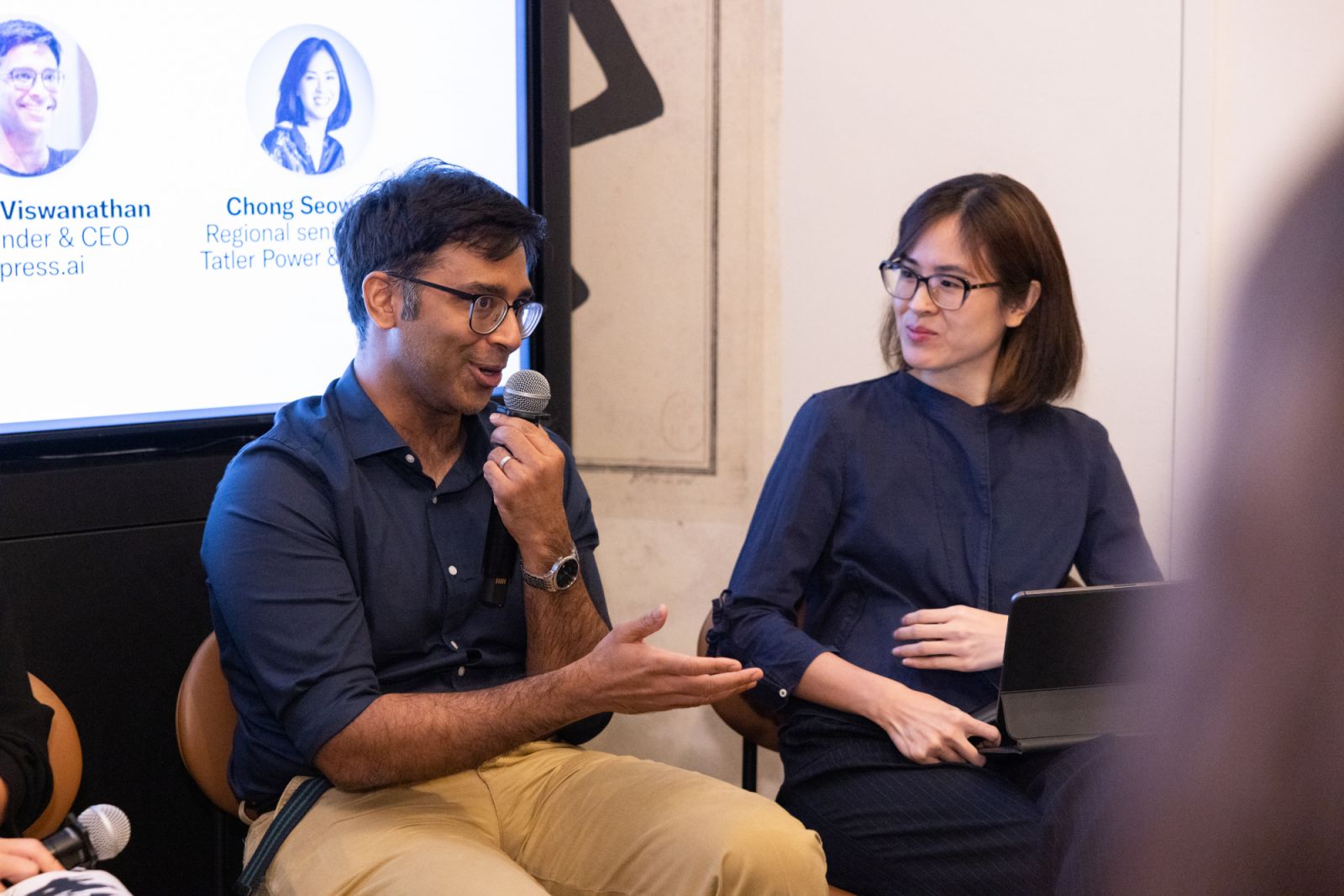
The idea also connects with his discussion with April Li of Trainocate Singapore. He described their conversation as moving from qualifications towards capabilities, with AI adding precision to the information available for human conversations and decisions. At the AI Student Developer Conference in May 2024, he moderated a recruitment panel involving representatives from defence, government technology and AWS. His work puts him among both the people seeking technical jobs and those deciding what competence looks like.
Eight minutes, and a human decision
In an April 2026 podcast appearance, Viswanathan described a recruitment platform spanning job descriptions, résumé screening, AI conversations and summaries for hiring managers. Candidates, he said, are told when they are talking to AI. The discussion reported a reduction in time spent per applicant from 40 minutes to eight. That is his account of an efficiency gain, not a promise that every hiring team will obtain the same result.
A reported workflow result, not a forecast for every employer.
He kept people at the decision points: defining whom to hire, determining what happens in the interview and making the final call. The distinction matters to his stated ambition of using AI for fairer workplaces. Faster information handling can give a team more room to consider evidence. What the team does with that room remains a human responsibility.
Across his public work, a consistent concern emerges: whether the information reaching a person is adequate for the decision expected of them. A driver, an interviewer, a colleague approving access, a manager reading a candidate summary - each sees a portion of a larger situation. Viswanathan’s career has changed settings, titles and tools. The interview’s missing memory gives his current work a concrete task. Keep what was learned. Let the next person ask a better question.