Founder / CEO / Polymath
Moe Nada
He spent twenty years inside enterprise software, then decided the most useful thing he could do was hand the resume pile to a machine.
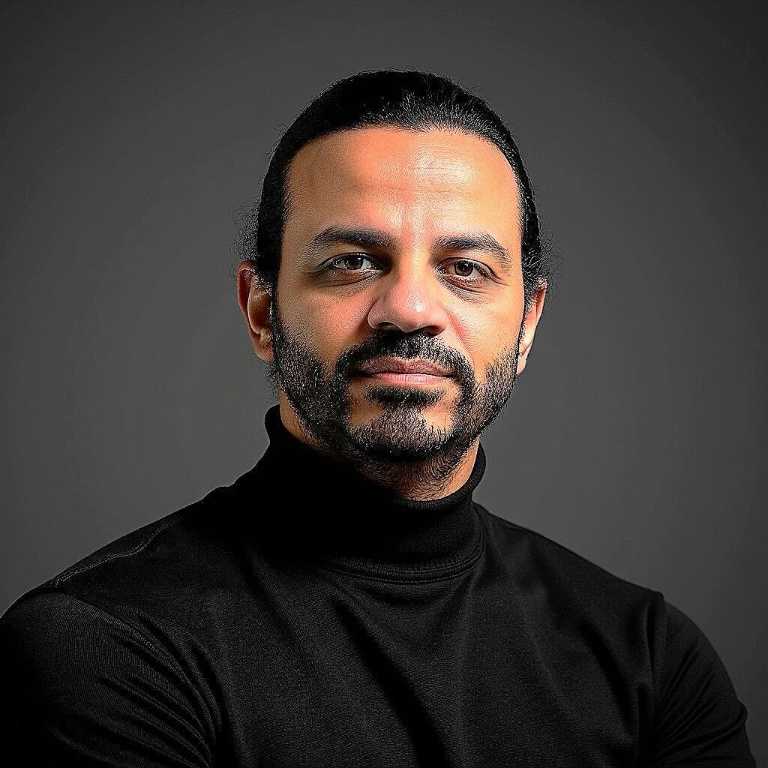
Moe Nada // built for the top of the funnel
He spent twenty years inside enterprise software, then decided the most useful thing he could do was hand the resume pile to a machine.
Most founders pitch you on what their software adds. Moe Nada starts with what it removes. The first task he automated out of existence was the one he had done a thousand times by hand: reading resumes, one after another, looking for a reason to say no. He calls the moment he stopped doing it the day he decided to fire himself from resume screening and hand the keys to an AI agent.
That is the founding logic of SupportFinity, the San Francisco company he leads as CEO and cofounder. It is an AI-native recruitment automation platform, built to collapse the fragmented stack of applicant tracking, sourcing and assessment tools into one system that runs the hiring lifecycle end to end. Job descriptions written by AI. Global sourcing across more than 2.1 billion candidate profiles. Screening, assessments, interviews, salary intelligence and analytics, all handled by a family of proprietary agents.
The promise is blunt: cut time-to-hire and cost by as much as 90 percent, and improve the quality of who actually gets hired. The thesis underneath it is quieter, and it sounds like someone who has sat through too many bad pipelines. Get the top of the funnel right, he says, and everything downstream gets easier. Fewer interviews. Faster decisions. Better hires.
It helps to know what he is reacting against. For most companies, hiring is not one decision but a relay race between systems that were never designed to talk to each other. The job posting lives in one tool. The candidates arrive through another. A screening spreadsheet appears, then an assessment vendor, then a scheduling link, then an applicant tracking system that everyone curses and nobody replaces. Each handoff loses information. Each loses time. Nada's wager is that the lost time is not a recruiting problem at all - it is a software architecture problem, and software architecture is something he has spent twenty years fixing.
If the top of funnel is right, everything else gets easier: fewer interviews, faster decisions, better hires.- Moe Nada, on the logic behind SupportFinity
There is a version of the startup story where the founder leaps from a dorm room to a valuation. This is not that. Nada's resume reads like a deliberate tour of every floor in the enterprise software building. He started in software development as a technical engineer. Then product design. Then implementation, the unglamorous work of making the thing actually run inside a customer's company. Then support. Then customer success, where you learn what people complain about after they have already paid.
The companies are names you know. HP, where he managed enterprise services and customer success. Hewlett Packard Enterprise, leading client solutions and success. OpenText, managing enterprise product services. IBM somewhere along the way. Two decades of watching how large organizations buy, deploy and outgrow software, before he ever sat in the founder's chair.
It is an unusual apprenticeship for someone now building AI agents. Most recruitment-tech founders come from recruiting, or from machine learning. Nada came from the side of the table where you have to keep the customer happy after the demo is over. That tends to make a person allergic to features that look good in a pitch and break in production.
Recruiting software has a habit of multiplying. A tool to write the job post. Another to source candidates. A third to screen them. A fourth to assess. A fifth to schedule. Each with its own login, its own data, its own opinions. SupportFinity's argument is that the seams between those tools are where good candidates fall through. So it stitches them shut.
The platform sources globally across more than 2.1 billion profiles, then lets AI narrow the field instead of a human scrolling for hours.
A family of proprietary AI agents runs the lifecycle: job descriptions, screening, assessments, interviews, salary intelligence and analytics.
The pitch is a sharp cut in time-to-hire and cost, with better-quality hires as the point, not a side effect.
Built to retire the fragmented ATS, sourcing and assessment tools that recruiters juggle, and put them under one roof.
Recognized by G2 and Gartner among top recruitment platforms in 2024, with work referenced by Forrester Research and TSIA.
Selected for UC Berkeley's SkyDeck Pad-13 accelerator for the 2024-2025 cohort, plugging the company into the Bay Area startup grid.
He calls himself a polymath, and the disciplines he has actually shipped in back it up. An informal read of where the two decades went:
Illustrative emphasis based on his stated career arc, not a precise measure.
Spend time with how Nada talks about his own product and a pattern shows up. He frames automation as subtraction, not magic. The interesting move is not that an AI can read a resume. It is that a founder decided his own hours were better spent elsewhere and was willing to say so out loud, in public, on LinkedIn.
It is a customer-success instinct wearing a founder's hat. The people who survive in success roles learn to ask a simple question relentlessly: what is the customer actually trying to get done, and what is standing in the way? Point that question at recruiting and you do not end up admiring resumes. You end up wanting to delete the part where someone has to read them.
The conversation that made me fire myself from resume screening and hand the keys over to an AI agent.- Moe Nada, on the origin of SupportFinity
The aspiration is not subtle and it is not small: retire the patchwork of recruiting tools and replace it with one AI-native system that does the grunt work, so the humans can spend their attention on the part that needs a human - judgment. If he is right, the recruiter of the near future does less searching and more deciding. If he is wrong, he will have built the most thorough resume-reading robot in San Francisco. Either way, he has already done the part most people skip: he stopped pretending the old way was working.
A small company that wants to replace the recruiting stack has to name the giants it intends to replace, and SupportFinity does not flinch from it. Its own writing lines the platform up directly against the heavyweights of enterprise hiring software - the systems that own the category by default rather than by love. The framing is consistent: legacy suites were built for a pre-AI world, bolted AI on as a feature, and still make a recruiter click through a dozen screens to do one job.
Positioned as the AI-native challenger to one of the most entrenched enterprise hiring suites in the market.
Pitched as outpacing legacy human-capital-management systems that treat recruiting as one module among many.
Framed as redefining hiring beyond the traditional applicant tracking system rather than competing inside its rules.
It is an audacious lineup for a company of its size, and that is rather the point. Nada is not trying to add a nicer feature to an existing category. He is arguing the category itself is built on the wrong foundation - a foundation of stitched-together tools and human hours spent on work a machine should own. Whether the market agrees is the open question of his career. The analysts have at least started to listen: recognition from G2 and Gartner in 2024, references in the research of Forrester and TSIA, and a seat in UC Berkeley's SkyDeck accelerator, the kind of credential that opens doors in a city where everyone is pitching something.
There are easier places to start an AI company, and there are none more obvious. SupportFinity is headquartered in San Francisco, the same square miles where the large language models that make its agents possible were trained and shipped. The timing is not lost on anyone. A recruitment platform built on AI agents would have read as science fiction a few years ago. Today it reads as a race.
Nada's standing in that race got a public marker in 2025, when CEORankings placed him at #2 among CEOs of the year in San Francisco, #7 in California, and #14 in the United States. Rankings like these are imperfect, and any honest founder knows it. But they are also a signal that a once-quiet enterprise operator has become a name people type into a leaderboard - a long way from screening resumes one PDF at a time.
#2 CEO of the Year - San Francisco
#7 CEO of the Year - California
#14 CEO of the Year - United States
#190 CEO of the Year - Global
Source: CEORankings, 2025