The meal plan is a useful place to begin. Manzana Verde, a food business in UTEC Ventures’ orbit, changed its monetization to monthly plans after working with the accelerator’s mentors. A founder might arrive hoping for an investor introduction and leave reconsidering how lunch gets sold. That is a more revealing advertisement for acceleration than another photograph of people holding oversized checks.
UTEC Ventures occupies that space between having a business idea and knowing how to build a company around it. Based within Peru’s Universidad de Ingeniería y Tecnología, it combines early investment with incubation, corporate innovation, and programs for social entrepreneurs. Its clientele runs from students with unfinished ideas to established companies trying to make something new happen inside an existing organization.
The proposition is practical: money helps, but so does someone who can challenge the product, understand the customer, or introduce a useful engineer. For a first-time founder, those needs tend to arrive together. UTEC has built several ways to address them without assuming that every entrepreneur starts at the same point.
A university puts money on the table
The institution launched UTEC Ventures in 2014, presenting it as an accelerator for businesses whose engineering or technology was central to their prospects. The original announcement advertised investment of up to $32,000 per project. Gonzalo Villarán was identified as its director in university coverage that year. This was an institutional initiative with money attached, a meaningful distinction from an entrepreneurship lecture series.
Public support arrived early. In August 2014, UTEC reported that the accelerator had secured 680,000 soles through Startup Perú to strengthen its capabilities and provide technical assistance and mentoring. That money supported the organization’s work; it was separate from the financing available to individual startups. The distinction matters when reading the financial history of a university accelerator.
Its place in Peru’s market remains unusually specific. A founder can approach a university incubator, an angel investor, or a corporate venture operation. UTEC combines parts of those offers. PECAP lists it among its members, while its university affiliation supplies an institutional base. The attraction depends on whether a founder needs the particular people and facilities that base can provide.
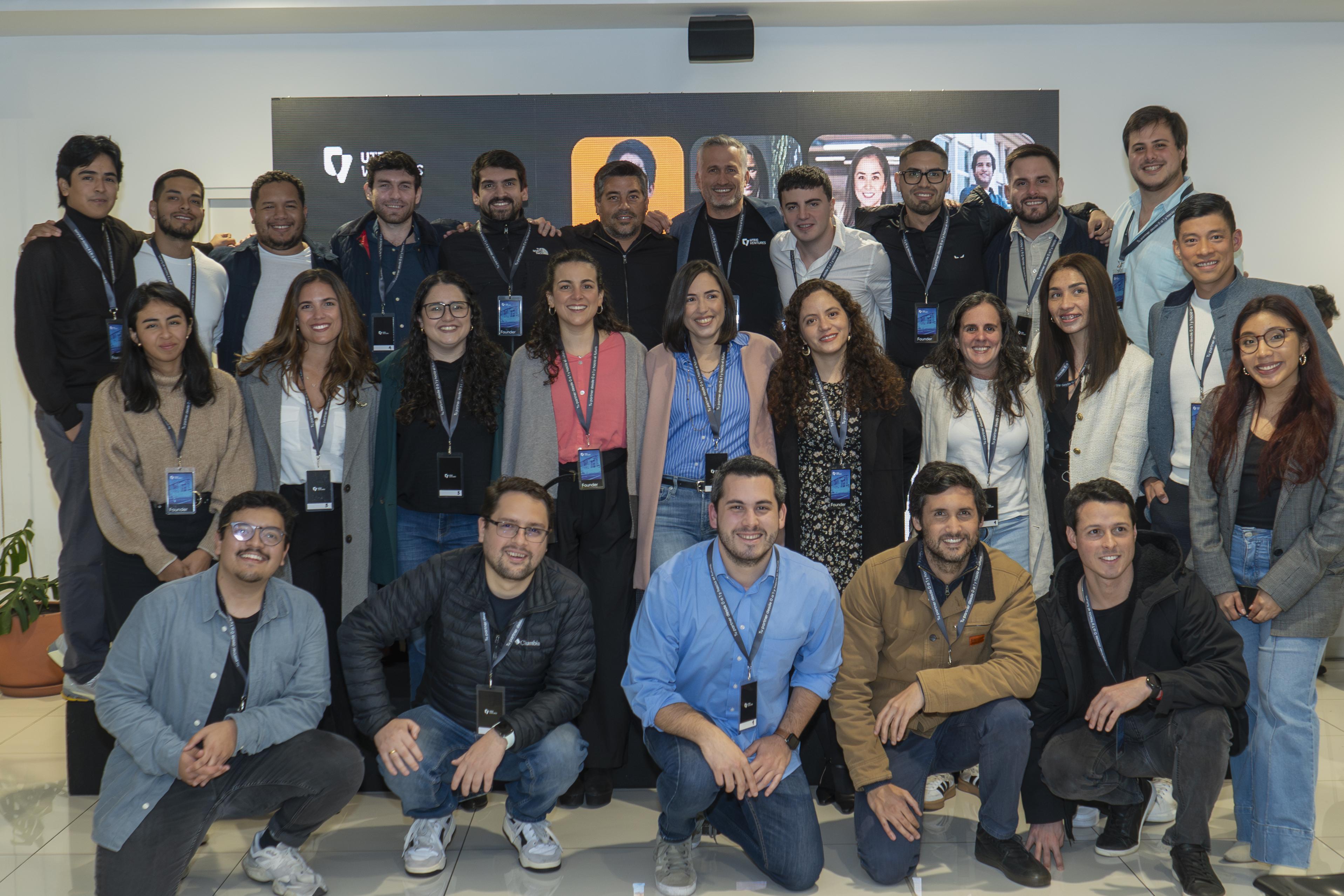
The check has changed. Read the date.
There is no single timeless answer to how much UTEC Ventures invests. Its January 2024 call described a selection process that would narrow applicants to 25 startups for four weeks of due diligence, then select ten for three months of acceleration. The published investment was $25,000 for 2.5 percent of the company, alongside a $30,000 equity-free award for each selected startup.
By February 2026, the advertised offer was $40,000 in cash and services, directed at founders in the Andean region. That phrase deserves to survive the headline: services have value, but they do not pay a supplier’s invoice. Comparing the package with an earlier cash investment requires attention to what is actually included.
Plus a published $30,000 equity-free award.
February call. A different package, not a like-for-like cash comparison.
For founders weighing an application, the useful exercise is to separate the cash, the ownership exchanged, and the services they will use. Then add the time commitment. A mentoring session has an opportunity cost even when nobody sends an invoice. The right offer is the one that advances the company’s next concrete task.
Twelve weeks, with engineers nearby
The current accelerator describes a 12-week program backed by mentors, investment contacts, and UTEC resources: computer science and engineering talent, laboratories, workspaces, researchers, and corporate relationships. This is the university connection made tangible. Access to a person who can help validate a technical claim can matter as much as access to another slide-deck review.
Its investment thesis now names two broad areas: industrial systems and technologies that improve people’s or businesses’ productivity. The former includes construction, energy, natural resources, manufacturing, and applied bioengineering. The latter reaches finance, health, education, and enterprise software. That gives technically ambitious founders a way to judge fit beyond the loose label of “tech startup.”
The portfolio is similarly varied. Coderhouse, Hapi, Udocz, Talently, and Fitia appear among the accelerator’s alumni. Those names span learning, investing, hiring, and nutrition. A logo on this list records a relationship; it does not establish that every company received identical terms or followed the same route. Founders should look for relevant experience within the portfolio, rather than simply count the logos.
The decision after the advice
Manzana Verde offers a concrete example. In IFC’s 2023 Scaling Equity report, co-founder Larissa Arias credited access to women in the ecosystem and mentoring with the move to monthly plans. The report recorded $35,000 of early funding from UTEC Ventures. At Talently, it recorded a $50,000 first investment and described founder Domenica Obando’s work on pitching.
“Thanks to this, we changed our monetization model to monthly plans”
Larissa Arias, Manzana Verde · IFC, 2023
The lesson to copy is a method of questioning. Ask which part of the business needs changing before assuming it needs more promotion. Is the customer buying once when the need recurs? Is the pitch burying the reason someone should care? A useful adviser makes a decision clearer. A subscription, however, only makes sense when customers have a recurring need and the company can deliver reliably.
That is also how to interpret a founder success story without making it do too much work. A reported change is evidence of an intervention. It cannot, on its own, tell us how the business would have performed without the program. For an applicant, the more productive question is whether the same kind of intervention would address their own bottleneck.
Different doors for different founders
Femlab makes the entry conditions explicit. It is a nine-week program for women on the founding team of an early startup, restricted to Peruvian nationals or residents of Peru. Participants commit ten hours a week. The curriculum covers pitching, leadership, product development, and startup finance. That is enough detail to judge both the relevance and the diary implications.
Students have a separate route. Future Founders offers short bootcamps; Pre-incUVa concentrates on defining the problem, user, and opportunity; IncUVa supports launch and growth. The longer student program requires at least one UTEC student or graduate founder and someone capable of building the product. The university publishes it as free, with full-time dedication during its 12 weeks.
The student pathway. Femlab and the investment accelerator have separate eligibility and selection.
The segmentation is sensible. Someone who is still identifying a user needs different help from a team negotiating its first investment. Making them sit through the same program would confuse activity with progress. Applicants can copy the underlying discipline: name the uncertainty first, then choose the program designed to reduce it.
Concrete, cables, and a chatbot
UTEC’s corporate work brings another customer into view: the established business. Its services cover internal entrepreneurship, open innovation, and venture creation. It names Cálidda, Indeco, and HERMES among its corporate examples. Here, the starting point is often an organizational problem or a proposed business model, with employees working toward a solution they can test.
The Prototyping Lab makes this less abstract. It lists Mixbot, a chatbot answering concrete-company queries, and Plania, an application for planning and selecting provisional sanitation solutions. Its methods move from examining a business challenge to designing a prototype and testing at small scale. A 16-week internal entrepreneurship format sits alongside programs tailored to particular sectors.
There is a useful commercial logic here. Startup equity gives UTEC exposure to a young company’s future, while corporate services and partner programs address immediate organizational needs. These are distinct relationships. For a corporate buyer, the appropriate measure is whether a prototype improves a process or helps validate a business opportunity. A lively workshop is a beginning, not the deliverable.
Impact gets its own investment homework
The social entrepreneurship programs broaden the audience further. Fondo Emprendedor is a Fundación Wiese initiative supporting social businesses. Acelera Ruralia works with organizations addressing rural education. Generación Impacto, developed with Anglo American Foundation, focuses on strengthening incubators and accelerators. These programs serve different institutions and stages; they should not be read as a single investment fund.
In February 2026, UTEC Ventures announced another route with Anglo American: Impact Finance Network Peru. The program prepares growth-stage impact businesses for investment through work on business models, unit economics, impact measurement, and investor matching. Its subject is the preparation that makes a capital conversation possible. The existence of an introduction is not the same thing as a completed financing.
Before the wine, rehearse
The 2024 Demo Day recap provides a welcome glimpse of actual accelerator life. Nine startups completed three months of work before presenting through in-person and virtual events. Preparation included founder feedback and sessions on fundraising, storytelling, and post-investment finance. Then came networking with a wine tasting. Even an investor introduction benefits from a less formal setting.
UTEC’s published culture values reinforce the working part of that picture: constructive criticism, teamwork, and giving first. Its explanation of doing one’s best emphasizes the quality of a contribution rather than the number of hours worked. That is a useful standard for a founder to apply to the accelerator itself. The question is what the relationship helps the business do.
For someone considering UTEC Ventures, the next step is straightforward: identify the relevant program, read its current conditions, and arrive with a specific problem. Bring the prototype that needs testing, the customer assumption that needs challenging, or the business model that still feels awkward. The first check can start the relationship. What changes afterward is the story worth following.