On March 5, 2004, three founders gathered around a laptop in an Austin pub that had become their office. A household move had found a transporter through their new website. The shipping price was $900. The company’s share was $71. For Matt Chasen, Jay Manickam, and Mickey Millsap, the important number was one: a stranger had agreed to pay another stranger to move something, and uShip had made the introduction.
- Compare carriers for furniture, vehicles, boats, equipment, and freight.
- Spare capacity can lower a quote when your route and timing fit.
- Read the handling terms and carrier history before booking.
There is something pleasingly unglamorous about this beginning. No one needed a new truck. Someone needed a better way to find the truck already available. uShip’s proposition was to make that search visible, competitive, and worth doing. The complication was that a marketplace needs considerably more than a good proposition.
The price was the first problem
The original system asked shipping customers to name an offer price and carriers to post a trip. In theory, unused capacity and waiting cargo would find each other. In practice, there were too few shipments for those particulars to coincide. A truck going somewhere is not necessarily a truck going where your dresser needs to go, on a day that suits you, for the amount you have imagined.
Chasen’s tenth-anniversary account describes the response: carriers were allowed to quote their own prices. The bidding format followed. The founders had loosened a rule that asked inexperienced customers to perform a professional pricing task. In a 2014 FreightWaves interview, Chasen put the larger lesson plainly: “If you have the freight, the service providers will come.”
“If you have the freight, the service providers will come.”Matt Chasen / 2014
Demand came first. Attract shipments, and a carrier has a reason to look. Attract only carriers, and you have assembled an audience waiting for a show. That distinction helps explain why uShip’s story travels beyond trucking: it concerns which side of a transaction has the power to make the other side appear.
The second purchase hiding inside the first
Consider buying a used armoire online. The purchase is wonderfully modern until the seller says collection only. Suddenly you must arrange labor, wrapping, a suitable vehicle, and two people’s calendars. A parcel label cannot rescue you. The bargain now has a second price, and sometimes that price ruins the first.
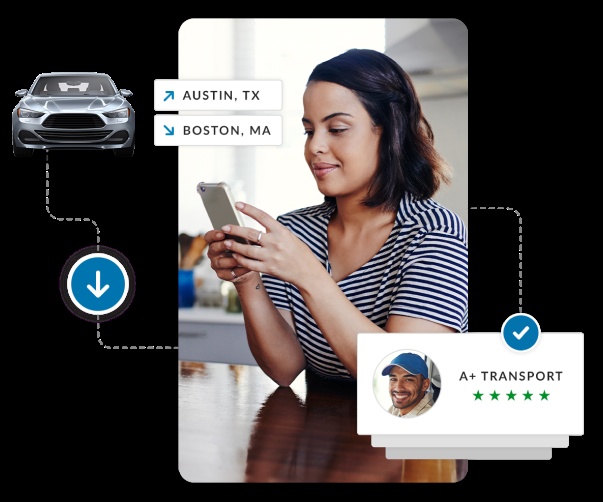
uShip gives this second transaction a place to happen. Consumers and businesses describe the item and route, receive shipping options, inspect carrier profiles and feedback, and book. Its categories include cars, motorcycles, furniture, boats, heavy equipment, and freight. An online seller gains a possible delivery method; an independent transporter gains a possible customer.
The business extends beyond one-off bids. In-Home Delivery serves retailers shipping bulky goods to homes. LTL, or less-than-truckload, tools let businesses compare bookable freight rates. Partner APIs offer shipping-price data and quote automation. These are related jobs with different needs: a sofa seller wants a delivery experience, while a freight shipper wants a usable rate and the right service details.
Compared with hiring a mover directly, the attraction is choice in one place. Compared with a carrier load board, the platform also caters to people who rarely ship anything larger than a box. That is its particular position in logistics: an interface between everyday buyers, commercial shippers, and transportation specialists.
Someone has to pay for the empty miles
Unused space can make a shipment attractive because the carrier is already traveling the route. It does not make every shipment cheap. Distance, dimensions, fuel, season, deadlines, and remote locations still affect prices. A flexible pickup can fit an existing journey; an urgent detour may demand a quite different calculation.
Listing is free on the current marketplace. Booking includes a separate customer service charge that varies by commodity. Carriers also pay applicable transaction fees. Optional protection has its own price. The $71 from that first $900 move neatly illustrates the distinction: the value of transportation passing through a marketplace is different from the money the marketplace earns.
uShip also developed enterprise freight software. In 2016, DB Schenker agreed to a five-year technology partnership; in February 2017, it led a $25 million Series D. Drive4Schenker launched in Germany using uShip PRO. Earlier, an $18 million Series C supported commercial freight, mobile development, and international expansion. Those investments bought development capacity, rather than a promise that every consumer shipment would become effortless.
A reputation cannot drive the truck
The stranger problem persists after a match. uShip supplies reviews, profiles, payment tools, and support. Its June 2026 safety account describes credential checks and monitoring. Customers still need to examine the actual provider, handling agreement, and coverage. Tracking depends on carrier participation; a marketplace profile cannot guarantee a continuous view of a truck.
Documentation is one practical answer. Electronic bills of lading capture photos, notes, and sign-off for eligible shipments. The less romantic answer is accuracy: LTL shipments can incur additional charges for wrong dimensions, residential access, liftgates, or redelivery. A low quote based on the wrong job description is a poor bargain.
The useful lesson fits in a loading bay
In May 2026, uShip added an optional mobile shipment-search experience with lane filters, saved searches, viewed indicators, and dollars-per-mile pricing. The company identified repeated searching and opening unsuitable listings as sources of friction. Carriers can try the update and switch back. Even after two decades, the matching problem needs small repairs.
The company’s human continuity has a similarly concrete example: Heather Hoover-Salomon joined as an intern in 2005 and was appointed CEO in 2023. That announcement also said uShip exited 2022 profitable. Familiarity with the business had become a qualification for leading it.
For sellers, the copyable habit is to investigate delivery before promising a distant buyer anything. For customers, it is to compare the service as carefully as the price. For marketplace builders, it is to remove the rule that prevents a willing transaction. The approach works best when routes, equipment, and schedules overlap. Without that overlap, spare space remains merely space, however elegant the website.