The useful number in UFCU’s origin story is $855. That was the sum deposited by its first 30 members when it opened on May 6, 1936. Eight days later came the organizational certificate. Before there was much of an institution, there was a group willing to put money into one. Ninety years on, that small act of collective confidence has become a considerably larger enterprise.
- A university-rooted cooperative now serves more than 438,000 member-owners.
- Its practical tools pair everyday banking with routes toward better financial health.
- A proposed MSUFCU combination would bring the two institutions to $13.5 billion in combined assets.
By September 30, 2026, University Federal Credit Union reported $4.235 billion in assets. Then, on October 13, it announced a planned combination with Michigan’s MSU Federal Credit Union. The resulting organization would serve more than 850,000 members. For an institution built around belonging, the question becomes interesting: what happens when the circle gets that big?
A campus is a place to keep showing up
UFCU’s history contains a pleasing collection of addresses: university halls, a carriage house, a bookstore. In 1979 it expanded membership to UT graduate students. Checking arrived in 1980; its first ATM followed in 1981. These were changes in how members could use the cooperative, alongside changes in who could join it.
The education connection remains useful because a campus gathers people with recurring financial needs. A student needs somewhere for wages to land. An employee may need a car. A family may eventually need a mortgage. UFCU can serve all three, with checking and savings, auto loans, credit cards, home loans and investment services. Businesses can use deposit accounts, equipment loans and working capital products.
In September 2026, UFCU announced its first Temple location, inside Temple College’s Student Union. Existing relationships include UT Austin, Texas State, Austin Community College, UTHealth Houston and UTMB. The location suggests a straightforward distribution idea: put useful services where a community already spends time.
“Our roots are in higher education”Michael Crowl, CEO and President
Temple College branch announcement, September 2026
Membership reaches beyond students. The online application includes a free route through the American Consumer Council. Digital access and shared banking networks also let the relationship continue beyond a Texas address. A prospective member still needs to satisfy eligibility and identification requirements.
The interesting feature is a limit
Consider Simply U. It costs $0 to open and has no monthly service fee. Members spend what they have deposited; there is no overdraft feature and no check writing. A restriction becomes part of the product’s appeal. For someone trying to keep a tight budget predictable, removing a way to incur overdraft fees can be more useful than adding another perk.
The Credit Builder loan tackles a different problem: establishing a payment history. UFCU holds the agreed funds while the member repays over six to 24 months, reporting payments to the three major credit bureaus. The advertised loan range is $500 to $2,500. Access to the funds comes after the final payment.
Structure shown for explanation. Eligibility applies.
There is no application fee; the listed APR was 3.00% when checked on October 27, 2026. Terms can change. This is a credit-building product, so a person needing cash immediately faces an obvious mismatch. Making payments on time matters, and a particular score improvement is not promised.
Credit Coach, powered by Credit Mountain, adds personalized guidance. The service is free, although optional services from third parties may charge. GreenPath provides free counseling sessions through UFCU on debt, credit, loans and housing. These are practical connections between recognizing a problem and having somewhere to take it.
Sometimes access needs a parking space
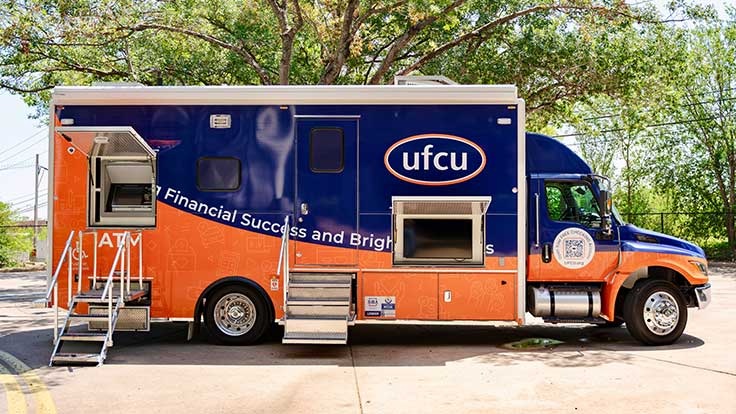
The mobile branch makes that thinking visible. The vehicle can support account opening, instant-issue debit cards, ATM deposits and withdrawals, and wire transfers. Spanish-language assistance is available. It also brings financial education workshops to community partners. A phone can move money; a traveling branch can help someone get started with a person beside them.
The cooperative still needs a working business underneath the service. Member deposits support lending; lending and investments generate interest income, alongside service and fee income. Member ownership changes whom the institution serves economically. It does not make every product free, every loan affordable, or every application approvable. Its appeal rests on the actual terms and assistance a member receives.
The upgrade still has to pay the bills
Closeness becomes harder to maintain when familiar tools change. UFCU began a staged conversion of online and mobile banking in August 2023. In public responses to complaints, it acknowledged intermittent problems and offered help with affected bill payments, including credits for resulting late fees.
One response explained a change in bill-pay check handling: funds would leave when the recipient negotiated the check. That is an ordinary processing distinction with a large consequence for someone watching a balance. The lesson for another organization is concrete: explain changes in everyday behavior, and provide a recovery route when the transition goes wrong.

A bigger balance sheet, a familiar name
The MSUFCU plan brings this tension into view. Completion is expected in summer 2027, subject to regulatory and UFCU member approval. Until then, the organizations operate independently. Their announcement describes keeping UFCU in Texas and MSUFCU in Michigan and Illinois, with University Federal Credit Union as the corporate name and MSUFCU’s charter.
UFCU presents the combination as a way to support technology investment, broader services and financial strength. Its member information page says Michael Crowl would become president and April Clobes CEO upon completion. Those are plans, rather than delivered benefits. Members will ultimately judge them through routine encounters: an account that opens, a payment that arrives, a question someone answers.
There is something worth copying in the smaller operating choices already visible: place a branch inside a college, attach guidance to a financial product, give employees paid time to volunteer. UFCU offers up to 32 volunteer hours annually. Whether the next chapter works will depend on keeping such choices useful at a much larger scale.