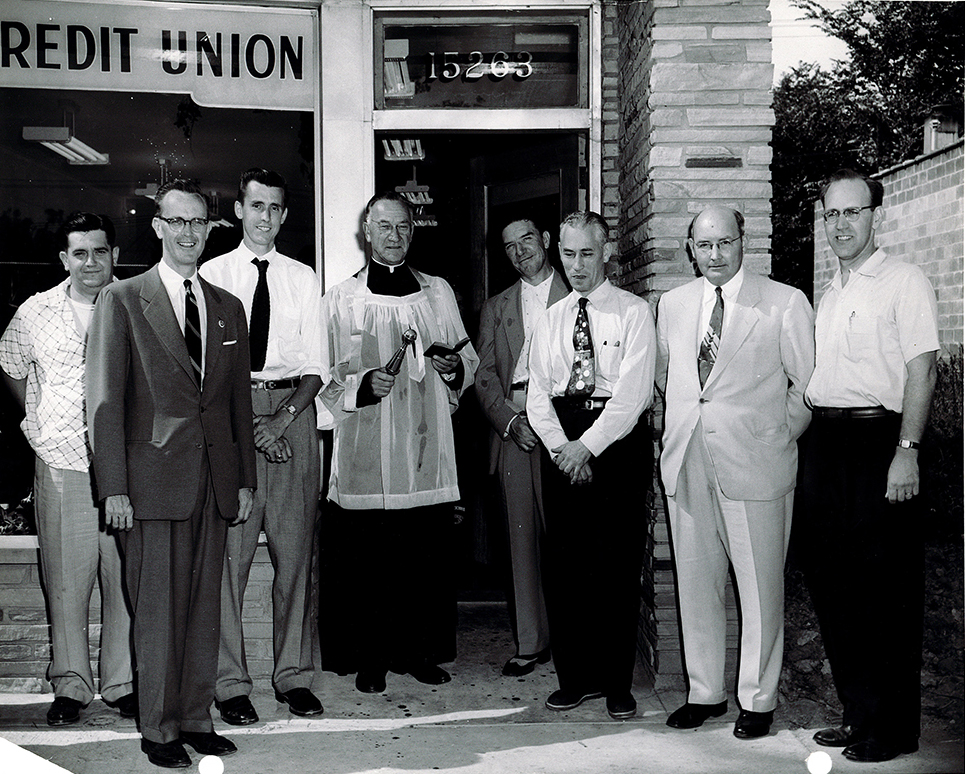
In an old photograph from Christian Financial Credit Union’s history, eight men stand outside a modest storefront. One wears clerical vestments. Above them, the sign says CREDIT UNION. The picture belongs to the institution’s St. Jude Parish beginnings in Detroit. It makes the original proposition easy to understand: people who already shared a community could share a financial institution, too.
- A parish beginning in 1950; Michigan-wide eligibility today.
- Everyday banking, business services and financial coaching under one membership.
- A cooperative whose growth depends on keeping ordinary money decisions manageable.
Then the circle widened. Christian Financial merged with other credit unions, built a headquarters in Sterling Heights, and added the products people expect from a modern financial institution. By August 2026, it reported more than 61,000 members and over $1 billion in assets. The interesting part is how much the meaning of “community” had changed along the way.
01 / The name stayed. The door opened.
Christian Financial traces its roots to St. Jude Parish Credit Union, established in 1950. Its religious origin remains visible in its name and in services designed for churches. But its current membership rules include people who live, work, worship or attend school in Michigan, as well as those qualifying through partner organizations. Church membership is no longer the defining boundary.
A decisive expansion arrived on July 1, 2025, when Catholic Vantage Financial merged into Christian Financial and the charter expanded statewide. The merger announcement emphasized compatible origins, additional services and stronger digital tools. For a cooperative born around existing relationships, this was a substantial change in scale: belonging could now begin with an address anywhere in Michigan.
in Detroit
across Michigan
August 2026
02 / Start with the six-dollar detail
What does membership buy? Mostly the things that make a household function: checking, savings, certificates, credit cards, car loans and mortgages. There are personal loans and home equity products, too. Small businesses can use checking, savings, commercial lending and payment tools. Churches get services shaped around organizational banking, including dedicated support and night-drop access at equipped locations.
The useful comparison with a bank begins in the fine print. Christian Financial’s E-Checking lists no monthly maintenance fee when the member uses electronic statements. Drop that enrollment and the listed charge becomes $6 a month. Essential Checking, designed for more traditional account management, also lists a $6 monthly fee, with age-based waivers. Other service charges can apply.
That makes the choice pleasantly concrete. Someone happy with electronic statements can match the account to that habit. Someone who wants paper should compare the resulting annual cost. Christian Financial’s appeal rests on this whole arrangement: price, access and help. A checking account that fits someone else’s routine can still be the wrong one for yours.
03 / Give saving a little suspense
Then there is Save to Win, a product with a more playful premise. Open a 12-month certificate with $25. Qualifying increases in savings generate entries into prize drawings, while the deposit earns interest. The product page describes monthly prizes and quarterly $5,000 prizes. Winning remains a possibility; building a savings balance is the everyday activity underneath it.
The distinction matters. A prize opportunity can make a small deposit feel more interesting, but this is still a certificate with rules and a term. Early withdrawal carries a penalty. Standard certificates generally start at $500. The practical lesson is to match money to its job: cash needed next week and cash set aside for a year require different homes.
“I will consider the member’s needs in everything I do.”
Christian Financial’s published “Think Member” core value
04 / A phone, with a person behind it
Christian Financial also has to compete with the convenience people carry in their pockets. Its mobile app supports check deposits, bill payments, transfers and card controls. Consumer features include credit-score coaching and budgeting tools. In 2025, the credit union introduced digital card issuance, sending card credentials into mobile wallets without waiting for a plastic replacement to arrive by mail.
Software covers the transaction. Other services address the uncertainty around it. Members can book financial coaching on budgeting, credit and debt paydown. Through GreenPath Financial Wellness, they can access free financial counseling alongside debt-management resources. Virtual appointments and co-browsing assistance offer another route to help. The combination suits people who want remote access and occasional human explanation.
05 / Who gets the surplus?
Christian Financial operates as a member-owned, not-for-profit credit union. Deposits help fund lending; interest income and fees support operations, reserves and member services. That structure shapes its position among Michigan’s banks and credit unions. The familiar products are widely available elsewhere. Its case for membership combines cooperative ownership, regional knowledge, digital access and services for households, businesses and churches.
Its community work has a separate, visible mechanism. The Outreach & Impact Foundation launched in 2022 with $50,000 from the credit union. Initial grants sent $10,000 each to four nonprofits. By its August 2026 announcement, the foundation reported $304,992 invested in nonprofit organizations. The summer awards included food assistance, bereavement support, school supplies and urgent family needs.

One day’s contribution across Southeast Michigan.
The employee side is measurable, too. Its careers page offers up to 30 volunteer hours annually. On October 12, 2026, 174 employees contributed 522 hours to community work. These figures give the language of service something tangible to stand on. They also offer a useful test for any institution making similar promises: look for a mechanism, a date and a count.
For a prospective member, the next step is less dramatic than a merger. Check eligibility. Compare statement requirements and fees. Try the digital tools. Ask how coaching works. Christian Financial’s long journey began with a small circle of people pooling resources. Its wider circle now has to earn the same place in a member’s everyday life, one useful interaction at a time.
Keep exploring
Official video tutorial / YouTube ↗Watch: Mobile check depositing ↗