The awkward number in Centra Credit Union’s rewards story is 85. More than 85% of members surveyed, the institution says, didn’t know it had a rewards program. Imagine running a restaurant where almost nobody notices dessert is included. The benefit exists on the balance sheet. In the customer’s mind, it barely exists at all.
- Centra replaced an overlooked rewards system with cash and a dedicated account.
- Qualifying members can earn through everyday banking; bonuses remain discretionary.
- Member ownership also has teeth: a proposed merger stopped after the other credit union’s members voted no.
01 / First, make the benefit visible
Centra spent 18 months researching and testing a replacement. Members volunteered to try the accounts and features, then reported back. Launched in 2021, Member Loyalty Rewards gathered cash benefits into a Member Loyalty Account, or MLA. The design made the reward easier to locate and easier to understand. You could withdraw it, transfer it, or leave it earning interest.
The business logic was equally practical. Electronic statements can reduce delivery costs. Direct deposit deepens the banking relationship. Debit-card use contributes to the institution’s economics. Centra connected those activities to rewards. The useful lesson for another business is to test whether customers can recognize and use a benefit before adding more benefits to the pile.
unaware of old rewards
and testing
launched
02 / A nickel has conditions
Consider Cashback Checking. Its base tier has no monthly maintenance fee or minimum balance. The next tier requires at least 15 monthly debit purchases, electronic statements and direct deposit. Qualifying purchases earn five cents each. At 25 purchases, with the same requirements plus a $500 average monthly checking balance, the reward rises to seven cents per purchase.
That makes 25 qualifying purchases worth $1.75 at the higher tier, before other benefits. It is modest money. The sensible comparison is the whole account: fees, cash access, deposit earnings and borrowing costs. A reward that changes someone’s spending habits could easily become an expensive nickel.
Round Up adds another distinction. It transfers the difference between a debit purchase and the next dollar into the MLA. That is the member’s existing money moving between accounts. Cashback is earned; rounding up is saving. Putting both in one place is convenient, provided the member understands the difference.
Illustrative monthly debit reward at the published higher tier, assuming every purchase qualifies and all account requirements are met.
03 / The owners get a deposit
In February 2026, Centra announced more than $1.5 million in Member Loyalty Bonuses, scheduled for deposit around February 19. Each eligible member would receive $10 to $30, depending on their relationship with the credit union. This was a distribution tied to performance, rather than a permanent promise attached to opening an account.
Centra explicitly says future bonuses depend on its results and the economy. That condition matters. The cooperative still needs to pay employees, cover credit losses, maintain technology and retain capital. Member ownership changes who benefits from the business; it does not remove the business’s expenses.
“People Helping People”
Centra’s stated philosophy
The arrangement began with eight Cummins Engine Company employees in 1940. Their first policies capped weekly deposits at $7.50 and unsecured loans at $25. They wanted affordable credit and somewhere convenient to save. Today’s product catalogue is longer, but the original problem remains recognizable: ordinary households need useful financial services at a manageable cost.
04 / A phone, a branch, a second chance
Centra serves households and businesses through digital banking and locations in Indiana, Kentucky, New York and North Carolina. Membership follows geographic, family or qualifying employer rules. Opening Membership Savings takes a $5 deposit. Printed statements generally carry a $2 monthly charge, with exemptions including primary members aged 65 or older.
Members can arrange auto financing, mortgages and home equity loans, use credit cards, save in certificates, or access investment services. The app adds mobile deposits, card blocking, alerts and external-account links. Businesses get commercial lending and treasury tools such as ACH payments, remote deposit and automatic sweeps. Banc Card supplies merchant-processing services through a partnership.
These are familiar capabilities in banking. Centra’s positioning comes from combining them with cooperative returns and personal help. Onward provides free bilingual education, workshops and individual coaching aimed at financial inclusion. Opportunity Accounts offer another entrance for people rebuilding their banking record, with published requirements for upgrading to Cashback Checking.

05 / Ownership includes the right to say no
Cooperative structure became particularly visible in 2024. Centra and Hoosier Hills proposed combining their institutions. Both boards supported the plan. Hoosier Hills members rejected it. Centra’s own vote subsequently produced 96% support among those voting, but approval on one side could not supply approval on the other. Hoosier Hills declined a second vote.
The two remained separate. The episode gives “member-owned” a consequence beyond a marketing phrase: management’s preferred growth strategy can meet a binding obstacle. For anyone copying Centra’s approach, rewards research and member consent belong in the same conversation. A financial benefit does not settle every question about trust, identity or control.
06 / The other kind of return
In October 2026, Centra announced a different piece of arithmetic. Its foundation’s $15,000 grant combined with $60,000 from FHLBank Indianapolis to produce $75,000 for Turning Point Domestic Violence Services. The shelter had recorded 6,300 nights of accommodation in 2025 and needed repairs. Here, the financial partnership helped fund a building people depended on.
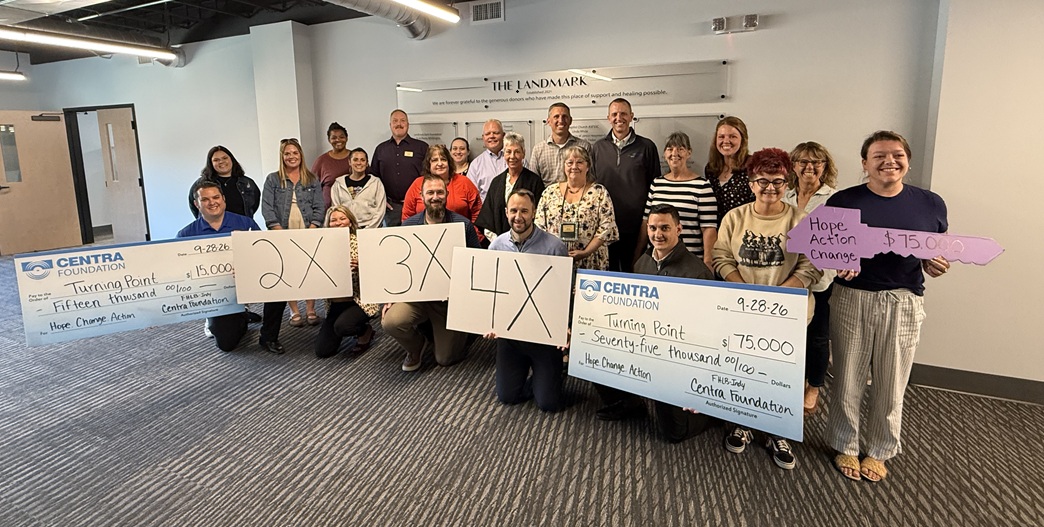
Centra Foundation + FHLBank Indianapolis = $75,000
Combined funding for shelter repairs, announced October 2026.
For a prospective member, the practical move is to check eligibility, compare the account rules with existing habits, and price the loans separately. For another institution, the lesson starts earlier: ask what people actually notice. Centra’s story turned on discovering that a benefit almost nobody recognized needed a different design.