At seven, Tyler Okonma was already worrying about packaging. He would pull the paper sleeves from CD cases and replace them with covers for albums that existed only in his head. He invented track lists. He wrote down song lengths. He did this before he knew how to make the songs. The sequence is almost suspiciously tidy: first the world, then the music required to fill it.
That childhood game became a useful prophecy. Tyler, the Creator is usually introduced as a rapper and record producer, which is accurate in the way that calling a department store a room is accurate. The records sit at the center, but around them orbit videos, clothes, shoes, perfume, characters, stage sets and a Los Angeles carnival. His gift is not merely having many interests. It is making those interests recognize one another.
A Tyler album arrives with manners, furniture and a dress code. IGOR brought a blond bowl-cut wig and bright suits. Call Me If You Get Lost traveled with trunks, passports and the elegant bellhop Sir Baudelaire. CHROMAKOPIA marched in behind a masked figure, military lines and industrial green. These are not marketing decorations applied after the song has dried. They are evidence that Tyler hears in pictures and sees in rhythm.
The cover came before the record
He was born in Hawthorne, California, in 1991 and moved among schools in the Los Angeles and Sacramento areas. The total was unusual: 12 schools in 12 years. At Westchester High, a theater class put him beside Lionel Boyce, who would become an Odd Future collaborator and later play Marcus on The Bear. Tyler taught himself piano one chord at a time. As a teenager, he began making beats. A kid accustomed to changing rooms was quietly learning how to furnish his own.
Odd Future supplied a crew and a delivery system. The collective's music, sketches, photographs and shirts moved through the internet with the energy of material made by friends for friends, while everyone else happened to be watching. Tyler self-released Bastard in 2009. Two years later, the stark video for "Yonkers" turned a black-and-white close-up, a cockroach and an elastic face into a calling card. He directed it as Wolf Haley, an alias that let the person behind the camera join the cast of names inside his records.
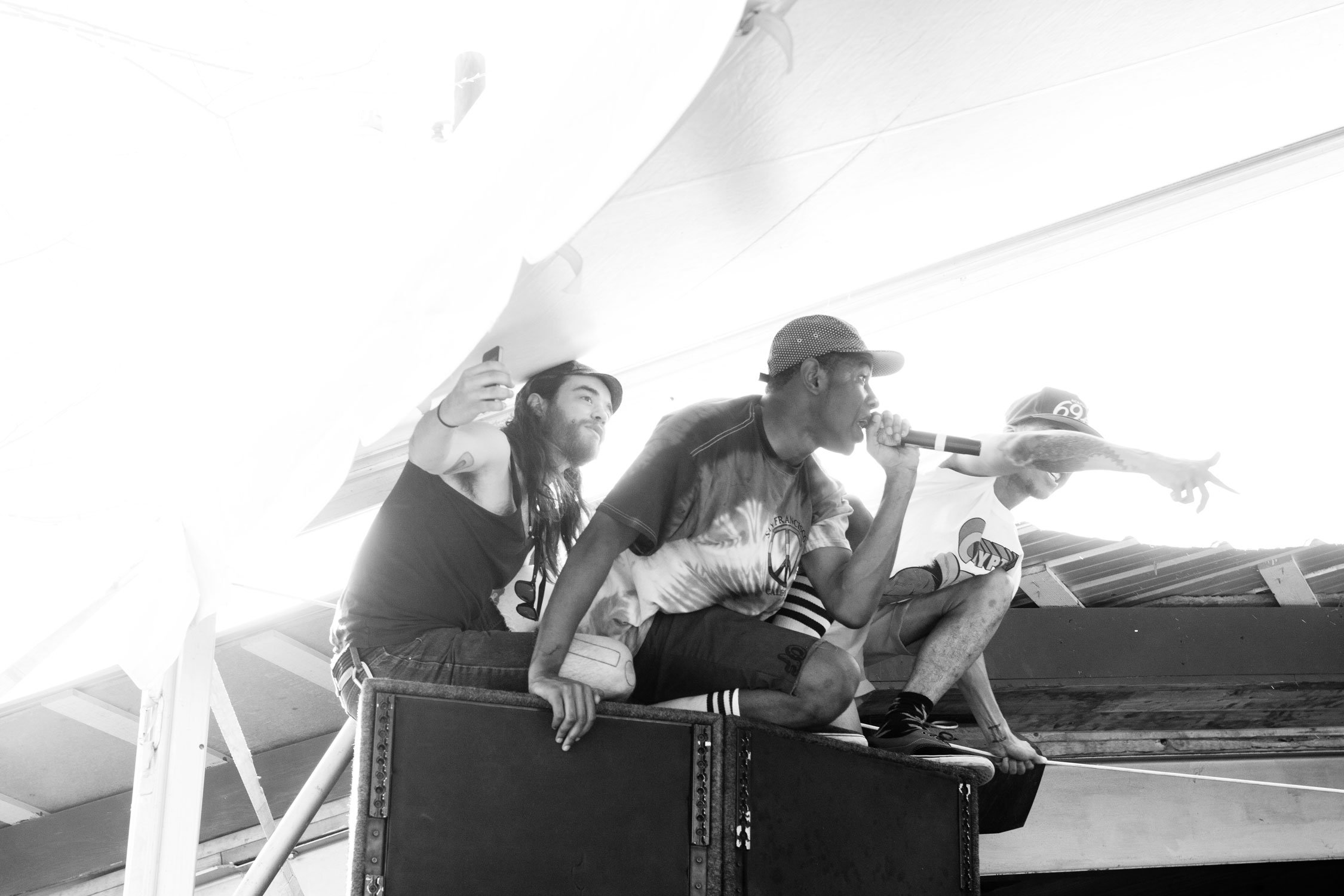
The early work was abrasive, funny, juvenile and frequently ugly on purpose. It also made the border between audience and maker feel porous. Fans could watch the videos on the same platform where the group posted sketches, buy the clothes and imitate the graphics. Odd Future looked less like a campaign than a neighborhood with an open gate. The language could repel; the completeness of the world pulled people in.
One point of view, four places to put it
A louder kind of listening
The public story often frames Flower Boy, released in 2017, as a pivot. The arrangements opened up. The writing turned inward. Chords, strings and negative space carried as much personality as provocation once had. Yet the album also sounded like the work of the same child designing complete packages. Tyler was not abandoning control. He was using it to admit more colors.
IGOR pushed further. Tyler produced the album and built a breakup story from warped soul, synthesizers and voices used as texture. It reached number one on the Billboard 200 and won the 2020 Grammy for Best Rap Album. In his acceptance speech, he thanked his mother and the friends who trusted his ideas before they were easy to explain. The award came with a complication: he questioned why genre-bending work by Black artists is routinely placed in rap categories. Even the victory became a prompt to inspect the frame.
“That's the whole purpose of my career - to push the conversation and the culture forward.”Tyler, the Creator
With Call Me If You Get Lost in 2021, he put rapping back near the front while keeping the orchestration, travel fantasy and comic detail. It also reached number one and brought another Best Rap Album Grammy. The lesson across the two records was not that he could switch styles. It was that style, for Tyler, is movable scenery. His point of view remains visible after every set change.
Taste becomes a place
Golf Wang began in 2011 with saturated color, irreverent graphics and the kind of pieces Tyler wanted to wear. Golf le FLEUR* later offered a more polished vocabulary: loafers, luggage, fragrance, careful knits and collaborations with Converse. The shift mirrors the music without tracing it exactly. Both grew from the pleasure of noticing how colors, materials and proportions alter a mood.
Camp Flog Gnaw made the same instinct architectural. It started in 2012 as an Odd Future carnival. The name is a small private joke made public: Flog Gnaw reverses Golf Wang, which itself rearranges Wolf Gang. Over time, the event moved to the Dodger Stadium grounds and hosted artists from rap, R&B, pop and alternative music. It became an annual self-portrait made from other people's sets.
The 2026 edition is scheduled for November 14 and 15, with Tyler alongside Future, Turnstile, Steve Lacy, Earl Sweatshirt, Syd, The Alchemist, Lola Young and others. The list reads like his record shelf after someone taught it to book stages. A curator makes an argument through proximity: this belongs beside that; this audience might enjoy meeting that sound. Tyler turned preference into public infrastructure.
Two albums, opposite instructions
CHROMAKOPIA arrived in October 2024 at six on a Monday morning, a deliberate break from the Friday release habit. Tyler had argued that weekend listening becomes passive, music reduced to gym or party atmosphere. A weekday, in his view, gave people time to hear the thing on the way to school or work. It was an eccentric release strategy with a plain request beneath it: pay attention.
The album rewarded that request with dense arrangements and adult questions about family, privacy, commitment and consequence. It spent three weeks at number one in the United States and became his first UK number-one album. Its sepia cover placed Tyler in a mask, his face visible and concealed at once. In 2026, the image earned him the first Grammy awarded for Best Album Cover. The child who drew fictional sleeves had become an officially recognized art director.
Three Grammys, two kinds of authorship
Bar lengths mark chronology, not a ranking. The category changed from recorded sound to the image holding it.
Then he changed the instruction. While touring CHROMAKOPIA, Tyler made DON'T TAP THE GLASS and released it in July 2025. He told listeners it was built for movement. The record is concise, rhythmic and less interested in confession than physical response. On the same tour cycle, one album asked for focused listening and the next asked people to stop standing still. Contradiction becomes useful when each brief is clear.
Apple Music named him its 2025 Artist of the Year and reported more than 4.5 billion minutes of listening between November 2024 and October 2025. Those minutes covered two albums with different temperatures, an arena tour and a catalog whose audience had learned to expect change without treating change as betrayal.
His birth name enters the credits
Tyler's screen work had long included Loiter Squad, commercials, videos and elaborate album characters. In Josh Safdie's Marty Supreme, released in 2025, he made his feature-film acting debut as Wally. The credit read Tyler Okonma. Dropping the stage name for the film did not signal a retreat from the creator persona. It widened the number of doors his own name could open.
The same curiosity continues in objects. In 2026, Converse released the 1908 Bronco Boot, his third excavation of the company's archive under the Converse 1908 project. He took a rugged 1990s design and translated it through the restrained colors and details of Golf le FLEUR*. It is a neat model for his larger method: study an artifact closely, preserve the useful oddness, then leave fingerprints.
Tyler once joked that “Tyler, the Creator” is a dumb statement, comma and all, while conceding the honesty inside it. The joke lands because the name has become almost bureaucratically exact. He creates records, images, clothes, events and roles. More importantly, he creates relationships among them. A green on an album becomes a tour uniform. A childhood seal becomes a festival. A directing alias becomes part of the mythology.
The career lesson is wonderfully inconvenient. Taste cannot remain a mood board forever. It has to choose a chord, cut a jacket, book an act, place a camera or ship a shoe. Tyler's world became large because he kept converting preference into finished things. The seven-year-old with the empty CD cases was not pretending to have a catalog. He was rehearsing the habit that would make one.