Before he was a headliner, Kanye West was a problem in a pink polo. Record labels liked his beats. They heard the sped-up soul, the drums with shoulders, the way a sample could become both memory and momentum. They were less certain about the person asking to rap over them. Early-2000s hip-hop had recognizable costumes and biographies. West, the son of an English professor, wore loafers, had never sold drugs and talked about insecurity as readily as ambition. Executives could not find the shelf for him. He responded by building a new one.
The College Dropout arrived in 2004 as autobiography, joke and manifesto. The title turned an abandoned education into a creative position: step outside the approved institution, then expose what the institution failed to notice. Its hero worried about money, faith, family, status and his own appetite for applause. He could be funny and wounded in the same verse. Hip-hop did not suddenly become introspective because of one album, but its commercial center made room for a different sort of star.
West had been preparing for that argument since Chicago. At fourteen, he used a $1,000 Christmas gift from his mother, Donda, to buy a keyboard. Beats filled their home. Donda, a professor who had learned not to correct the child who colored bananas purple and oranges blue, connected him with local producers. No I.D. became a mentor and later remembered his defining feature as persistence. Talent opened the conversation; returning after “no” kept it going.
“My greatest award is what I’m about to do. I’m always thinking about the future.”Kanye West
The producer steps through the frame
His first reliable identity was producer. Work for Jay-Z, especially on The Blueprint, made his warm, pitched-up samples audible far beyond Chicago. Yet he did not want to remain the useful person behind the glass. After a 2002 car crash, he recorded “Through the Wire” while his jaw was still wired, turning impediment into concept with almost suspicious neatness. The song did more than introduce his voice. It established a career-long habit: make the obstacle part of the artwork, then make the artwork proof that the obstacle was wrong.
The next albums changed scale without surrendering curiosity. Late Registration brought orchestration and the No. 1 single “Gold Digger.” Graduation used synthesizers and arena dimensions. Then 808s & Heartbreak stripped away rap’s armor for Auto-Tuned singing, sparse electronics and grief. Its fingerprints appeared across the melodic rap that followed. West’s catalogue began to resemble a set of doors other artists could walk through.
His process was rarely solitary. The mythology of Kanye prefers the lone visionary, but the records tell a more social story. My Beautiful Dark Twisted Fantasy gathered writers, producers, instrumentalists and guests in Hawaii under a famously exacting schedule. Donda, the creative company he named for his mother, extended the method to designers, artists, filmmakers and architects. West once described his fashion role as closer to George Lucas or Quincy Jones: the person who assembles specialists, sets a world in motion and insists that the disparate pieces play as one song.
When the rollout became the medium
A conventional artist releases work. West increasingly staged the act of release itself. In May 2013, “New Slaves” appeared in black and white on the sides of buildings. People gathered on pavements, phones lifted toward a face enlarged against brick. The city became screen, venue and rumor network. It was inexpensive, uncanny and perfectly matched to the industrial abrasion of Yeezus.
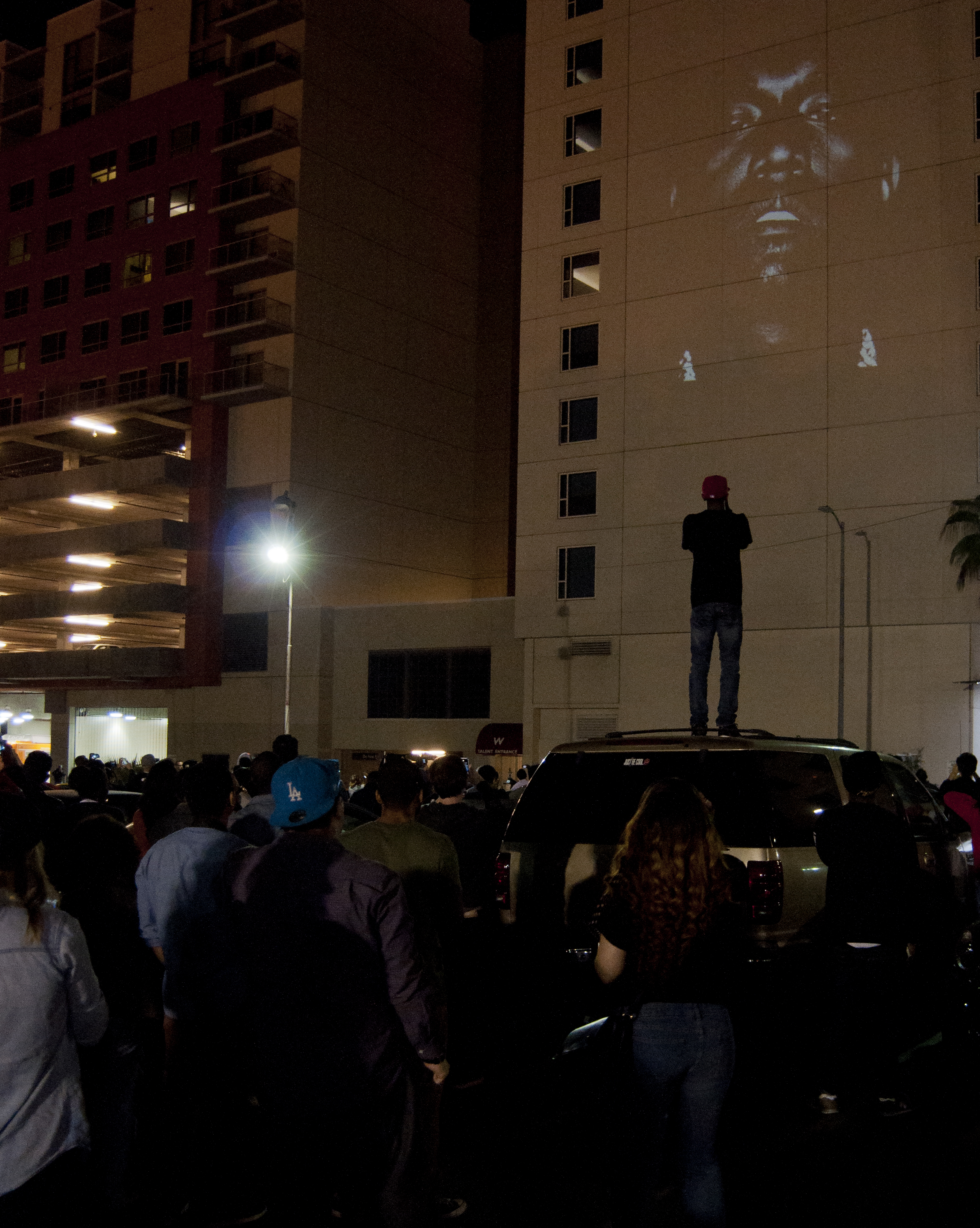
Later came stadium listening events, temporary sets and albums treated less like sealed records than editable files. The Life of Pablo continued changing on streaming services after its 2016 arrival. Mixes shifted. Lyrics moved. A work that used to harden at the pressing plant remained liquid on the server. Fans became witnesses to revision, though sometimes also unpaid quality control. The mess was part of the access.
The shoes followed the same logic. West did not approach sneakers as celebrity merchandise attached to an album cycle. He approached them as mass sculpture and social signal. Nike collaborations made the case; Adidas supplied the scale. Bulbous soles, muted palettes and knit uppers moved from odd proposition to global visual language. Yeezy widened the imaginable job description of a recording artist.
Fashion also revealed the friction in his method. He wanted entry into its guarded rooms, then wanted to rearrange the furniture. He and Virgil Abloh arrived at Paris Fashion Week in 2009 as conspicuous outsiders. Over time, West’s orbit became a gathering point for designers and image-makers who would shape the next decade. He could identify talent and create proximity. He could also make collaboration feel like weather: energizing when it moved in your direction, exhausting when it did not.
A career measured in more than applause
The instinct that stopped being useful
For years, West’s combativeness produced an attractive plot. Gatekeepers doubted him; he ignored their vocabulary; the work vindicated the nerve. But not every boundary is a dull convention awaiting a genius with a hammer. His antisemitic statements, praise of Hitler and sale of a swastika shirt were not daring formal experiments. They caused harm, drew broad condemnation and ended partnerships with Adidas, Gap and others. The commercial structure he had fought to build came apart with remarkable speed.
This rupture cannot be reduced to the familiar rhythm of provocation, backlash and a better album. It changed the meaning of his defiance. When institutions had rejected the pink-polo producer, the audience could enjoy the correction. When institutions rejected hate, the old outsider script no longer fit. The habit of interpreting every refusal as evidence of one’s own vision had reached its moral limit.
The consequences remain concrete. In April 2026, the United Kingdom blocked his travel authorization, citing his history of antisemitic remarks. Wireless Festival, where he was meant to headline three nights, was canceled. Sponsors had already withdrawn. West said he wanted to meet members of the Jewish community and acknowledged that words would not be enough. This is the uncommon challenge for a performer fluent in grand gestures: repair is repetitive, specific and rather poor at generating trailers.
THE NEW QUESTION: CAN ACCOUNTABILITY EXIST AFTER THE APPLAUSE?
Seventy thousand witnesses
Attention, at least, has not disappeared. In March 2026, Bully arrived as an 18-track album, with a deluxe edition following. In April, roughly 70,000 people filled SoFi Stadium for the second of two sold-out concerts. Lauryn Hill joined West for “All Falls Down,” folding a voice from his debut era into the attempted return. Travis Scott, CeeLo Green and North West appeared too, lifted above the stadium floor on a half-orb that changed from moon to Earth to smoking sphere.
The scene contained nearly every Kanye motif: family, mentors, enormous architecture, technical mishaps, religious timing, old songs rearranged as communal memory. He thanked the audience for remaining through the hard years. They answered by singing “Heartless” at stadium volume. A catalogue can survive its maker’s worst choices inside individual listeners, where a song attaches itself to a first job, a late drive or a person no longer present. The music’s endurance is real. So is the damage outside it.
Calling the evening a comeback would settle the story too cheaply. A stage is easy territory for West. He understands scale, suspense and the exact emotional temperature of a sample meeting a crowd. The harder arena begins when the house lights rise. An apology is not an album drop. Accountability has no deluxe edition and no tasteful listening party. It is measured in behavior sustained long after novelty moves elsewhere.
Kanye West’s career has always asked who is allowed to design culture. His answer was expansive when it meant a producer could become a rapper, a rapper could shape a shoe, and a record could behave like software or public architecture. It became destructive when freedom was confused with freedom from consequence. The distinction now sits at the center of his legacy.
The catalogue still travels. The audience still knows the words. Trust is the material in shortest supply.
His creative instinct remains recognizably restless. Music, clothing, stages and images continue to arrive as parts of one unfinished world. Yet the most significant thing he could design next may be a pattern of conduct rather than an object. For an artist trained to transform resistance into spectacle, that would require a new skill: resisting the spectacle itself.
The future tense still suits him. It once described confidence so complete that an award in hand seemed less interesting than an idea not yet built. Today it carries a sharper condition. What comes next will not erase what came before, in either direction. The records remain. The influence remains. The harm remains. The next act earns its meaning one action at a time.
Follow the work, then read the room
Portrait: Cosmopolitan UK, CC BY 3.0. Story photograph: Ian T. McFarland, CC BY-SA 2.0. Profile updated September 2026.