The Producer Everyone Has Heard, Nobody Can Name
Jake One - born Jacob Brian Dutton, May 11, 1976, in Seattle, Washington - is one of hip-hop's most consistently essential producers. His credits span from G-Unit to Rhymesayers, from Drake's Nothing Was the Same to De La Soul's final chapter. He made the beat playing underneath one of the most recognizable entrances in professional wrestling history. He produced what many consider the defining MF DOOM feature of the 2000s. He built a funk duo with Mayer Hawthorne and signed to Stones Throw. And through all of it, he has kept a deliberately low profile.
He is not a star. By choice. "Some people want to be stars," he said in an interview. "I'm just the kind of person that doesn't want attention." In an industry that runs on personal branding and social media presence, Jake One is an outlier: a producer whose work carries more weight than his name recognition. That's exactly how he prefers it.
What sets him apart from most producers working at his level isn't any single hit - it's the range. He can make something that sounds like it belongs on a late-night corner in Brooklyn, then pivot to P-funk boogie for Tuxedo, then build a Drake introspective mood piece, then hand Freeway a platform that feels like the best rap album of 2010. The thread through all of it is a certain commitment to the right note at the right tempo - not flash, but inevitability.
A Neighborhood, A Record, A Casio
The story starts with a neighbor named Robert Harris. Jake was 7 or 8 years old, growing up in Seattle's Central District - a historically diverse, music-soaked neighborhood - when Harris played him Grandmaster Flash's "It's Nasty (Genius of Love)." That was it. The mechanism was set.
He made his first beat somewhere around 1991, using a Casio keyboard. "I think we looped a Sly Stone record or something like that," he recalled. By 1992, when his family relocated to Mountlake Terrace after his parents' separation, he was already obsessive. He attended Mountlake Terrace High School, then the University of Washington, where he studied Sociology. But music was never a side interest - it was the operating system running underneath everything else.
His influences crystallized around Pete Rock, DJ Premier, Dr. Dre, and Marley Marl. He studied sampling at the source - analyzing the records that BDP and NWA had looped, reverse-engineering the technique. Around age 14 or 15, the mechanics clicked.
"I'm first generation hip-hop. It first came out when I was a kid, so I was fascinated by it early on."- Jake One
His first real industry break came through the most Seattle route possible: a demo tape handed to a friend working at a local record store. DJ Mr. Supreme - Supreme La Rock - heard it. When Supreme established Conception Records, Jake came with him. His first production credits appeared on Conception Records' Walkman Rotation compilation in 1998. He was 22. It had taken him six years to get from the Casio to the catalog.
G-Unit, MF DOOM, and a Decision That Defined Him
By 2003, Jake One had made it into G-Unit's in-house production collective, the Money Management Group. His first major placement was "Betta Ask Somebody." The next year brought something more consequential.
In 2004, De La Soul's The Grind Date came out. Jake had approached the group backstage and handed a CD of beats to Posdnuos through a mutual contact named J Moore. What Posdnuos said next became the instruction that shaped the session: "Give me the beats you would give Mobb Deep. We don't just want what people think is a De La beat."
The result was "Rock Co.Kane Flow," featuring MF DOOM. Redman reportedly spent two hours playing the instrumental before De La Soul ever recorded vocals. It became one of the most talked-about tracks of the 2000s underground era - the kind of record critics still reference twenty years later as proof that the right beat at the right moment can make something permanent.
The 50 Cent Test: After De La Soul recorded "Rock Co.Kane Flow," 50 Cent wanted the instrumental for The Massacre. Jake declined. De La Soul had the record - the beat wasn't available. He chose the underground credibility over the commercial placement. It is one of the quietest and most consequential business decisions in hip-hop that decade.
A year later came the moment that would follow Jake One into every subsequent profile: John Cena's WWE entrance theme, "The Time Is Now" (2005). Cena's entrance music has played for two decades now, in arenas across the world, to millions of viewers. It is one of the most-heard beats in sports entertainment history. Jake recalled Cena telling him bluntly: "Man, I don't even own my name." The business reality of professional wrestling, delivered casually in a studio session.
White Van Music: A Statement in 30 Features
In 2008, Jake One released White Van Music on Rhymesayers Entertainment. The album had 30+ features - Brother Ali, Young Buck, De La Soul, M.O.P., Freeway, MF DOOM, Slug, Busta Rhymes, Elzhi, Royce Da 5'9", Little Brother, Evidence, Prodigy, Black Milk. It documented every sample source in the liner notes, which was both a legal disclosure and an act of respect for crate digging culture.
The album arrived at a strange moment: the underground and the mainstream barely communicated in 2008, and White Van Music refused to pick a side. It bridged G-Unit-era rap with independent label credibility. Critics called it one of the best albums of the year. More importantly, it established Jake One as a solo artist in his own right - not just a beat supplier, but someone with a curatorial vision.
In 2010, he released The Stimulus Package with Philadelphia MC Freeway. It peaked at #63 on the Billboard 200 and #19 on the Top R&B/Hip-Hop Albums chart - remarkable numbers for an independent hip-hop record with no major label infrastructure behind it. "We went around the world with that thing," Jake said. The album's success validated the bet he had made on the Rhymesayers ecosystem.
Drake, J. Cole, and the Quiet Giant Phase
The next decade expanded Jake's reach into the mainstream without changing what he was making. In 2013, he co-produced "Furthest Thing" for Drake's Nothing Was the Same - layering ambient synths and trap drums into something that sounded like 3 AM in a penthouse with regret for company. The same year brought credits on J. Cole's Born Sinner and work with Wale, Chance the Rapper, Rick Ross, and Game.
His 2013 production discography alone spans 28 tracks across major projects. It was a period of maximum throughput: Jake One was everywhere on records that mattered, rarely mentioned by name. The producer as infrastructure.
Later in the decade, his credits extended to Future (two albums), Playboi Carti, Travis Scott, 21 Savage, Nipsey Hussle, and The Weeknd's Starboy. He produced on DJ Khaled's Major Key. Every wave of hip-hop that rose through the 2010s seemed to find a Jake One beat somewhere in its foundations.
"People are successes because they have a thing that's theirs, that's genuine. Sometimes it takes time for people to find that."- Jake One
Tuxedo: The Funk Detour That Wasn't a Detour
Around 2006, Jake One and Mayer Hawthorne started trading beat tapes. Nearly a decade of low-key collaboration later, they signed to Stones Throw Records and released the first Tuxedo album in March 2015. It peaked at #16 on the R&B/Hip-Hop Albums chart.
Tuxedo is a different animal from Jake's hip-hop production work. The reference points are Parliament, Zapp, Shalamar, Chic - the whole P-funk and boogie universe. It sounds like Saturday night in 1983 if 1983 had slightly better studio equipment. The duo appeared on NPR's Tiny Desk and brought a kind of analog warmth to a moment when everything was trending toward digital minimalism.
They have now released four albums together: Tuxedo (2015), Tuxedo II (2017), Tuxedo III (2019, featuring MF DOOM and DaM-FunK), and Tuxedo IV (November 2024, with DJ Battlecat and Leroy Burgess as additional collaborators). The fourth album arrived nearly ten years after the first and sounds like they never left the studio - which is essentially true.
Stimulus Package 2, De La Soul, and the Work That Never Stops
Jake One's output in the 2020s matches the productivity of any earlier decade. Seaplane (2021) - a 19-track project he described in 2024 as containing "some of his best beats." Wolves & White T's (2023) with Seattle rapper Travis Thompson. Then 2024 arrived with three major releases back-to-back.
12/96 dropped in September 2024 on his own Snare Jordan label - a 20-track solo instrumental album. The Stimulus Package 2 followed in July 2024 with Freeway, 14 years after the original: reviewed as Freeway's best album in over a decade, featuring Conway the Machine, Black Thought, and a State Property reunion with Peedi Crakk. Then Tuxedo IV in November.
Into 2025: Never Going Bacc with Huey Briss on Blacc Wax Records. And perhaps most meaningfully: Track 13, "Patty Cake," on De La Soul's Cabin in the Sky - the group's first album since the death of Trugoy the Dove in 2023. The album earned a Metacritic score of 81, features Nas, Common, Slick Rick, Q-Tip, Black Thought, and Killer Mike, and was one of 2025's most emotionally resonant hip-hop records. Jake One, twenty years after producing "Rock Co.Kane Flow," still in the De La Soul orbit.
"Hip-hop is young people's music. So, if you're constantly doing the same thing over and over with the same people, you're not going to be inspired."- Jake One
Snare Jordan: The Education Side Project That Became a Brand
Somewhere along the way, Jake One built a second business. Snare Jordan - a play on Air Jordan - is the brand under which he sells drum kits sampled from his own Ensoniq ASR-10 and SSL console sessions. The kits, priced at $24.99 each, are used by producers who have made records with Wiz Khalifa, Chance the Rapper, J. Cole, De La Soul, Brother Ali, and Freeway. Volume 1 through Volume 8 and beyond, each a discrete collection of sounds with Jake One's sonic fingerprint built in.
His YouTube channel (Snare Jordan) hosts "Behind the Beat" breakdown videos for tracks he produced: Drake's "Furthest Thing," De La Soul's "Rock Co.Kane Flow," Chance the Rapper's "Acid Rain," Dom Kennedy sessions, Larry June tracks. They are methodical, unflashy tutorials that show exactly how the sausage is made - which takes some confidence, since most producers guard their process as trade secrets.
"I don't even want it to be known whether I'm sampling or not; it shouldn't be obvious," he has said. The Behind the Beat series is, in some ways, the opposite impulse: here is exactly what I did, beat by beat. Both things can be true. The mystery in the final product. The transparency in the education.
One Sampler Since 1997
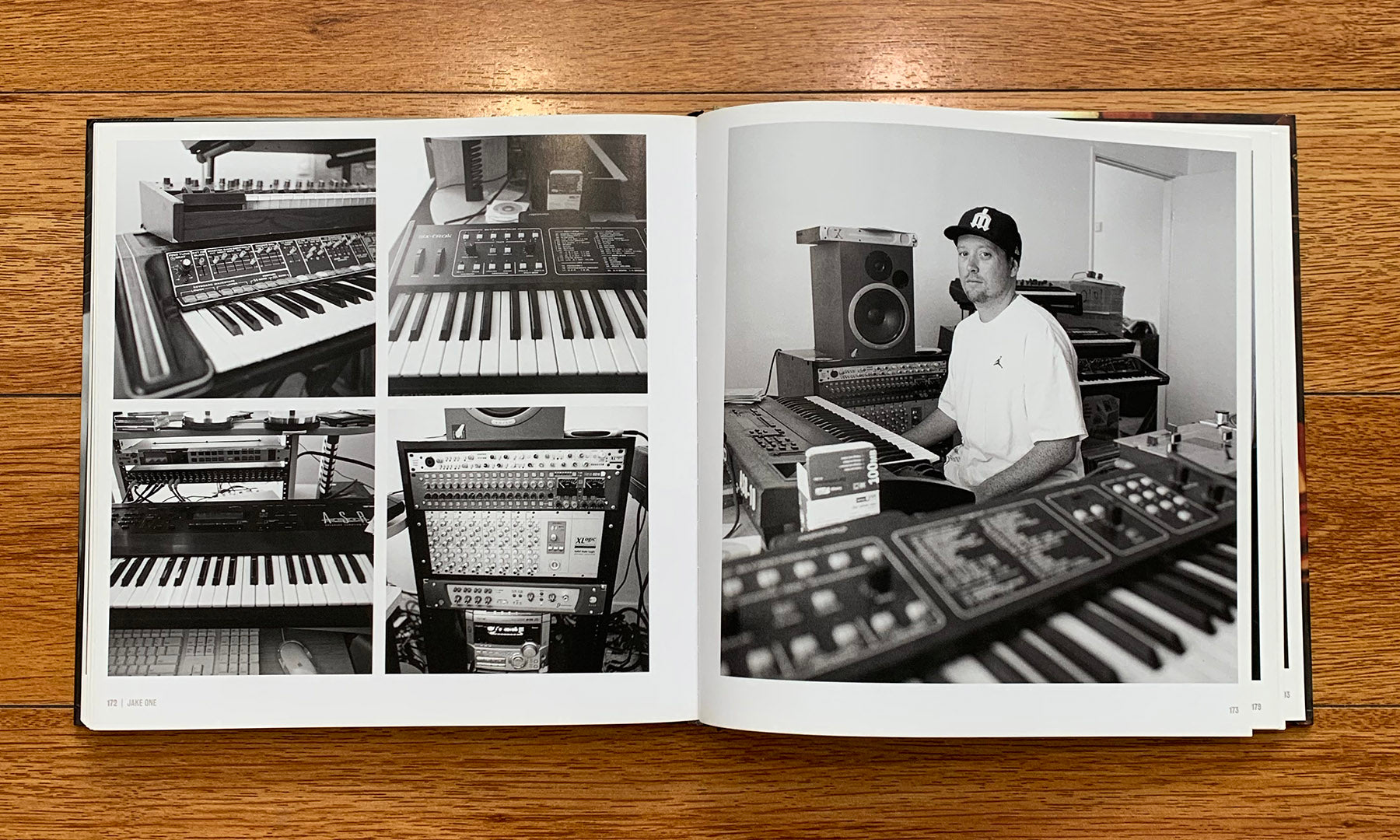
Most producers working at Jake One's level have updated their equipment multiple times in the last decade. Jake One has not. His primary instrument is the Ensoniq ASR-10 - a keyboard sampler he acquired around 1997 and has used ever since. "At this point I could really use that thing and not even think," he said. The ASR-10 is not the producer's equivalent of a guitar - it is a specific, idiosyncratic machine that shapes how you sequence, how you time, how you think about sound. Running it through an SSL console adds the warmth and punch that defines his output.
Albums & Major Collaborations
| Year | Title | With | Label |
|---|---|---|---|
| 2008 | White Van Music | Solo (30+ features) | Rhymesayers |
| 2010 | The Stimulus Package | Freeway | Rhymesayers |
| 2010 | Patience | Truthlive | Independent |
| 2015 | Tuxedo | Mayer Hawthorne | Stones Throw |
| 2016 | #PrayerHandsEmoji | Solo (Instrumental) | Independent |
| 2017 | Tuxedo II | Mayer Hawthorne | Stones Throw |
| 2019 | Tuxedo III | Mayer Hawthorne | Stones Throw |
| 2021 | Seaplane | Solo | Independent |
| 2023 | Wolves & White T's | Travis Thompson | Independent |
| 2024 | 12/96 | Solo (Instrumental) | Snare Jordan |
| 2024 | The Stimulus Package 2 | Freeway | Rhymesayers |
| 2024 | Tuxedo IV | Mayer Hawthorne | Funk On Sight |
| 2025 | Never Going Bacc | Huey Briss | Blacc Wax |
The Artists, Across Three Decades
A partial accounting of who Jake One has produced for. The scope spans every era and subgenre of hip-hop since 1998.
The Moments Behind the Moments
Redman reportedly spent two full hours playing the "Rock Co.Kane Flow" instrumental before De La Soul ever walked in to record vocals. That beat spent two hours as its own entity before it became a collaboration.
When 50 Cent wanted the "Rock Co.Kane Flow" instrumental for The Massacre, Jake One said no. De La Soul had recorded it first. That one decision separated the transactional from the principled - and people in hip-hop noticed.
Jake met De La Soul backstage and handed a CD of beats to Posdnuos through a mutual contact. No manager, no industry gatekeeping. Just beats on a disc, passed between people who respected the craft.
Tuxedo started as beat-tape exchanges between Jake and Mayer Hawthorne back in 2006. It took nearly a decade for that exchange to become a Stones Throw deal and a debut album. Some collaborations are not rushed.
John Cena's entrance theme "The Time Is Now" was produced in 2005. As of 2025, it has been playing in arenas worldwide for two decades. The beat is older than some of the wrestlers currently entering to it.
Jake One operates without a manager. He handles his own business affairs, books his own sessions, and makes his own deals. In a business that rewards delegation, he retained control - and retained the profits.