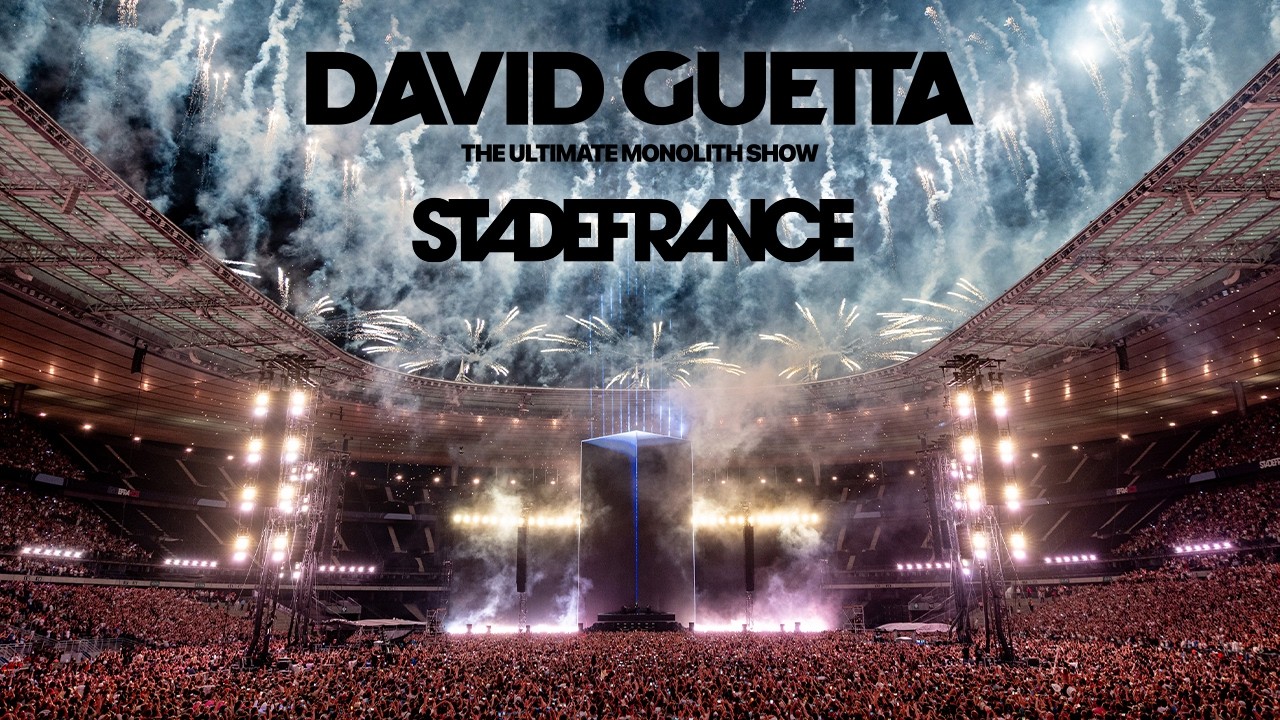
On a June night in Saint-Denis, the crowd takes over “Titanium.” David Guetta cuts the track and listens. Tens of thousands of voices carry the chorus through the Stade de France while he stands beneath a 32-metre black tower, the central piece of a production called the Monolith. The staging is built for scale: a curved screen stretches 60 metres, flames rise ten metres, lasers comb the Paris sky. Yet the useful moment is almost primitive. A DJ stops a record. A room answers.
For Guetta, that exchange has been the job for more than forty years. The room has expanded from Paris clubs to Ibiza terraces, Las Vegas pools, festival fields and, in June 2026, three sold-out nights at France’s national stadium. The machinery grew around a habit that did not: make something, play it in public and study the reaction.
This is easy to miss because Guetta’s public image arrived gift-wrapped in spectacle: raised hands, broad grin, countdown, drop. He helped make a certain kind of global electronic pop so common that it began to feel like weather. But his biography is not a tale of instant elevation. It is a long apprenticeship followed by a late, dramatic change of scale. He was already 41 when 2009 turned him into a name on American radio.
The teenager in the booth
Pierre David Guetta was born in Paris in 1967. His earliest memory, he has said, is playing with a record on his mother’s turntable at four. As a teenager he began DJing at Broad Club. He initially played the popular songs a Paris room expected, then heard a Farley “Jackmaster” Funk record on French radio in 1987 and found the music that would reorganize his working life: house.
His parents were unimpressed by the nightclub business. Guetta later recalled that their politics rejected the glossy artifice of club life; approval came only after he moved from playing other people’s records to becoming an artist himself. It took time. His first single, “Nation Rap,” appeared in 1990. During the decade he worked the Paris circuit as DJ and promoter, connected clubs including Le Palace and Les Bains Douches, and learned the unglamorous precision of keeping a floor moving.
That education had no diploma, but it had immediate marking. A dance floor is an honest examiner. The wrong record clears space. The right one rearranges faces. Guetta would later describe his studio as a laptop, portable enough to plug into rooms in Paris, London or Ibiza. The technology mattered less than the feedback loop. Production could follow the touring life, and the touring life could test the production.
It’s a very special moment when I play a song for the first time.David Guetta, on testing prospective releases during his sets
2009, by useful accident
The year that changed Guetta’s reach began with an unfinished instrumental. He played it during a set in Cannes. Kelly Rowland came to the booth and asked what it was. “Just a beat I made,” he told her. She asked to try writing over it. “When Love Takes Over” followed, pairing Rowland’s vocal with the bright pressure of a house record and giving Guetta his first large crossover.
Then Akon recognized him during a BBC Radio 1 appearance in Britain. Guetta booked Metropolis Studios in London for that evening. They made “Sexy Bitch” that night. The third hinge was “I Gotta Feeling,” the Black Eyed Peas single Guetta produced. It spent 14 weeks at No. 1 in the United States and made the four-on-the-floor pulse of European clubs sound at home on American pop radio.
Guetta calls such meetings “the accidents of life.” The phrase is modest and slightly mischievous. Chance did bring Rowland to the booth and Akon to the radio studio. Chance did not make the instrumental, recognize the invitation or book a studio before the feeling cooled. Luck found somebody carrying work.
Kelly Rowland hears an instrumental from the DJ booth and asks to write over it.
Akon proposes a collaboration; “Sexy Bitch” is recorded at Metropolis the same night.
“I Gotta Feeling” holds No. 1 for 14 weeks and carries dance production deep into pop radio.
The distinction matters. Guetta did not merely place a dance beat under a famous singer. His records gave vocalists large, clean emotional architecture: a few chords, a patient climb, then release. Purists could hear reduction. Millions of listeners heard room to enter.
Pop upstairs, house in the basement
Global success brought an argument that dance music enjoys having with itself. Could a record remain credible once it became popular? Guetta’s answer was less a manifesto than a shrug: “I love pop. So what?” He had spent years in an underground that could promote an artist as a genius on Friday and reject the same artist as a sellout after the hit arrived on Monday.
He also understood what the criticism was pointing at. A famous name accumulates expectations. So he made room around it. The 2011 album “Nothing but the Beat” separated vocal pop songs from instrumental electronic tracks. In 2018, the double album “7” devoted its second disc to Jack Back, his underground-facing alias. With Danish producer MORTEN, he began developing Future Rave in 2019, aiming for a bridge between darker club textures, trance tension and the scale of a festival main stage.
David Guetta
Open-hearted choruses, prominent vocal collaborators and records built to travel from radio to large festival stages.
Jack Back
A return route to house music: fewer pop expectations, tougher rooms and permission to follow the groove before the brand.
This split is not evidence of a secret “real” Guetta hiding behind the pop figure. Both are real. The interesting part is his refusal to accept that scale and curiosity must cancel each other out. One name handles the broad invitation. Another preserves the smaller laboratory.
The quiet before “boom”
Guetta’s stage manner is kinetic enough to power a modest arrondissement, but his preparation relies on contrast. Before a Las Vegas performance, he told an interviewer, he would sit quietly, close his eyes and try to become “super calm and super bored.” Then the stage could feel like “boom.” It is a producer’s solution to performance: create dynamic range before the first note.
Other small details reveal a mind that rarely stops arranging sound. In 2017 his phone wallpaper was not a family snapshot or a beach. It was a list of chord progressions that work well together. Asked what he feared, he answered: losing inspiration. Asked which contribution made him proud, he chose giving DJ culture more respect.
His longevity can be plotted through a popularity poll, with all the necessary caution that a readers’ vote measures enthusiasm rather than objective rank. Guetta first finished No. 1 in DJ Mag’s Top 100 DJs poll in 2011, then returned in 2020, 2021, 2023 and 2025. The revealing number is not five. It is fourteen, the span between the first and most recent wins in a culture that changes tempo, slang and heroes quickly.
Five returns to No. 1
Bars show the passage of time, not vote share. DJ Mag does not publish this poll as a scientific ranking.
Paris answers back
The 2026 Stade de France shows turned that long span into a homecoming. The three dates sold 240,000 tickets before the first firework went up. Armin van Buuren opened. Jennifer Lopez and Akon appeared as guests; with Akon beside him, Guetta thanked the singer for changing his life. The set traveled through “Love Don’t Let Me Go,” “Memories,” “When Love Takes Over,” “Without You” and “I Gotta Feeling,” songs that now double as timestamps in other people’s lives.
A stadium retrospective can become a wax museum with subwoofers. Guetta avoided that trap by remaining an active producer. In 2025 he released music with Sia, MORTEN, Afrojack, Martin Garrix and others, and won the DJ Mag poll again. Early 2026 brought more releases and a Grammy nomination for his remix of “Golden.” The Paris production looked backward because the audience had four decades to sing. The person at its center was still making records for the next set.
At the end of the first Stade de France night, Guetta was in tears. This was not the neat finale of a career. The party continued for two more nights, and the tour moved on. It was, instead, a rare chance to see the scale of a feedback loop: a boy reaches for a record, a teenager studies a Paris floor, a producer carries beats on a laptop, and a stadium gives the songs back.
The fireworks make better pictures. The pause tells the story. Guetta lowers the volume, and Paris keeps singing.