A jar of mayonnaise is a small negotiation among ingredients that do not naturally agree. Oil would rather separate. Acid can bully the flavor. Salt changes more than saltiness. The consumer wants creaminess, the factory wants stability, finance wants a cheaper oil, and the regulator has opinions about what the label may say. Somewhere in the middle sits a product developer with a spreadsheet and a calendar.
- Turing Labs predicts which consumer-product formulas are worth testing in a physical lab.
- Its customers include global food, beverage and household-goods R&D teams.
- The company raised a reported $1.75 million seed round and a $16.5 million Series A.
- The useful idea to copy: preserve failed experiments, then rank the next test against explicit constraints.
This is the world Turing Labs chose. Founded in 2019 by Manmit Shrimali and Ajith Govind, the company makes enterprise software for the people who formulate food, beverages, cosmetics, personal-care goods and household products. Its engine, Luna, learns from a company's own formulation records, lab measurements, sensory panels and consumer tests. It then predicts which combinations are worth making in the physical world.
The distinction matters. Turing is not promising to type a clever recipe into a chat window. Formulation is a constrained search problem. A cheaper ingredient may ruin texture. A healthier ingredient may shorten shelf life. A winning flavor may fail on a production line. Luna's job is to calculate across those collisions, assign confidence to a recommendation and give a scientist a reason to try batch 47 before batches 12 through 46.
The graveyard of useful failures
The first thing that fails in conventional product development is often not the recipe. It is memory. Results live in electronic notebooks, supplier files, spreadsheets and the heads of experienced formulators. Teams repeat tests because they cannot retrieve what happened last time, or because the result from one brand never traveled to another. Turing's pitch begins here: the failed batch is not waste if the organization can learn from it.
That premise became especially vivid when laboratories closed during the pandemic. A 2020 account of the young company described consumer-goods teams trying to continue development without normal access to benches and pilot plants. Virtual experiments did not replace reality, but they helped decide which reality was worth paying for. Turing raised a reported $1.75 million seed round that year. In January 2022, Insight Partners led a $16.5 million Series A, joined by Moment Ventures, Y Combinator and Borge Hald.
“A lot of the work of CPG product formulation is done manually by product developers who operate in silos.”Ajith Govind, co-founder, in the 2022 funding announcement
Seven months hiding in a detergent
The clearest illustration comes from a case study whose customer remains anonymous: a global home-care brand with a powder detergent losing ground on whiteness and stain removal. A conventional reformulation took eight to twelve months. The team fed formulation, cost, descriptive and consumer-test data into Turing's platform. The software searched for ingredient combinations that could improve performance without breaking the budget.
According to Turing, the resulting formula improved stain removal by 7.3 percent and whiteness by 3.8 percent, while formulation costs fell 8.8 percent. The brand reached market seven months faster and used the product across 40 markets. Those are vendor-published results, not a controlled independent trial. Still, they reveal the economic unit Turing is selling: not “AI” in the abstract, but fewer batches, fewer months and fewer expensive detours.
Another published case says a plant-based cheese project shrank from two years to four months. A condiment maker case reports work completed in five weeks and cost reductions above 29 percent. The specifics shift by category, but the pattern is consistent. The customer brings messy historical data and a real product target. Turing proposes candidates. Human experts test the short list. Each result returns to the system.
Why not simply ask a general AI?
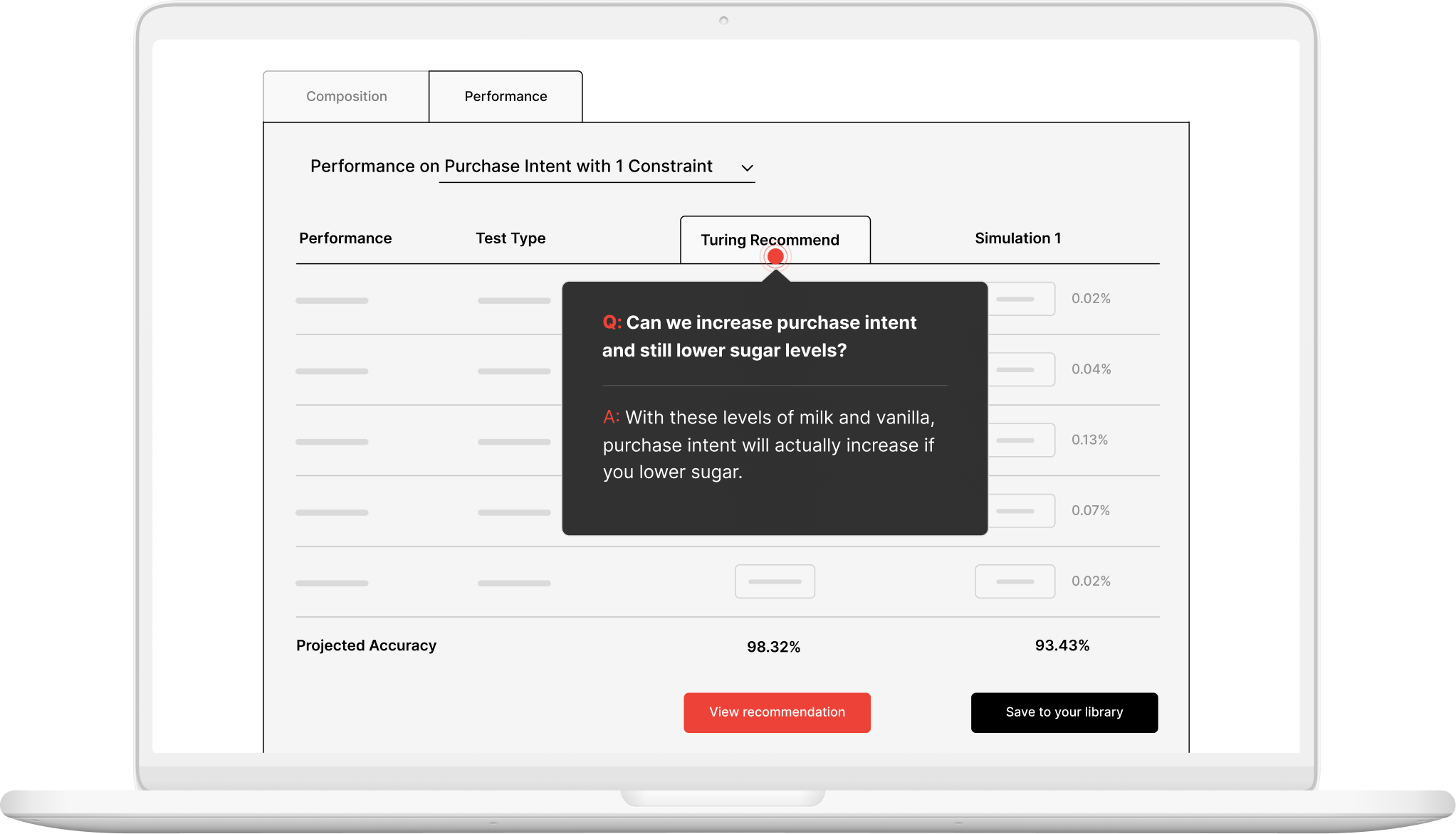
Because a fluent answer is not necessarily a manufacturable one. General models are trained to predict language. Turing says Luna is trained around how formulated products behave, including sparse data, ingredient interactions and objectives that pull against one another. A formulator needs reproducibility, not charm. “Try less sugar” is advice. “At these milk and vanilla levels, predicted purchase intent rises while sugar falls” is a testable proposition.
The alternatives are not foolish. A veteran scientist with a disciplined design-of-experiments method can learn a great deal. Electronic lab notebooks preserve records. Scientific software firms such as Dotmatics, Benchling and Uncountable cover adjacent parts of the R&D stack. An in-house data-science team may build a tailored model. Turing's wager is that consumer-products specialization, low-data methods and a workflow already shaped around formulation make its system faster to put to work.

From optimizer to operating system
The company now describes a larger “Innovation-led Growth Operating System.” The names are brisk: IC Q helps choose concepts; Optimizer IQ, powered by Luna, works on formulations; Cost IQ hunts margin; Memory IQ preserves what the organization learns. In 2025, Turing added an R&D assistant and regulatory intelligence. In 2026 it made ResearchIQ free, offering plain-language access to what it says are four million peer-reviewed papers plus FDA, EFSA and USDA material.
This expansion explains what changed the pitch. Faster formulation was useful, but formulation is only one stop between an idea and a shelf. A recipe can be scientifically sound and commercially pointless. It can delight consumers and miss a new additive rule. It can be cheap in the laboratory and awkward at factory scale. Turing has moved upward, from recommending ingredients toward helping decide which products deserve attention at all.
The free research tool is revealing, too. Finding a paper is becoming cheap. Applying evidence to a company's peculiar equipment, claims, costs and customers remains difficult. Turing is giving away more of the library while charging enterprises for the judgment layer built on top.
The lesson worth stealing
A company does not need Luna to copy the most useful idea. Begin by treating every experiment as an asset. Record the formula, conditions, result and reason for failure in a form that another team can retrieve. Define the tradeoffs before testing: cost, quality, nutrition, regulation, scale. Then use a model, whether purchased or built, to rank the next experiments rather than pretending it can certify the final product.
This approach works best where experiments are costly, outcomes are measurable, formulations recur and enough comparable history exists to learn a pattern. It weakens when data is inconsistent, the desired quality is subjective but unlabeled, ingredients behave differently at factory scale, or the product is so novel that history offers no useful neighbor. Regulatory and safety decisions still require qualified humans. So does taste.
That last fact is not an embarrassment to the software. It is the point. Turing Labs does not need to invent the perfect mayonnaise. It needs to help the formulator arrive at the right mayonnaise before the calendar, the budget or the rival brand arrives first.