On one side of a cosmetic lab sits the product everyone sees: the serum, lipstick or shampoo in its photogenic bottle. On the other sits the product-development record almost no shopper sees: percentages, trade names, supplier documents, retailer blacklists, allergen limits, claims evidence and rules that change by market. For years, much of that second product lived in a spreadsheet. It was less glamorous than the jar, and far more capable of delaying its launch.
Good Face Project built its company around that gap. The San Diego business sells a cloud workspace where cosmetic chemists create formulas, regulatory teams screen them and product developers compare them with the market. A formula can be checked while it is being assembled against more than 100 global regulations, retailer policies and third-party standards. Launched products can stay in a portfolio with their documents attached, ready to be reviewed when a rule or ingredient status changes.
The result is vertical SaaS in a lab coat. Good Face is not a beauty brand and it does not manufacture cream. It organizes the information required to make, explain and legally sell one.
The consumer app was the map
Co-founders Iva Yovchev Teixeira and Lena Skliarova-Mordvinova started Good Face Project in 2018 amid an argument over “clean beauty.” Shoppers were asking what was safe, brands were making competing claims and the word “clean” had no shared technical definition. Teixeira, a former Bain consultant with a science background, wanted an ingredient guide that informed without turning every compound into a political verdict. Skliarova-Mordvinova brought deep artificial-intelligence and data expertise.
Their first answer was the Good Face Index, a consumer tool that cataloged products and ingredients, then matched recommendations to a user's priorities. Teixeira described the engine as a kind of Pandora for skincare. The useful asset was not the score on the screen. It was the ontology underneath: a structured map connecting ingredient names and synonyms to functions, safety evidence, sustainability information and policy.
Target selected the company for its accelerator in 2020, validating the appeal of transparent beauty information. But the founders kept following the data upstream. They found cosmetic R&D teams that were underfunded relative to their importance and chemists storing valuable formulas in Excel. The process itself failed first: teams often formulated a product, then screened it for compliance after the expensive creative work had already happened. A conflict discovered late could force another round at the bench.
Many chemists were literally creating and storing formulas in Excel spreadsheets.Iva Yovchev Teixeira, describing the industry's starting point
That observation changed the business. Instead of only explaining the label to a shopper, Good Face could help determine the label before a product existed. The consumer layer became a training ground for an enterprise system sold to brands, retailers, contract manufacturers and ingredient suppliers.
What the software actually does
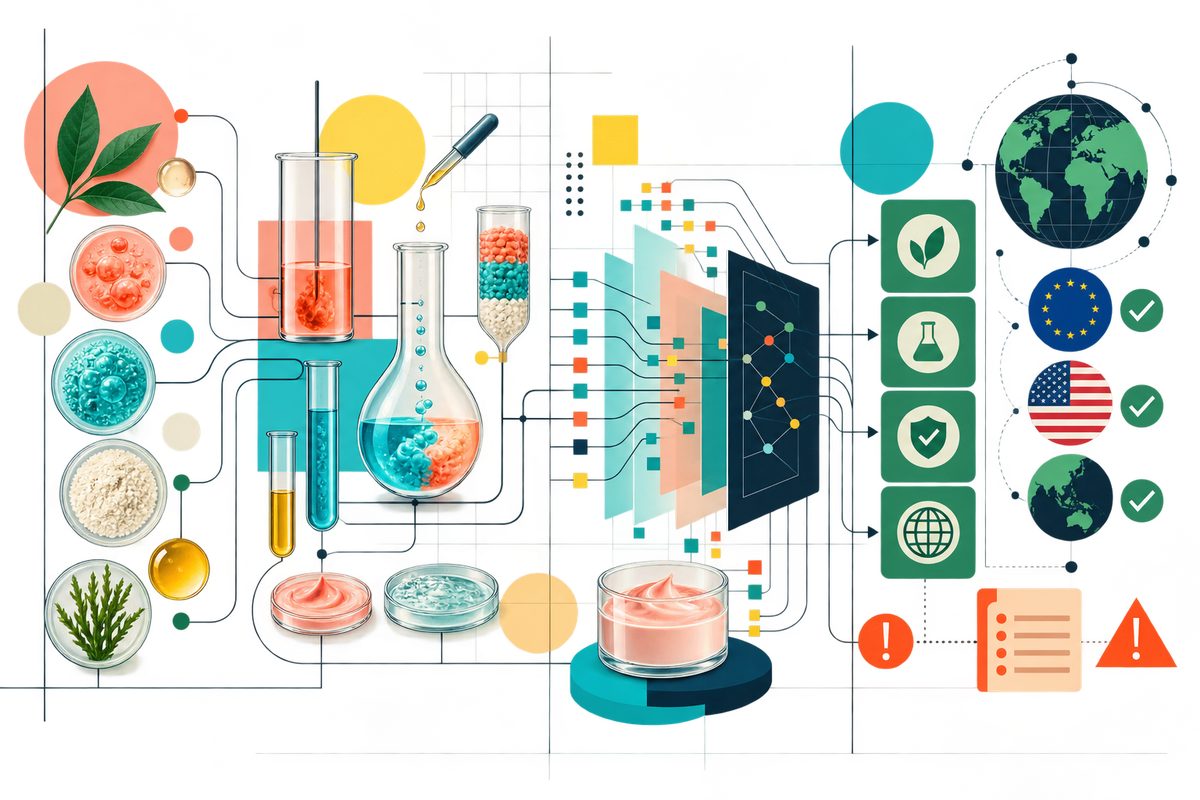
A formulator can build a formula from raw materials, qualify functional ingredients and see whether the proposed product meets a brief. The platform checks the ingredients during formulation instead of waiting for a separate compliance review. Teams can generate specifications and batch documents, manage private chemical policies and use a secure portal to communicate with external R&D partners.
Concept tools sit earlier in the process. A product developer can research an active ingredient, compare competitive products, look for similar formulas and examine consumer sentiment tied to ingredients or benefits. Portfolio tools sit later. They monitor products already on the market for exposure to regulatory updates or supply disruptions, hold supporting documents and assist with FDA cosmetic-product listings under the Modernization of Cosmetics Regulation Act, known as MoCRA.
One continuous record
In 2024, Good Face added CARA Chat and a reverse-engineering module. CARA is a beauty-specific assistant that can answer questions using the company's structured information plus a customer's private documents. The reverse-engineering tool begins with a public ingredient list, identifies likely trade-named materials and assembles an estimated formula that a chemist can adjust. It is useful for benchmarking, supplier discovery and exploring a lower-cost or more compliant alternative. It is not a substitute for laboratory validation.
The same year, the company added human regulatory services covering MoCRA filings, international market entry, label and claims reviews, portfolio risk and policy interpretation. That move clarified the limit of automation. Software is good at gathering a changing rule and mapping it across thousands of ingredient records. A specialist is still needed when enforcement history, product context or the wording of a claim changes what the rule means.
The price of avoiding the late surprise
Good Face sells subscriptions rather than jars. Public reporting around its 2022 seed round said plans generally began at $299 per month and reached thousands of dollars per month. Current pricing is quote-based, and regulatory services add a consulting layer. The customer has to compare that bill with a less tidy collection of costs: a chemist searching databases, a regulatory specialist reviewing another workbook, duplicated raw-material records, a reformulation after a retailer rejection or a delayed launch in a second country.
The company raised a $5.65 million seed round led by VMG Catalyst in 2022. Its public customer lists have included L'Oreal, e.l.f. Beauty, K18, Supergoop!, The Honey Pot Company, Hero Cosmetics, Vegamour and contract manufacturers. Mario Badescu has publicly credited the platform with making regulatory work and product-development collaboration easier. Good Face says hundreds of cosmetic companies use the software.
Its partnership with the Society of Cosmetic Chemists widened the funnel in 2025. More than 5,000 SCC members became eligible for one year of complimentary access to a defined R&D tier, including unlimited raw-material evaluation and up to 25 formulations. It is education, professional infrastructure and product distribution in one arrangement.
The moat is maintained context
Good Face competes with specialist systems including Coptis, KosmetikOn, EcoMundo, Cosmedesk and Cosmetri, plus broader product-lifecycle software and regulatory consultants. Its most persistent rival is cheaper in the budget and costly in the workflow: Excel, email and institutional memory.
The company's distinction is the attempt to connect the full sequence around an ingredient. One record can carry scientific literature, supplier and trade names, formula function, geographic restrictions, retailer policies, sustainability attributes and the products in which it appears. That context makes AI more useful. A general chatbot can write fluent prose about niacinamide. A system linked to a customer's actual formula, documents and target markets can flag the question the team needs answered.
The pitch is therefore less “AI invents your next moisturizer” than “your chemist does not need to open six tabs and three workbooks before lunch.” The second promise is narrower. It is also easier to measure.
What another founder can copy
Build the industry's grammar before its chatbot
- Start where confusion is visible. Good Face began with shoppers trying to decode labels.
- Structure the nouns. Ingredient names, synonyms, rules and evidence became reusable data.
- Move upstream to the recurring workflow where delay has a budget.
- Put compliance inside creation, not at the end as a separate gate.
- Add AI after the private and proprietary context can constrain the answer.
- Keep experts for decisions where policy, precedent and judgment still matter.
When the model works, and when it does not
Good Face has the strongest case when a team owns formulas, manages many raw materials, sells across markets or retailer programs and needs chemists, regulatory staff and brand managers to share one source of truth. Complexity compounds the value. Each additional product and jurisdiction creates another reason not to maintain the system by hand.
It is less compelling for a tiny brand that outsources formulation and regulatory work, has a short portfolio and sells through one simple channel. Software cannot repair poor supplier data, replace stability or safety testing, guarantee a regulator's interpretation or make a weak product brief commercially smart. Reverse engineering still produces an estimate, not the competitor's laboratory record. AI output remains only as reliable as the underlying evidence and the user's review.
| Condition | Likely fit |
|---|---|
| Strong | Multiple chemists, many formulas, several markets, retailer-specific policies and regular regulatory review. |
| Mixed | A growing brand with outsourced manufacturing but enough launches and claims work to require a shared record. |
| Weak | A very small, single-market portfolio whose manufacturer already owns the full formulation and compliance workflow. |
The larger market bet is straightforward. Beauty is producing more variants for more channels while governments and retailers ask for more documentation. The industry can either hire enough people to reconcile that complexity manually or give those people better systems. Good Face Project is selling the second option.
There is a pleasing loop in the company's path. It began by asking how a shopper could understand what was inside a bottle. Eight years later, its business is helping the people behind the bottle understand the same thing sooner, together and with fewer attachments named “final_v7.”