At New Roots AME Church, there is a useful way to explain an unexpected trace of Prince or J Dilla in the soundtrack: blame Rahn. Turahn Dorsey serves on the church’s steward board, helped shape its founding design team and is married to its founding pastor, Mariama White-Hammond. The jazzy vibes are part of his contribution. It is a rather more revealing job description than most executive biographies manage.
The music belongs in the picture. Dorsey is president and chief executive officer of Eastern Bank Foundation, a former Boston education chief and a co-founder of Jazz Urbane Recordings. His work stretches from classrooms to commercial space, from the practicalities of a grant to the possibilities of a gathering place. Across those settings, the question keeps returning: how do people gain access to the opportunities around them?
A school can be nearby and still feel out of reach. A neighborhood can attract investment without giving its residents much say in what arrives. A promising job can remain inaccessible to someone who needs English instruction. Dorsey’s career follows these gaps between proximity and participation. It also suggests that a city’s cultural life deserves a seat at the economic development meeting. Preferably somewhere near the speakers.
Detroit supplied the first classroom
Dorsey grew up in Detroit, attending the school where his mother taught. Her colleagues were people he encountered beyond the classroom, too. Education had a social life. At middle school, he remembered students setting demanding expectations for one another, sometimes exceeding the expectations adults held for them. Learning was something the children helped keep in circulation.
His education also included art classes, drawing comics with friends and time in recording studios learning from engineers. That assortment helps explain the adult who can move between evaluation frameworks and a record label without treating either as an eccentric diversion. Each offered a way to learn through contact with people who knew something worth knowing.
Concord Academy brought a different setting. Dorsey arrived through A Better Chance and Midwest Talent Search, graduating in 1989. He has described bringing a strong sense of agency from Black-majority Detroit into the independent school. Music and friendships mattered there, alongside the challenge of managing his own time. The move expanded his world without requiring him to disown the one he came from.
A research apprenticeship began at 16 with a suburban Detroit firm owned by a family friend. By 19, he was managing projects for Michigan and Detroit. He earned a bachelor’s degree in economics at the University of Michigan and moved to Boston in 1995 to join Abt Associates. Before grantmaking and public office came the less photogenic business of investigating how programs worked.
“I'm data-driven but not data religious.”
Turahn Dorsey, 2014
The numbers were an invitation to ask
At Moore and Associates in Michigan and later Abt in Cambridge, Dorsey worked as a researcher and evaluator. The work included quantitative and qualitative analysis for governments and foundations. Measuring outcomes meant moving between a program’s intentions and what people actually experienced. An elegant theory still had to survive an encounter with the evidence.
At the Barr Foundation, he became its first evaluation director and also worked in education grantmaking. His responsibilities included evaluation approaches for education and climate investments. He supported learning outside school, summer programs and connections between schools and community organizations. These were places where a child’s experience could cross several institutional boundaries before lunchtime.
The combination matters. An evaluator asks whether an effort works; a grantmaker decides which efforts receive support. Dorsey had experience on both sides of that conversation. In 2014, preparing to become Boston’s education chief, he explained that data should prompt further questions and help people improve their work. Numbers offered direction, with room left for judgment.
A city with more than one school door
Mayor Martin J. Walsh brought Dorsey into his cabinet in September 2014. Dorsey served as chief of education until November 2018. The remit connected schools with a much wider landscape of learning: colleges, community organizations, workplaces and technical training. Boston had abundant institutions. Getting them to work together was a separate assignment.
During those four years, he co-led the creation of the city’s universal prekindergarten system and the first phase of public school facilities planning. That planning led to $200 million in school improvement investments. He also led a redesign of Boston’s college scholarship program and co-created the Family-Led Stability Pilot, which addressed homelessness among public school families. Housing and education appeared in the same working life because they already appeared in the same family’s day.
The access question continued through his board leadership at Franklin Cummings Tech. At the college’s June 2024 annual meeting, Dorsey joined Massachusetts Education Secretary Patrick Tutwiler, Dearborn STEM Academy head Darlene Marcano and Smith Family Foundation education director Marjorie Ringrose for a discussion of Early College. The arrangement depends on institutions doing some unglamorous coordination so students can make an ambitious transition.
The college highlighted its Advanced Standing Associates Program, through which high school seniors can finish school with a year of college credits toward an associate degree. Here, the distance between high school and college becomes something institutions can actively shorten. Dorsey’s place in that discussion fits a career concerned with how the pieces of an education connect.
There was always a record playing
Music runs alongside this public work. In 2014, Dorsey co-founded Jazz Urbane Recordings with Berklee professors Bill Banfield and Joey Blake. Banfield’s musical project brought experienced performers together with younger players. Their different ideas about rhythm and harmony created an exchange in both directions, with mentorship built into the music.
The production process had an appealingly domestic beginning: Banfield, Blake and Dorsey worked in Banfield’s kitchen, recording with GarageBand. The project went on to involve producer and keyboardist George Duke. Institutional ambition, in this instance, began with the sort of software available on a home computer. A kitchen is an excellent place to test an idea, provided everyone can find somewhere to put the cables.
Jazz Urbane Café carried the cultural ambition into a physical development in Nubian Square. Dorsey’s partners included Banfield and restaurateur Nia Grace. In October 2023, he and Grace welcomed visiting mayors to the Bolling Building during a Mayors’ Institute on City Design session hosted by Michelle Wu. He was identified then as the venture’s co-CEO and director of business strategy and community engagement.
The venue’s route through city approvals offers a small lesson in how much administration goes into a place designed for pleasure. Boston licensing materials from December 2023 described 187 indoor seats and 32 seasonal outdoor seats, with Dorsey named as manager. The board granted the application pending availability of a qualifying license. Behind a future evening of music sit hearings, floor plans, licenses and people willing to keep attending meetings.
Giving money a longer assignment
Dorsey joined Eastern Bank Foundation as a fellow in 2019, initially working on early childhood strategies. In July 2022, he was promoted to its newly created chief impact officer position, which combined economic inclusion work with measurement, evaluation and learning. The researcher’s concerns had followed him into philanthropy.
He became president and CEO in July 2025, succeeding Nancy Huntington Stager. Working with Stager and the foundation’s fellows, he had helped develop its mission and strategies, including its first debt investments in affordable housing and community land ownership through long-term, low-interest loans. A loan can serve a different purpose from a grant. Choosing between them requires attention to what a particular project needs.
One early announcement during his presidency made the workforce connection concrete. In July 2025, the foundation welcomed Eva Millona to lead its Career-Focused English Proficiency Initiative, backed by a $10 million commitment over three years. Jerry Rubin, another foundation fellow, remained a partner in the effort. The initiative linked language learning with careers, treating access to instruction as part of the region’s economic capacity.
In September 2026, the foundation gave its inaugural Nancy Huntington Stager Collaborative Impact Award to Just A Start and its Rindge Commons partners. The Cambridge development combines affordable housing, workforce training and early childhood education. Dorsey emphasized bringing those services together in response to the range of a family’s needs. The award recognized a model built by several organizations, each contributing something the others could not supply alone.
What belonging asks of a balance sheet
On October 7, 2026, Dorsey sat down with Greater Lowell Community Foundation president Jay Linnehan at UTEC in Lowell. Their conversation connected economic mobility with belonging: whether people can feel part of a community when they cannot get ahead in it. Cultural spaces, including his work on Jazz Urbane Café, were part of the discussion.
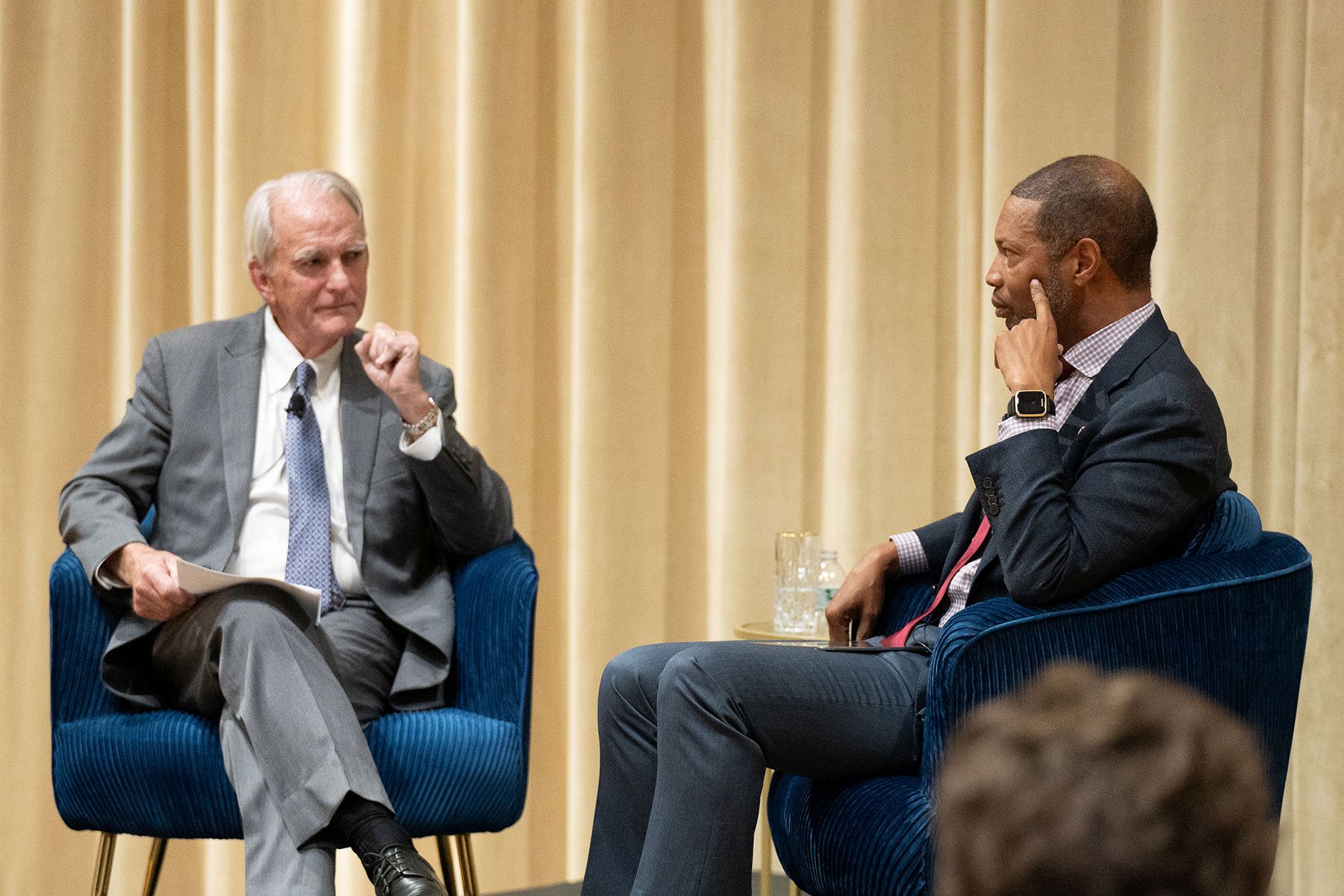
That is a demanding way to think about philanthropy. It asks organizations to consider the daily experience behind an economic category: studying, finding work, staying housed and having somewhere to gather. Dorsey has spent his career moving among the institutions responsible for different pieces of that experience. The movement is the story.
His current ambition includes accelerating economic mobility, an idea he describes with the phrase “escape velocity.” The phrase carries urgency. His methods still require other people: educators, researchers, community leaders, musicians, public officials and neighbors. A city cannot schedule its progress like a solo performance. Someone has to listen for the next entrance. With Dorsey, there is a reasonable chance the listening began long before the meeting.
Keep the conversation going
- Eastern Bank Foundation - Turahn Dorsey ↗
- LinkedIn - Turahn Dorsey ↗
- X - @turahndorsey ↗
- Listen: the 2014 Radio Boston conversation ↗
- Read: Concord Academy’s conversation on civic dialogue ↗
- Watch on YouTube: Franklin Cummings Tech’s Early College panel ↗
- Watch: ROXTalks with Turahn Dorsey ↗
- Listen: Yours, Mine, Ours - Jazz Urbane Café ↗
- Read: Rindge Commons and the 2026 collaborative impact award ↗
- Read: the October 2026 Lowell conversation ↗