The internet is excellent at producing video and terrible at producing a common account of what happened next. YouTube counts one way. Instagram offers another window. A creator’s follower number may be impressive, inert or both. A brand sees its own dashboard; its competitor’s campaign remains a silhouette. Tubular Labs built its business in that gap. The Mountain View company collects public social-video activity, organizes creators across platforms, standardizes performance and lets a buyer ask the question native analytics cannot answer: compared with what?
Today Tubular markets a database of more than 25 billion videos, 50 million creators and 2 million categories and topics. Those figures are not decoration. They are the raw material for a research tool used by publishers deciding what to make, agencies defending a media plan, brands vetting influencers and sales teams trying to prove that their audience deserves a larger check.
A dashboard for the people who did not own the platform
Rob Gabel and Allison Stern founded Tubular in 2012, when “online video” largely meant YouTube and multichannel networks had names such as Machinima, BigFrame and AwesomenessTV. The first private beta was almost quaint by current standards. It showed creators audience demographics and viewing habits, identified superfans, suggested possible collaborations and even helped community managers find comments worth answering.
The original customer problem was not mysterious. Creators had audiences but little institutional machinery for understanding or selling them. Tubular helped them describe the crowd to an advertiser. It raised $650,000 in seed funding, followed by a $2.5 million round in December 2012. Early trials included networks and individual YouTubers. There was no public price.
Nothing in the public record points to a cinematic first failure - no scorched launch, no midnight pivot memo. The first thing that broke was the neatness of the market. Video escaped YouTube. Facebook, Instagram, Vine, Twitch and later TikTok made a YouTube-only view increasingly incomplete. By 2016, Tubular had expanded from serving influencers and networks into measuring video across roughly 30 platforms for agencies, studios, entertainment companies and consumer brands. The company did not abandon its premise; the premise outgrew the first product.
“Online video is incredibly complicated.”Rob Gabel, explaining the market in 2014
That change also moved the budget. A creator wants to grow. An enterprise wants to allocate millions across content, sponsorship and advertising while explaining the decision to a finance team. Tubular Intelligence, introduced in 2014 alongside an $11 million Series B, became the central product for that larger buyer. Another $7 million arrived in 2015 and $10 million in 2016. Across the disclosed early rounds and debt, the company raised more than $30 million; company databases put its lifetime total in the mid-$30 millions.
The clever bit is the filing cabinet
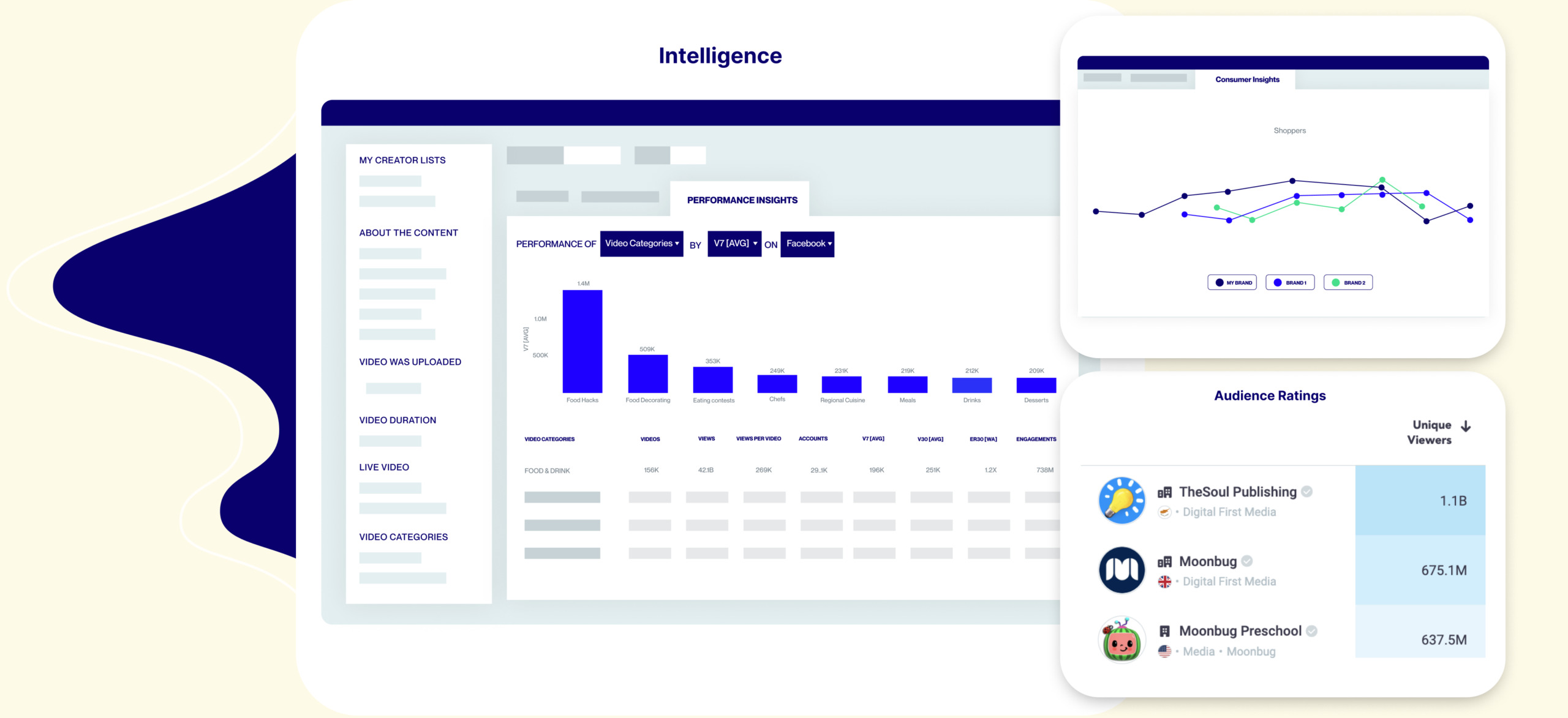
A large database is useful only when a user can name what is inside it. Tubular’s defensible layer is ContentGraph, its machine-learning system for sorting videos and consolidating a creator’s channels into a cross-platform portfolio. The taxonomy includes broad categories and fast-changing topics. A food marketer can move from “food and drink” to Japanese food, strawberries or street food; an entertainment analyst can compare a franchise with the memes, music and reaction videos orbiting it.
That classification feeds the product family. Tubular Intelligence is the deep research environment. Viewpoint gives a wider team simpler monitoring dashboards. Audience Ratings uses TV-like measures such as unique viewers, minutes watched and 30-second views. Consumer Insights connects viewing with modeled shopping, search and website behavior. DealMaker tracks sponsored content so a brand can inspect a creator’s history before negotiating. The API sends the same data into a warehouse, a BI tool or an internal model. Consulting is available when the customer would rather buy an answer than operate the machinery.
This is how Tubular differs from native analytics. YouTube Studio is usually the better place to diagnose your own channel in detail. Tubular is built for the market outside your login: competitors, unaffiliated creators, adjacent categories and aggregate behavior. It also differs from classic social-listening tools, which often begin with mentions and conversation. Tubular begins with video consumption, then layers on audience, content and commercial context.
The sale happens when the benchmark changes a decision
The sharpest evidence comes from customers using the data to change a rule, a pitch or a production plan. Roblox, facing pandemic-era growth, expanded its Video Stars program from about 200 creators to 700 in a year. Tubular data helped the company define entry criteria including 10 million cumulative Roblox video views, 25,000 average views per Roblox video and 100,000 followers. The useful copyable move is not Roblox’s exact thresholds. It is writing down performance gates from category-specific evidence instead of recruiting by follower count and instinct.
Jungle Creations had a different problem: prove sponsored work was worth more. Six Oreo videos from its Twisted food brand averaged 3.5 million views in their first 30 days, 11 times the reach of Oreo’s organic content in the comparison. Engagements were 326,000 against 94,000. That evidence supported an ongoing partnership and gave the sales team a clean proof point instead of a glossy case-study adjective.
Roblox creators
A program expanded with explicit, data-backed admission rules and a map of adjacent interests.
Oreo reach
Jungle Creations compared sponsored first-30-day views with the brand’s organic benchmark.
Other public cases describe BuzzFeed increasing average monthly views by more than 11 percent, Mattel growing social channels 42 percent in a year and Hearst Television lifting Facebook engagement 310 percent. These are customer stories, not controlled experiments. The reasonable takeaway is narrower: a broad competitor dataset can expose formats, timing and topics that an owned-channel dashboard will never reveal by itself.
What it costs, and where the bargain disappears
Tubular does not publish a dollar figure. It sells seat-based plans with custom quotes, product suites, add-ons, API access and consulting. DealMaker requires Tubular Intelligence; Viewpoint can stand alone or extend an Intelligence plan. The acquisition price was also undisclosed when Chartbeat bought Tubular and Lineup Systems in March 2023.
The opacity tells you who the product is for. Its return is easiest to defend when a customer manages many channels, markets, creators or client accounts, or when one partnership decision can cover a meaningful subscription. A solo creator who mainly needs retention curves and thumbnail feedback should start with native tools. A small brand running three campaigns a year may be better served by an agency or a one-off research engagement. Tubular becomes interesting when the cost of a wrong content bet, a weak sponsorship or a missed trend is larger than the cost of ongoing intelligence.
Copy the method, not the software bill
- Choose a decision first: what to make, whom to hire, where to sell or what rate to defend.
- Build a real comparison set, including rivals and adjacent categories your audience also watches.
- Normalize time. Compare first-day with first-day, or first-30-day with first-30-day performance.
- Separate reach from attention, then connect both to a business outcome such as a sale, visit or renewal.
From social telescope to media operating system
Chartbeat’s purchase changed Tubular’s context more than its purpose. At acquisition, the combined group said Chartbeat, Tubular and Lineup would serve more than 1,000 media organizations in 70 countries. Chartbeat saw what happened on a publisher’s properties; Tubular saw the social-video landscape; Lineup managed advertising and subscription revenue. FatTail later joined the portfolio. By 2026, the group was pitching a single AI-powered platform intended to connect editorial intelligence directly with ad operations.
Where Tubular earns its keep
The risk is the same one that follows every data platform. Public signals are not the whole person. Modeled behavior is not a receipt from every viewer. Platform rules change, APIs narrow, and a beautiful historical pattern can still lose to a strange new format tomorrow morning. A taxonomy can organize culture without predicting it. Teams that treat the dashboard as permission to stop experimenting will merely make more expensive mistakes.
Tubular’s better lesson is almost boring: make incompatible evidence comparable, then attach it to a decision with money behind it. The company started by helping YouTubers find fans. It grew because brands and publishers needed to see the audience they did not own. Fourteen years later, the names of the platforms have changed and the videos have multiplied. The valuable question has stayed put: what is everyone else watching, and what should we do before they move on?