An order arrives. Then another. Sales climb, the owner hires, and the next month looks busier than the last. It is an attractive business story. An investor, however, has a second question: when does the cash arrive? That question offers a way into Trinity Investment Group, a private investment firm whose stated preferences begin with businesses that have already demonstrated something.
- The work: capital solutions for small and middle-market companies.
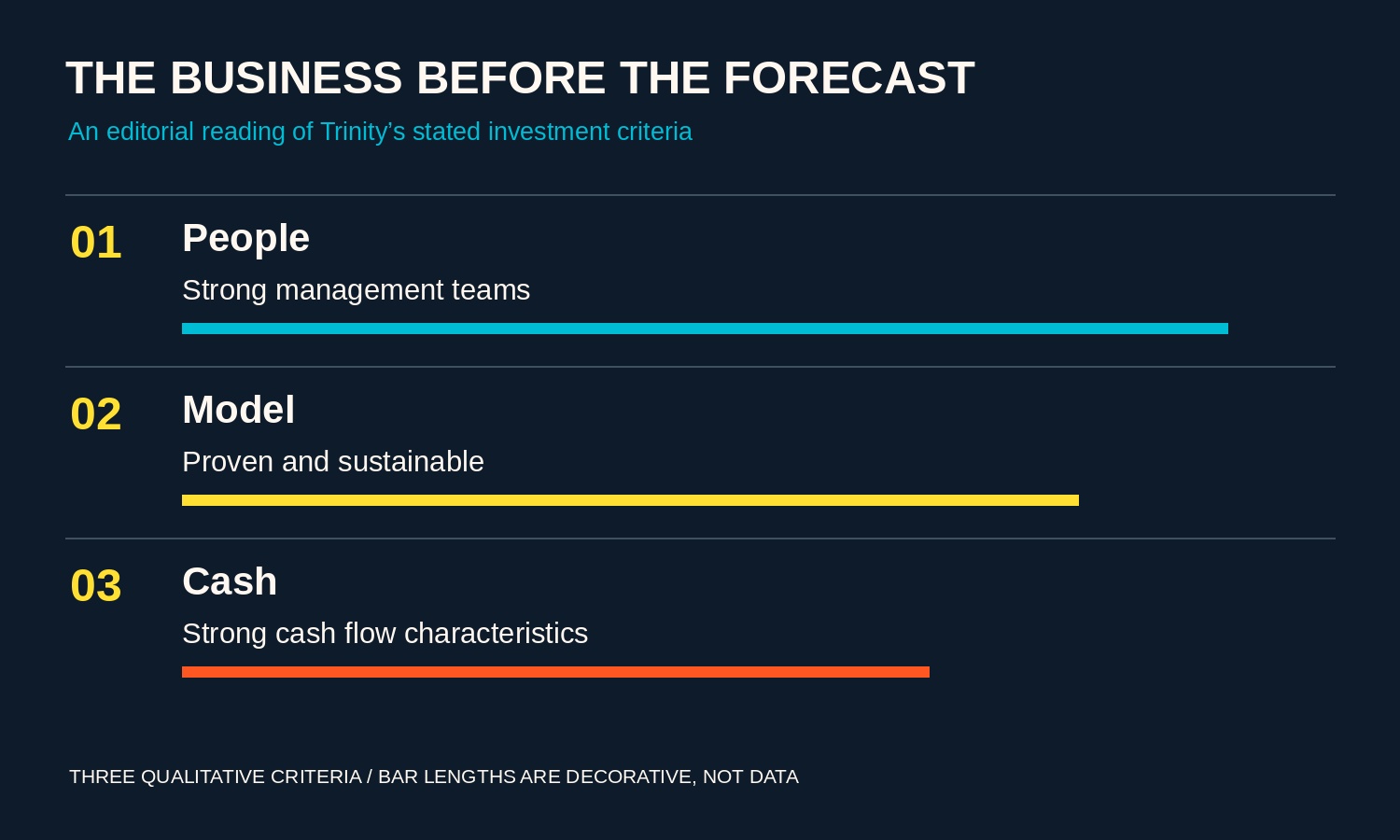
- The preference: capable management and a proven, sustainable business model.
- The financial focus: strong cash flow characteristics.
Those are the essentials of Trinity’s published company description. Read together, they suggest an investment conversation built around operating evidence. For a business owner, the interesting part is how those few criteria change the pitch. A forecast still matters. It simply has to stand on something.
The business before the forecast
Trinity describes its work as providing capital solutions. Its audience is small and middle-market companies, and the managers running them. The offer belongs in the world of business finance: capital entering an operating company to address a business need. Its description presents a relationship between an investor and a management team.
The word “proven” does considerable work here. A new idea asks an investor to believe that demand might exist. An operating business can bring evidence that demand does exist. Repeat orders, customer retention, margins, and collections are examples of evidence an owner could assemble. These are an editorial interpretation of the brief, rather than a published Trinity checklist.
That distinction gives the company’s positioning its shape. The apparent fit is an enterprise with an operating record and a team able to explain it. A founder still discovering who will buy the product faces a different conversation. Trinity’s language points toward evaluating an existing economic engine.
The invoice has a different calendar
Cash flow can sound like the dull cousin of growth. In an operating business, it sets the timetable. The SEC’s guide to financial statements distinguishes reported profit from cash generation. A sale can contribute to earnings while the customer’s payment is still on its way. Meanwhile, wages, suppliers, and equipment have payment dates of their own.
Consider a hypothetical distributor. It wins a larger account, buys inventory, and delivers the goods. The customer pays later. On paper, expansion looks successful; in the bank account, the timing is uncomfortable. This is an illustration, not a Trinity portfolio company. It explains why sales growth alone cannot answer an investor’s cash question.
Strong cash flow characteristics can therefore be read as a preference for understandable cash generation. An owner can make that discussion more useful by showing when customers pay, what inventory absorbs, and how much equipment spending the operation requires. A revenue chart becomes more informative when it sits beside the cash calendar.
“strong cash flow characteristics”Trinity Investment Group’s stated investment preference
The revealing moment in the hypothetical distributor’s story comes when the next order arrives before the previous invoice is paid. More demand now requires more money tied up in stock. An owner who can explain that sequence gives an investor something specific to evaluate: the timing problem, its size, and whether it repeats predictably.
A partner needs someone to partner with
Trinity also says it strives to partner with strong management teams. That puts the people running the business inside the investment case. The published ambition is a partnership with capable operators. The language suggests that management quality matters alongside the financial characteristics of the company.
For an owner preparing an introduction, a useful response would be concrete: identify who runs sales, who controls spending, and who can keep the operation moving when the owner is absent. Explain the decisions the team has already made. Those examples do more to illuminate capability than a row of impressive job titles.
Partnership is also a word worth unpacking during any financing discussion. Owners can ask how decisions would be made, what reporting would be expected, and which matters would require investor approval. These are questions prompted by the language, rather than claims about Trinity’s contracts. A shared adjective does not settle a governance arrangement.
The price lives in the agreement
A company seeking capital needs to know both what the money enables and what it costs. Across business finance, debt and equity create different obligations. The SBA’s explanation of investment capital describes debt as money repaid with interest and equity as ownership exchanged for funding. That distinction is useful context for assessing any capital proposal.
A sensible comparison puts the complete arrangement beside the business plan. How much cash must leave the company? What ownership would change? Who gains decision rights? What happens if the plan takes longer? Those questions help an owner compare proposals without confusing a large funding amount with a favorable bargain.
Trinity’s broad capital-solutions description makes the initial conversation a matter of fit. Its stated emphasis on management, a proven model, and cash flow provides a starting point for that discussion. The eventual economics belong in an actual proposal and agreement; a company description cannot establish them.
For an established company, the available alternatives might include another private investor, a lender, or retaining more earnings inside the business. Each answers a slightly different need. Trinity’s place in that comparison follows from its stated role as a capital provider and its preference for management partnerships, rather than from any claimed advantage in price or speed.
Borrow the questions
The useful lesson travels beyond one firm. Before approaching an investor, write down why customers return, how the management team makes decisions, and how sales become available cash. Put evidence beside each answer. This is a preparation exercise drawn from Trinity’s positioning, not a promise that following it will secure funding.
The same exercise can expose a mismatch. If a business still needs to prove demand, or continually consumes cash while testing its model, it appears less aligned with these stated preferences. That is an inference about fit, not a confirmed exclusion policy. An owner can use it to make an initial conversation more precise.
Trinity’s brief leaves an owner with a practical challenge: explain the business that exists today well enough for someone else to understand what additional capital could change. The most persuasive page in that presentation may be the one showing how an ordinary month actually works.