The enrollment form went home with the employee. That was the problem. At TaskRabbit, Kevin Busque had helped arrange a retirement plan, yet the people he wanted to help were largely ignoring it. In a later interview, he recalled participation of just 36 percent. The younger employees faced unfamiliar funds, contribution decisions and paperwork. Tomorrow had acquired a surprisingly effective gatekeeper: a form nobody wanted to finish.
- Guideline bundles retirement administration, recordkeeping and investment services for small businesses.
- Payroll connections reduce repeated data entry and contribution handling.
- Gusto acquired the company in 2025. Current service depends on the payroll and plan arrangement.
Busque’s response became Guideline, founded in 2015 with Mike Nelson and Jeremy Caballero. All three had worked at TaskRabbit. They were tackling a peculiar failure: a business could buy an employee benefit without making it practically useful. Offering access was one task. Getting someone through the door was another.
Build the plumbing first
A retirement plan appears to be an investment product. Underneath, it is also a demanding recordkeeping operation. Someone must track who is eligible, what each person contributes, which employer payments belong where, and whether the plan satisfies its requirements. Each payday produces more information. Each correction has consequences.
Guideline built its own recordkeeping system. That decision put engineering effort into the machinery behind the screen. The company could then automate work commonly spread across providers, including administration, compliance testing and government reporting. The attractive dashboard was the visible end of a longer piece of work.
“Our motto at Guideline is to do the hard things first.”
Kevin Busque · founder interview, 2023
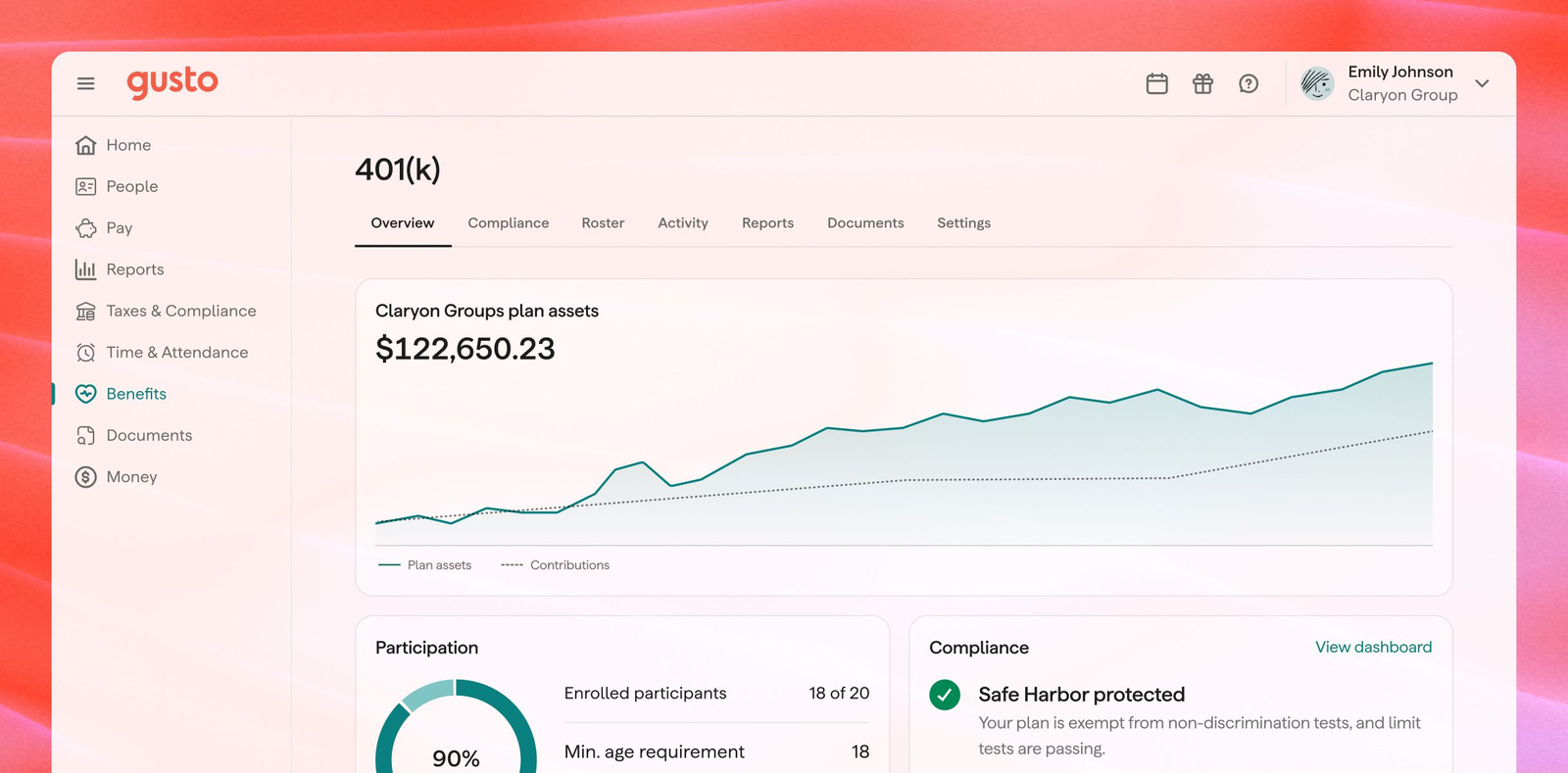
Payroll supplied the connection. A paycheck already contains much of the information a retirement provider needs. Connecting the systems lets employee deductions and employer contributions flow through a familiar routine. Gusto’s current setup documentation describes contributions automatically syncing with payroll and retirement dashboards accessible through Gusto.
Less retyping. Fewer handoffs. A benefit inside the routine.
This was also distribution. Retirement benefits could reach a business through software it already used to pay people. A payroll integration improved the service and put it near the purchasing decision. For a founder, that combination is worth studying.
The customer with twelve other jobs
The natural buyer is the small-business owner who has become the HR department by accident. An employer wants to offer a useful benefit, perhaps add a match, and return to running the business. Employees want to enroll, choose contributions, see their balance and understand their investments without first mastering retirement administration.
Guideline’s published customer stories include Affogato HR Consulting, Rose City Philanthropy and Michigan’s Children. These are useful examples because they move the story beyond technology startups. A consulting practice and a nonprofit have the same administrative problem, even if their budgets and reasons for offering a plan differ.
In a company-published account, Rose City’s Jeri A. described introducing its plan: “I just checked it off my list and got back to business.” This is selected customer testimony, but the appeal is concrete. A task that once looked like a project had become something she could finish.
Alternatives include Human Interest, Betterment and Vestwell, alongside established retirement providers. Guideline’s pitch rests on connected administration and a legible buying experience. The sensible comparison includes investment choices, service responsibilities and payroll compatibility. A handsome balance chart tells only part of that story.
The broader offering also includes SEP IRAs and traditional and Roth IRAs, extending beyond an employer’s workplace plan. Here, too, the distinction between a simple interface and the underlying service matters. Administration, investment advice and custody have different jobs, performed by separate entities. The screen brings them together; it does not make them the same business.
The price has more than one line
The old description of Guideline as simply a flat-fee provider needs updating. Its published 2026 tiers combine an employer base charge with an active-participant charge. The comparison also lists a separate 0.25 percent annual participant account fee. Fund expenses are another layer, and legacy arrangements can differ.
The monthly employer bill
Base fee + 10 participant fees. Excludes employer contributions, participant account fees, fund expenses and other applicable costs. Published 2026 rates; legacy terms may differ.
The arithmetic above uses $49 plus $6 per participant for Starter, $119 plus $8 for Core, and $179 plus $8 for Premium. Those prices buy different capabilities. Starter excludes employer contributions and loans, and restricts eligibility to qualifying businesses without a retirement plan in the preceding twelve months.
Core allows employer matching and profit sharing. Premium adds support and transfer capabilities; businesses bringing an existing plan must retain that tier for at least a year. The cheaper tier will therefore disappoint an employer shopping primarily for matching or a plan transfer. The feature decision comes before the price decision.
The partner became the parent
By 2020, an investor announcement reported more than 13,000 business clients and $2.5 billion in retirement assets. General Atlantic led a $200 million financing in 2021. Then the longstanding payroll relationship became the company’s next destination: Gusto announced an acquisition agreement in August 2025, and Guideline announced completion that November.
businesses helped to offer a 401(k), with $10 billion saved through the Gusto–Guideline partnership, according to the companies.
The product became Gusto 401(k) powered by Guideline. There is a practical qualification. The post-acquisition professional-program FAQ distinguishes integrated Gusto payroll plans from new self-service arrangements using other providers. Some former plans moved to Accrue; Vestwell subsequently acquired Accrue and published a 2026 transition schedule.
For an employer, that makes the current payroll connection a purchasing question, rather than a detail to check later. For another founder, the transferable idea is equally specific: find the recurring work surrounding the product, then connect it to a routine the customer already trusts. Guideline began with the form people abandoned. Its opportunity lay in everything that made that form necessary.