The barcode scanner is rarely the star of a business story. It sits in a worker’s hand, reads a label and earns its keep by attracting no attention. Then it breaks, disappears or ships out inside somebody else’s order. Suddenly, a small piece of equipment becomes an expensive interruption. This is the territory TRG has made its own: the daily work of keeping business technology available to the people who need it.
The Ohio company sells and supports the devices that connect physical work to digital systems: handheld computers, printers, tablets, payment terminals and more. Its place in the technology economy is unusually tangible. Someone must load the applications, label the asset, arrange the replacement and find out why the same unit keeps coming back. TRG offers to handle that sequence.
The trouble starts after checkout
Sean Kennedy launched TRG in 2002 with a straightforward ambition. His company biography describes a comprehensive equipment and services offering “under one roof.” That idea remains useful because buying equipment and operating equipment involve different kinds of work. A procurement team can negotiate a price; a distribution center still needs a functioning scanner at the beginning of the next shift.
TRG’s deployment business includes new, refurbished and rental devices, application loading, configuration, kitting and installation. Customers can buy the equipment and the preparation together. For a company opening locations or adding seasonal capacity, the practical attraction is receiving something workers can use, rather than another project for the local IT team.
At the other end, reverse logistics covers repair coordination, replacement inventory and retirement. TRG can repair devices itself or manage their trip to the manufacturer. Configured spares wait for deployment; equipment at the end of its working life enters disposal processes. Those services make the business partly a repair operation, partly a logistics operation and partly an outsourced technology department.
- 01Source
- 02Configure
- 03Deploy
- 04Support
- 05Repair / retire
ServiceHub connects the records. Technicians and logistics teams do the physical work.

The scanner in the wrong box
A pet food distributor’s problem was almost comically literal. Workers sometimes left handhelds where the next shift could inadvertently pack them into customer orders. In TRG’s account of the relationship, hardware losses exceeded $100,000. Its proposed safeguard used RFID tags and a tunnel that could detect a boxed device and stop the conveyor.
The relationship had begun with secure lockers in 2016. Nearly $3 million in locker systems were installed; subsequent hardware and support business approached $6 million. These were separate scopes, not the price of the RFID tunnel. Delayed repairs, deliveries and quotations from the incumbent provider helped persuade the customer to expand its work with TRG.
The lesson is deliciously unglamorous: locate the moment an asset loses its owner. Then build the control there. A badge-operated locker addresses checkout accountability. A conveyor checkpoint addresses an accidental departure. Buying more handhelds leaves both process problems intact.
An airline needed a map of its own equipment
Another customer arrived with a repair complaint and ended up with a software project. An unnamed global airline had grown dissatisfied with manufacturer service delays. According to TRG’s airline case study, a customized ServiceHub implementation brought nearly 100,000 IT assets from more than 100 manufacturers into one system. Development and launch took more than a year.
The portal routed repair requests to the appropriate provider, including providers other than TRG. That detail matters: large organizations inherit equipment and service relationships from many purchasing decisions. A useful operating system for repairs must accommodate the fleet that exists.
ServiceHub’s broader offering includes repair tickets, device histories, spare inventory, orders and custom reports. TRG currently reports more than 10 million devices under management and more than 5,000 enterprise customers. Those company-reported figures describe reach; the airline example better illustrates the work involved in making information usable.
Historical customer project described by TRG
The pilot passed. The firmware moved.
TRG’s paint-manufacturer story contains the sort of detail that polished technology presentations tend to hurry past. Between the pilot and the rollout, Honeywell released two more firmware versions. The newer firmware caused compatibility trouble involving older devices. TRG says it worked with Honeywell’s development team on a patch.
The same customer account describes a change of mind driven by business conditions. Pandemic uncertainty had delayed an Android migration. A profitable summer and stronger demand for home-improvement products revived the project, with procurement tied to the 2020 budget year. The customer chose two device types following employee feedback.
For anyone planning a rollout, the inference is clear: test the configuration that will actually arrive. A successful demonstration can age before the purchase order becomes a shipment. Preserve the tested software image, record changes and keep a route back to the manufacturer’s engineers.
TRG’s ongoing endpoint management services cover enrollment, application packaging, remote monitoring and migrations. Its published plans distinguish standard from fully managed coverage, including different support windows and change allowances. Buyers should read those limits closely. The service level determines how much operational responsibility actually moves outside the company.
A repair network with a security department
Physical equipment brings physical obligations. In payments, TRG operates key injection facilities in the United States and Canada, preparing terminals with encryption keys as part of deployment. It supports merchants, independent sales organizations and software vendors, and maintains replacement devices. A checkout application needs that surrounding hardware work before the first customer can tap a card.
Security became a more explicit part of the offering in September 2024, when Inversion6 became TRG’s dedicated cybersecurity division. Its capabilities include a continuously staffed security operations center and fractional chief information security officers. The combination gives customers access to security expertise alongside the people managing their device fleets.
TRG occupies a busy market. Stratix also designs, deploys and supports enterprise mobility programs. Peak Technologies combines mobility, printing, data capture and managed services. TRG’s case rests on the combination of physical service capacity, multiple manufacturer relationships, ServiceHub and in-house cybersecurity. The buying decision turns on which provider can support the customer’s particular equipment, locations and working hours.
The business model follows those obligations: equipment transactions and rentals, deployment projects, repair and managed services, plus repeat consumables such as labels. White label services let other providers use TRG as an extension of their own teams. Customers are buying people and processes along with technology.
More countries, more repair benches
TRG’s geographic growth has followed a sequence of practical additions. Its company history records a Netherlands service center in 2013, Canadian operations in 2016, and the purchases of Real World Communications and Symec in 2023. The Boreal acquisition in October 2024 added Latin American operations and automation expertise. Each move widened the places and kinds of equipment the company could support.
Ownership changed in January 2026. A Gemspring Capital affiliate acquired TRG in partnership with Kennedy. The Kennedy family and management retained a significant stake, with the existing brand and leadership continuing. Gemspring identified additional capital, operational expertise and acquisitions as ingredients in the next phase.
Two subsequent purchases show the direction. On July 14, TRG announced Barcode Supply, a Georgia business bringing barcode, RFID and labeling capabilities. On August 27 came Reverse IT, a Netherlands mobility provider that deepens its Benelux presence. Both announcements described continued service through the acquired teams. The test for customers will be how well that local expertise connects to the larger operation.
A basketball court beside the inventory
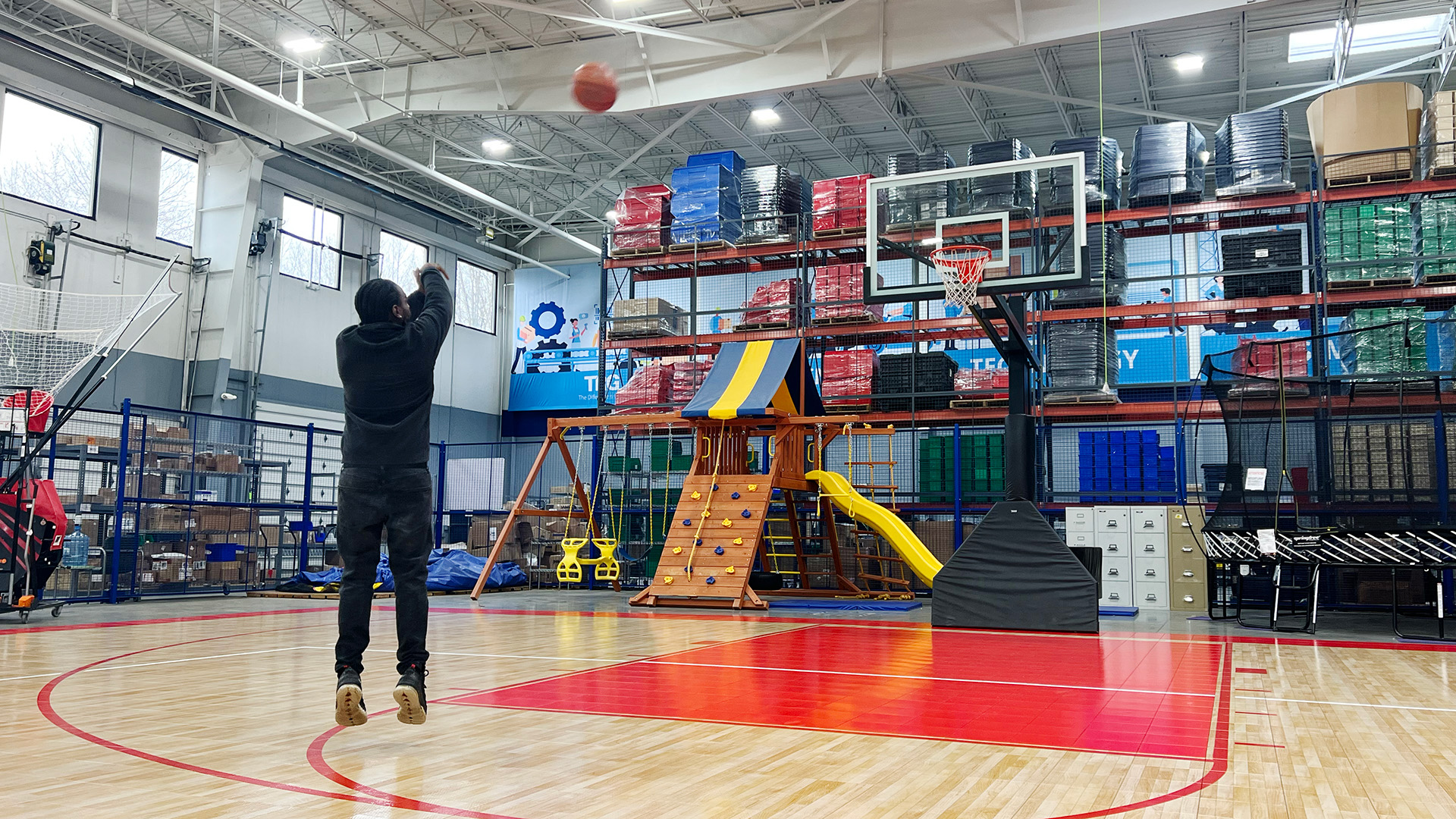
The company’s culture page has its own inventory: a sports court, golf simulator, gym, yoga classes, jungle gym and dog-friendly environment. Its gallery places a basketball shot against a background of industrial storage. It is an unusually direct portrait of a business where office life and equipment handling coexist.
TRG lists integrity, customer focus and employee wellbeing among its values. Amenities alone cannot establish how a workplace feels, but they do give its recruiting pitch a recognizable character. The operational promise still depends on technicians, dispatchers, engineers and account teams coordinating work that stretches across buildings and time zones.
Buy the response, as well as the device
One retailer’s requirements illustrate the limits of a generic repair model. TRG says it established on-site repair facilities at eight distribution centers because the customer could not tolerate shipping delays. A depot can make sense for one fleet; another needs someone within walking distance of the broken equipment.
The useful question for a prospective customer is therefore concrete: when a device fails during a busy shift, what happens next? Specify the replacement location, configuration, dispatch responsibility and support window. For a small, simple fleet, the coordination burden may not justify an extensive managed program. For a distributed operation, those details can be the purchase.
TRG’s most persuasive stories follow that logic. They begin with a delayed repair, an incompatible update or equipment in the wrong place. The company earns a larger role by taking responsibility for the next step. The scanner can return to its preferred condition: useful, available and completely uninteresting.
Follow the working parts
Visit TRG · LinkedIn · X · Facebook · Company news · Blog
Watch: Zebra retail kiosk demonstration
Watch: TRG and Inversion6 integration
TRG on YouTube