By the summer of 2017, Travis Collins had arranged something a Georgia Tech football supporter might reasonably envy: time at work with players from his favorite team. Matthew Jordan, Tre’ Jackson and Jake Whitley were helping prepare Incident IQ for launch. There were tests to run, bugs to find and a deadline approaching. The football conversation was suffering.
“We have talked about football almost not at all. Zero. Isn’t that a shame?” Collins said. He had brought the players into a business with work for them to do, and the business was taking him at his word. A national trade show was coming. The software had to be ready.
That small disappointment offers a good entrance into Collins’s career. His attachment to Georgia Tech supplied the introduction. His experience running technology companies supplied the assignment. Schools supplied the reason to hurry. The people testing the product were learning a business while helping build something intended to make learning elsewhere easier.
The repair bill comes first
Collins graduated from Georgia Tech in 1979 with a bachelor’s degree in industrial management and began his professional career at NCR. His subsequent businesses dealt with the physical and commercial workings of technology: AccuScan in automatic data capture, Black Arrow eCom in web storefront technology, ChannelMax in specialty hardware distribution, and Lexicon in maintenance.
It is a career best understood through the jobs these companies performed. A device has to be sold and delivered. Its information has to reach the right system. Eventually, somebody has to keep it working. Collins’s businesses occupied several points along that route. The less ceremonial stages of ownership gave him plenty to work on.
Lexicon, founded in Conyers in 1998, repaired and maintained technology already in use. Its customers included service businesses, manufacturers, resellers and enterprises. In 2013, the company marked fifteen years in business. Collins’s account of its priorities included engineering, quality management, execution and supply-chain expertise. Those are practical concerns for a company whose customers already own the equipment and need it back.
The company also opened a facility called the Repair Factory, nearly 40,000 square feet devoted to work on barcode and point-of-sale devices, tablets and other electronics. At the opening, Collins described a business planning for the long term. The scale belonged to repair benches, equipment and the movement of devices through a building.
Software entered that maintenance work through RepairEngine. The platform brought together contracts, expiration notices, repair histories and information about device performance by location. A mobile app supported tasks including barcode-based repair ticket creation. Collins described a gap in tools for managing maintenance across an organization. His attention was moving toward the information around the repair as well as the repair itself.
Twelve years on the other side of the table
Alongside the technology businesses, Collins served three elected terms on the Rockdale County Board of Education. His twelve years included time as chair and vice-chair, ending in 2008. A school board gave him another institutional setting in which equipment, budgets and the needs of students had to coexist.
His working life now included responsibilities in a school system as well as companies supplying technology services. At a board meeting, the question concerns an institution and the people it serves. At a repair business, the equipment has to pass through a working process. Incident IQ eventually put school operations at the center of a software business, bringing those two settings closer together.
The company was founded in August 2016. Its public launch followed in June 2017, after more than 100 schools had piloted the platform during the 2016-2017 school year. The initial proposition was specific: a help desk for K-12, with asset tracking and analytics suited to technology teams handling thousands of devices across many locations.
Collins’s explanation focused on a familiar imbalance. Schools were adding classroom technology while support teams faced limited staff and resources. Buying equipment created an ongoing obligation to support it. Incident IQ gave that obligation a system: somewhere for requests, asset information and the work of resolving problems to meet.
A summer with very little football
Before the public introduction, the interns were helping test that system. Jordan and Jackson worked through the product and fed observations back to the developers. They also helped with the language and presentation of the help material. Finding an awkward instruction could be as useful as finding a software fault.
Collins and his wife, Rose, had met players through Georgia Tech’s scholarship endowment gatherings. At Lexicon, the introductions became working relationships. The interns joined business meetings and encountered the companies involved in the hardware world. Their summer included exposure to product development, sales and marketing, with Collins explaining how the pieces fitted together.
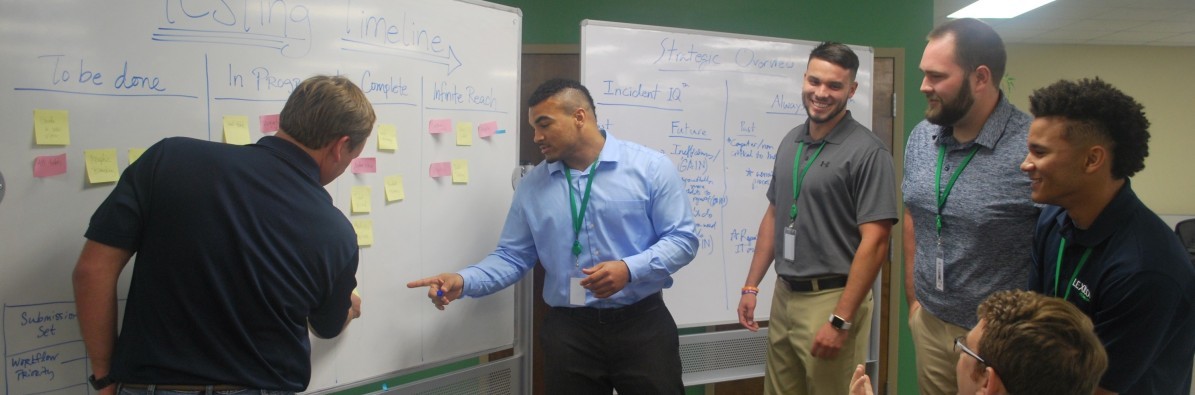
The arrangement carries a useful distinction between giving a student a task and allowing a student to contribute. Collins included the interns in discussions about the product they were testing. The people checking details could hear the wider business conversation. For a young employee, that is one way the details begin to make sense.
The deadline kept the experience grounded. There was a release ahead, and the summer’s work had somewhere to go. Collins’s football loyalties had helped bring people into the room; preparing the product gave everyone a reason to concentrate once they arrived.
From Georgia districts to 48 states
In August 2021, Incident IQ announced a growth investment from JMI Equity. By then, more than 650 school districts across 48 states were using the platform. The company reported adding more than 350 districts over the preceding twelve months. A business built around school support had acquired a national customer base.
The investment was intended to expand product development, staffing, customer support, sales and marketing. Its ambitions also extended beyond IT and facilities into other district departments. Collins described the purpose in terms of the operations that keep classrooms going. The software could grow by taking on more of the work around instruction.
School districts using Incident IQ at each announcement. Figures are reported lower bounds, not a continuous growth series.
That expansion also required people with experience running a larger product organization. In early 2022, Incident IQ announced Carolina Rodríguez as vice president of product. Her background included product strategy at Stibo Systems and building the product management organization at LogFire. Collins welcomed her experience to the leadership team. The founder’s work now included helping assemble the people for a broader platform.
An invitation to compare notes
Collins’s own welcome message for the Incident IQ online community arrived on March 22, 2022. He singled out a quality he admired in school districts: their willingness to share practices with colleagues elsewhere. The community was intended to give that exchange a place to happen.
He thanked the team responsible for the launch and connected the investment to listening and learning from users. There was a practical idea behind the greeting. A district could encounter a problem another district had already worked through. Giving those people a way to talk could make the product more useful alongside the software itself.
It also reveals what he chose to emphasize in a public introduction. He could have led with adoption figures. Instead, he talked about the habits of the people using the system and the value of helping colleagues. It was an invitation to participate in an ongoing conversation about the work.
The title changes. The ties remain.
On March 31, 2023, Collins retired as CEO. Chief Operating Officer R.T. Collins succeeded him the following day. Travis continued on the board. At the time of the announcement, the company served more than 1,200 school districts and employed 150 people. The handoff placed day-to-day leadership with someone who had helped build it from its early stages.
“not a day of it has really felt like work!”
Travis Collins, on his time with Incident IQ, March 2023
His own assessment was unusually warm for work involving service queues, software releases and school operations. He called the experience a professional highlight and looked forward to what the team and partner districts would create next. Retiring from the executive job still left a relationship with the company and its future.
Georgia Tech remained another place for his time and experience. In November 2023, Scheller announced him among four new advisory board members. The board works with the dean on alumni engagement, industry connections and strategic projects. Its current directory continues to list Collins. The 2026-2027 athletics trustee roster also records a 2025-2028 term.
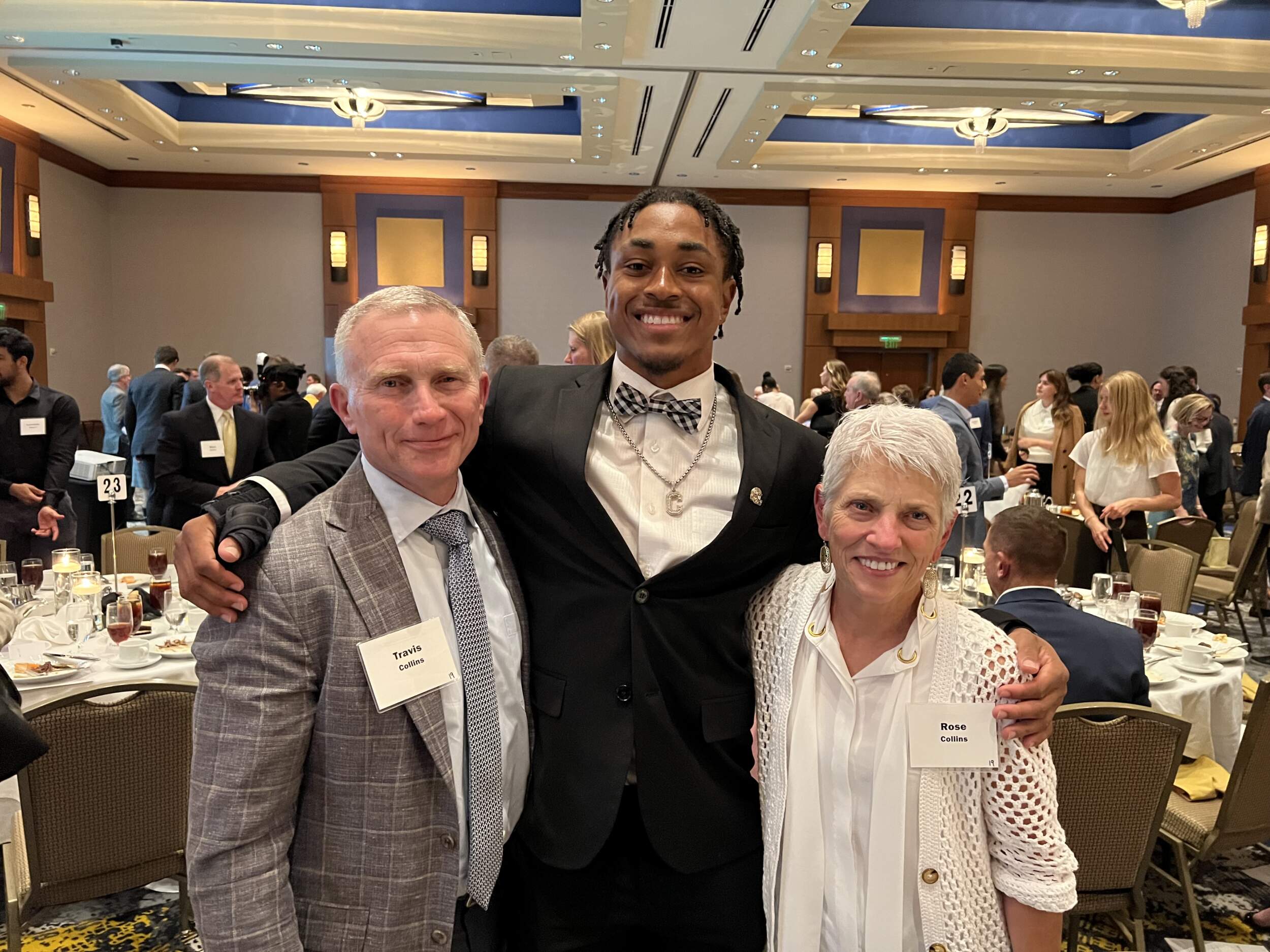
The connection began long before the degree. Born in Athens, Collins moved to the Atlanta area as a child when his father, Bob, went to work at Georgia Tech. His father’s trade was tool and die making. Collins remembered watching him start a steam engine and seeing its machinery move. College was already a visible place in family life.
He applied to Georgia Tech alone. Later, he and Rose established a football scholarship honoring Bob and Collins’s brother, Stuart. University ties brought students into his businesses and eventually brought him back into advisory service. The recurring thread is a place where people learn, find work to do and give someone else an opening. In 2017, that opening came with software to test and scarcely a minute for football.