Paul Brown found a useful clue at Arby’s when people moved restaurant logos around a table. Asked to map the market, prospective customers put the more expensive burger brands at one end and the cheaper chains at the other. Arby’s landed in the middle. There was a business proposition sitting there among the little symbols: food that felt a step up, with the price and convenience of a drive-through.
For an executive arriving from Hilton, the exercise offered something more useful than an opportunity to sound clever. It offered a place to begin. Brown could ask people what they thought, then build around what he heard. The restaurant business had plenty of opinions already. Another confident arrival carrying a presentation would hardly have constituted a breakthrough.
That habit helps explain a career that connects consulting, online travel, hotels, roast beef and, eventually, Dunkin’. Brown co-founded Inspire Brands in 2018 with Roark Capital founder Neal Aronson. Its six main brands now include some of the most familiar stops in an American day. The route there was less tidy than the corporate biography suggests.
The student with the Flintstone Mobile
At Georgia Tech, Brown was shy. He credited management professor Philip Adler’s questioning classroom style with drawing him into speaking his mind. Serving as president of the Interfraternity Council gave him another kind of practice: getting people to agree to things when a job title alone would accomplish very little.
He graduated with a management degree in 1989, leaving behind memories that included converting a golf cart into a Flintstones parade float with his fraternity brothers. The future restaurant executive had already acquired some experience in unconventional transportation. Graduate study at Northwestern later added an MBA and a master’s in engineering management.
The campus stories offer a useful corrective to the finished-executive version of Brown. Confidence was something he developed through participation. So was the willingness to put an idea in front of other people and discover whether it survived the encounter.
A detour with an expensive tuition bill
Early in his career, Brown left Boston Consulting Group for an online travel startup during the internet boom. The company failed. His savings went with it. With two young children, he had reason to reconsider the attractions of being in the right industry at precisely the wrong company.
He refocused on hospitality and established businesses. His subsequent career included McKinsey, Expedia and Hilton. In London in 2005, a recruiting call from Barry Diller reached him on a train. Brown remembered the personal attention behind the invitation. It became one of his examples of how to make someone feel wanted at work.
By the time Roark approached him about Arby’s, Brown had experience with brands, franchise relationships and shared services. He initially declined. His recollection of the opportunity was wonderfully economical: “That looks hard.” It did. A familiar name on a roadside sign can conceal a considerable amount of work.
Fifty restaurants, a thousand conversations
Brown started as Arby’s CEO on May 13, 2013. Sales had already begun recovering under the previous leadership. His task was to strengthen that recovery and give the business a more coherent direction. Any account that awards him every quarter of growth would be serving an excessively generous portion.
He visited more than 50 locations and estimated that he spoke with over 1,000 employees in his early months. He asked what they would change if they ran the business. For his first three months, more than half his time was spent away from the office. Developing the new vision took roughly six months.
“What would you do differently if you ran this?”
Paul Brown’s question to Arby’s teams
The wording mattered. A request for complaints produces one conversation. Inviting someone to imagine responsibility produces another. It asks the person serving lunch to think about the entire restaurant, and gives the visiting executive a chance to hear something that would never make it into a polished briefing.
Brown had an advantage he was willing to use: nobody could reasonably expect a hotel executive to know every answer about sandwiches. Being new gave him permission to ask elementary questions. The harder managerial trick would be keeping that permission once he had been around long enough to seem authoritative.
The roast beef got some company
Arby’s had more food to sell than its reputation suggested. Brown explained in 2016 that its menu included nine proteins, while customers still associated it overwhelmingly with roast beef. Broadening that association could bring the chain into consideration on more occasions. Brisket, turkey and other sandwiches gave the advertising something concrete to talk about.
The “We Have the Meats” campaign, voiced by Ving Rhames, made variety sound like a declaration. New food, restaurant remodels and a clearer identity worked together. Brown described remodels producing sales increases of roughly 15 percent, sometimes 20 percent or more, in that period. A memorable commercial still needed somewhere appealing to send its audience.
There was also room for a joke. When Pharrell Williams appeared at the 2014 Grammys in a hat resembling Arby’s logo, the social team joined the conversation. Arby’s later bought the hat at a charity auction. With Jon Stewart, whose mockery had become a recurring irritation, the company sent food, wrote letters and offered him a job when he left The Daily Show.
Brown’s account of the Stewart response reveals a certain practical lightness. The company could have become defensive. Instead, it participated. Few brands improve a joke by involving their lawyers. Arby’s found a way to be recognisable, slightly ridiculous and comfortable enough with itself to let the audience enjoy the exchange.
2016 results. Arby’s also returned to net restaurant growth for the first time since 2008.
What a hotel executive saw in a sandwich shop
At Hilton, Brown’s responsibilities had included brand management, marketing, pricing, loyalty, franchise relations and technology. Different hotels could keep different promises to their guests while drawing on capabilities built across the group. A customer checking in did not need to spend the evening contemplating the shared infrastructure.
Restaurants offered a related possibility. A sports bar, a drive-in and a coffee stop serve different purposes. Bringing them together could make certain expensive capabilities more useful across a larger business. It could also create trouble if the parent became so enthusiastic about efficiency that every brand started to feel alike.
Inspire’s answer was to preserve distinct identities while sharing support. Brown described separate brand purposes, strategies and priorities when the company launched. The distinction put a limit on what headquarters should standardise. A purchasing advantage has little value if the customer’s reason for choosing a particular restaurant quietly disappears.
Different customer occasions. Common support behind the counter.
Colleagues noticed the continuity between this approach and his earlier listening tour. Melissa Strait, then Inspire’s chief people officer, described him as curious and willing to hear ideas from across the business. Even a name could be reconsidered: after hearing the Rusty Taco team’s preference, Brown supported restoring that original name in place of R Taco.
The family grows, one closing at a time
In February 2018, the completion of Arby’s acquisition of Buffalo Wild Wings brought Inspire into existence. SONIC followed that December. Jimmy John’s joined in October 2019, taking the group to more than 11,200 restaurants. What began as an argument about how to run brands was becoming a substantial operating test.
Inspire Brands is formed
The drive-in joins the group
A second sandwich occasion
$11.3 billion transaction
The $11.3 billion Dunkin’ Brands acquisition closed on December 15, 2020. Dunkin’ and Baskin-Robbins brought coffee, ice cream, an international network and a substantial licensing business. At closing, Inspire counted nearly 32,000 restaurants across more than 60 countries. Breakfast and dessert had considerably expanded the family conversation.
Those numbers describe restaurants across the system, including franchise locations. The sales figures require the same care. Inspire’s brands generated $33.4 billion in global system sales in 2025. That measures sales through the restaurant network; it is different from revenue retained by the parent. Brown’s challenge includes influencing businesses whose owners have capital, judgment and opinions of their own.
The limits of deciding everything centrally
Brown has described one revealing mistake in community giving. Pulling money raised in individual restaurants into a central fund made the programme more coordinated, but drained enthusiasm from franchisees. The revised approach focused on youth empowerment and committed half of locally raised money back to the market where it originated.
That is an unusually useful admission for someone assembling a large company. Scale can make an activity more orderly while making the people responsible for it less interested. The spreadsheet records the funds. The operator notices whether the local cause still feels local. Both observations belong in the decision.
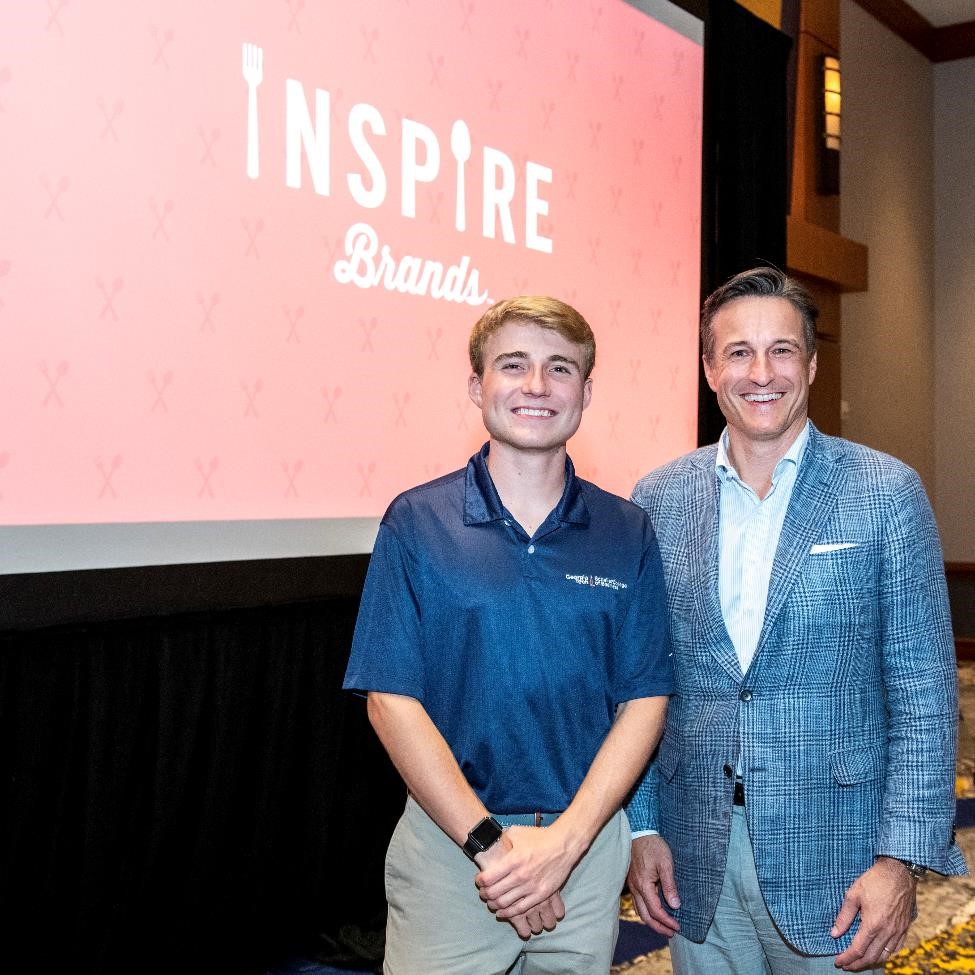
The same question follows Brown into conversations with younger employees. In August 2026, Inspire’s internship programme included 90 interns from 42 schools. One participant recalled his advice to concentrate on solving problems rather than simply accumulating data. After a career spent observing changes in technology, his practical test remained what someone could do with the information.
Keeping the questions open
There is a catch to Brown’s reputation for listening. In a September 2025 conversation with David Novak, he acknowledged that it had become harder as his tenure lengthened. People assumed he knew more answers. He said he had been working to invite contrary views and make himself more vulnerable with his team.
The candour gives the earlier stories a useful edge. A listening tour can be scheduled. An organisation in which people continue to disagree with the CEO takes repeated effort. Success itself changes the conversation: the person who once needed the explanation becomes the person everyone expects to provide it.
Brown’s career keeps returning to that awkward moment before certainty. The logos are still on the table. Someone closer to the customer may see something the executive has missed. After all the acquisitions, restaurant counts and carefully differentiated brands, the next useful idea may still require him to ask a question and leave enough silence for the answer.
Continue the conversation
- Inspire Brands / leadership
- Paul Brown / LinkedIn
- The early Arby’s listening tour
- Campus memories / Georgia Tech
- Company culture and career advisers
- Community giving / a conversation with Brown
- Watch / How Leaders Lead with David Novak
- Watch / Georgia Tech conversation
- Summer 2026 / meeting Inspire’s interns