Brett Goodson bought about 15 glass vessels at Ikea for a photo shoot. They were perfectly serviceable glass vessels. They were also, he discovered, not especially good at being milk jugs. For the founder of Almond Cow, this was more than an irritating shopping trip. It was a list of products waiting to be made.
That small episode catches something useful about Goodson. He notices the awkward business surrounding an object: what goes into it, what comes out, where the result goes, what the owner has to figure out next. A machine may finish its cycle. Its customer still has a kitchen to contend with.
Today, he leads an Atlanta-based business built around making plant-based milk at home. Earlier, he worked on hybrid vehicle batteries and developed a pork-rind brand. Read those occupations in a row and they sound like three people sharing a LinkedIn account. Follow the products, though, and a pattern emerges: Goodson keeps taking familiar things apart to see whether they could work a little better.
A farm, a battery, a dinner party
He grew up on a cattle and honey farm in Alabama’s coastal plains. There is a photograph of him bottle-feeding a calf while a dog takes an interest in the proceedings. It is a pleasingly literal beginning for someone who would eventually sell a machine called Almond Cow. The calf, presumably, had fewer questions about the name.
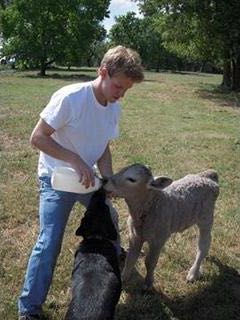
Mechanical engineering gave that agricultural upbringing a different set of tools. Goodson earned his bachelor’s degree at Auburn University in 2009. His early career at Exide Technologies involved battery development, including prototype production and, later, leading product-development work across factory sites. He subsequently completed an MBA at Georgia Tech, studying there from 2014 to 2016.
The kitchen experiments overlapped with the engineering work. Goodson was refining the recipe that became Pork Clouds while working in hybrid vehicle batteries. A successful dinner-party batch helped turn the experiment into Bacon’s Heir, an Atlanta food business whose pork rinds offered an airy texture and seasonings beyond the usual convenience-store repertoire.
The product had a particular sense of occasion. By 2013, Pork Clouds appeared in Mantry’s Bacon Nation selection. Goodson later described the ambition with dry social precision. Few business plans have made quite such considerate provision for the host.
“These are the pork rinds you could bring to a dinner party and not be embarrassed.”
Brett Goodson, on Pork Clouds
There was engineering underneath the joke. Preparing the skins, controlling their moisture and cooking them in hot oil shaped the finished texture. The product depended on a repeatable process. An enjoyable recipe had to survive becoming a product line, with all the consistency that customers expect once money changes hands.
- 2009Auburn
Mechanical engineering - 2013Pork Clouds
Featured by Mantry - 2014-16Georgia Tech
MBA - 2016Almond Cow
Incorporated in Georgia - 2023Vistage
Impact Award
The carton becomes optional
Almond Cow was incorporated in Georgia in November 2016. A Kickstarter launch followed in 2017. Goodson describes the campaign’s response as an early indication that people wanted the product. Crowdfunding offered a practical answer to a difficult question for an appliance maker: would anyone volunteer to add another machine to an already crowded counter?
The appliance gives its owner a way to make milk from nuts, seeds or grains. A filter basket holds the ingredients; water goes into the base. The machine processes the mixture and separates the milk from the pulp. A 2023 company announcement described batches of five to six cups in less than a minute, without applying heat.
It changes the purchase being offered. Someone buying a carton chooses a finished drink. Someone buying a milk maker acquires a recurring household task, along with control over the result. Goodson’s business therefore has to make that task attractive enough to repeat. A demonstration can sell the first batch; the routine has to earn the next one.
The range consequently extends beyond the appliance to ingredients and accessories. Milk Medleys, introduced in 2023, packaged blends for individual batches in packets the company described as home compostable. That launch joined the equipment to a more convenient way of supplying it. Even a customer who likes making things may appreciate having one fewer thing to measure.
For Goodson, ingredient choice is part of the appeal. The company sells the ability to vary a familiar drink rather than accept the same finished recipe each time. Almond Cow’s name supplies a useful starting point, but the machine’s ingredients can wander considerably further than the almond aisle.
The customer’s kitchen is the test bench
The Ikea expedition belongs here. Goodson had encountered the milk-storage problem himself, and it helped identify a need for accessories. His own shopping difficulties also exposed the work involved in choosing suitable ingredients. These are modest inconveniences individually. Together, they decide whether a customer keeps using a purchase.
A founder can admire an elegant mechanism and still overlook the person trying to pour from it. Goodson’s account keeps returning to what happens around the mechanism. The jug has to make sense after the photo shoot. The ingredients have to make sense after the first demonstration. The second use deserves as much thought as the unboxing.
That attention also reaches the instructions. Recipes and explanations give owners more ways to use the appliance and its leftover pulp. Viewed this way, the website continues the product-development work: an unanswered practical question can become a reason to leave the machine in a cupboard. A useful answer can get it back onto the counter.
The engineering challenge has its own domestic complications. A factory controls its inputs; kitchens supply variation. Goodson has discussed the team’s fluid modeling and testing of the blade underwater. The tidy appliance on the counter conceals a less tidy development problem: making a process work reliably beyond the controlled conditions in which it was designed.
Waste has a remarkably good disguise
Goodson connects his approach to reducing waste with his automotive background. At Almond Cow, the ambition includes less disposable packaging and more reusable materials. The attraction is practical as well as environmental: make the drink where it will be used, with ingredients the owner has chosen, and keep using the vessel.
Such ambitions become more interesting when they encounter ordinary details. Packaging has to protect an appliance in transit. Ingredients have to reach the buyer. Customers need to know what to do with the pulp. Each detail makes the argument more demanding than simply printing a green claim on a box.
The Milk Medleys launch shows one attempt to work through that tension. Portioning ingredients creates convenience, but the packet itself becomes part of the design problem. The company’s use of home-compostable packaging for that product put the disposable element under scrutiny, too. The surrounding materials have to answer for themselves.
Goodson’s career makes this interest in process intelligible. Batteries, snacks and milk makers each involve turning materials into something people will pay for. The end products differ; the questions about unnecessary steps, inconsistent results and awkward handling remain available. There is plenty of work for an engineer between the factory and the kitchen sink.
The founder still has paperwork
By March 2026, another kind of waste had Goodson’s attention: time spent managing sales tax. Almond Cow sold appliances, ingredients and accessories through multiple online channels. An outside firm and separate software tools handled parts of the work, while Goodson filled the gaps. Growth had supplied him with a recurring administrative chore.
After moving to TaxCloud, he estimated that he spent 70% less time thinking about sales tax compliance. That is his reported experience, rather than an independently measured productivity result. Its significance is still plain: a founder’s attention has competing uses, and sorting out a missed filing consumes some of it.
Time thinking about sales tax compliance, by Goodson’s estimate after changing providers.
It is an unusually prosaic update for a founder profile, which is precisely its value. The person associated with a tangible kitchen product also has to make software choices, manage costs and keep operations moving. The counter has a milk maker on it. The business behind it has bills.
Good people, useful analogies
Goodson received a Vistage Impact Award in 2023, having joined the organization in 2021. His father and uncles were entrepreneurs. The leadership principles recorded in his award profile emphasize understanding other people’s perspectives, choosing actions that make progress easier and using analogies to communicate. They fit a career that has crossed several product categories.
His endorsement of coach Jay McDonald’s book, Strategic Jaywalking, makes the people side explicit. He values the efficiency of working with people whose company he enjoys. That observation gives a warmer edge to all the talk of processes: a business also depends on whether its participants want to keep working together.
Return to the glass vessels. A founder needs a photograph, buys a selection of jugs and discovers that the available choices leave something to be desired. It is hardly a grand entrance. Yet it is a revealing piece of Goodson’s story: the next useful product may begin with the small nuisance he has just brought home.