Imagine a door checked at midnight. The officer records the visit. A supervisor checks the record. Later, someone in the office makes the hours agree with a schedule, a pay rate and an invoice. The door takes a moment. The agreement can take considerably longer. It is an oddly elaborate afterlife for a perfectly ordinary patrol.
Trackforce sells software for that afterlife, as well as for the patrol itself. Its subject is physical security: people checking buildings, responding to alarms and protecting sites. Its commercial insight is that the person with the flashlight and the person preparing payroll belong in the same information system.
- The job: connect guard activity, incidents and dispatch to workforce administration and client reporting.
- The products: TrackTik is the global platform; GuardTek is currently offered for field operations in EMEA. Silvertrac remains in the portfolio.
- The evidence: Colonial Security says consolidating four applications cut payroll processing from nearly a day and a half to minutes.
- The useful lesson: follow one shift through to payment before buying another dashboard.
01 / THE ADMINISTRATIVE CRIME SCENEFour systems, one very long payday
Colonial Security Services offers a good place to begin. In Trackforce’s published customer account, the firm had more than 775 security personnel and clients across over 30 states. Growth made its separate administrative tools increasingly inconvenient. Dispatchers struggled to keep employee availability and shifts straight. Information had to move between applications before anyone could confidently pay an officer or bill a client.
Colonial chose TrackTik for a broader view of operations, then consolidated payroll, scheduling, invoicing and guard monitoring. It also worked with TrackTik’s trainers on a tailored program and made its own instructional videos. Adoption was part of the purchase.
“It used to take us nearly a day and a half to complete payroll; now we’re done in minutes.”
Dave Jackson / CEO and President, Colonial Security Services
Customer statement in Trackforce’s published case study
That is a customer’s account, rather than a promised result for the next buyer. The mechanism, however, is easy to understand: enter information once, then let the following processes use it. Reconciliation is a rather expensive way to discover that two departments have been describing the same shift differently.
02 / WHERE THE RECORD TRAVELSThe report has somewhere to go
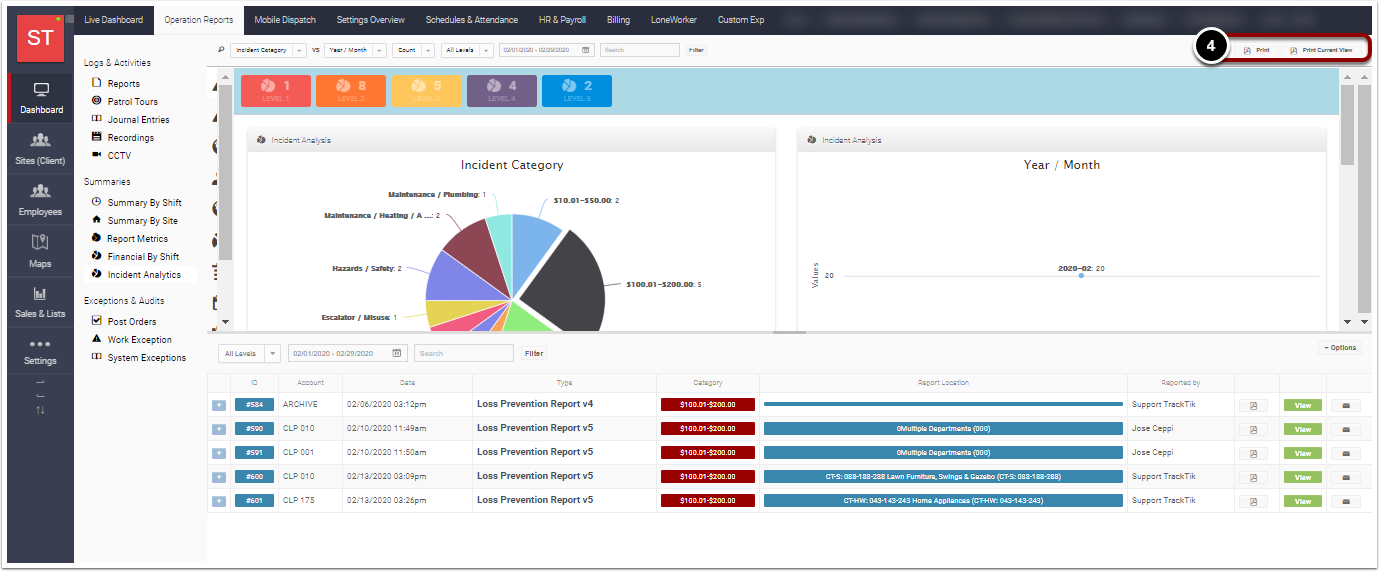
TrackTik joins mobile guard tours, incident reporting, scheduling, attendance, billing, payroll preparation and analytics. A checkpoint can be verified with GPS, NFC or a QR code. Supervisors can see operational activity; customers can receive evidence of service. The point of connecting the modules is to give a field event a destination beyond the officer’s phone.
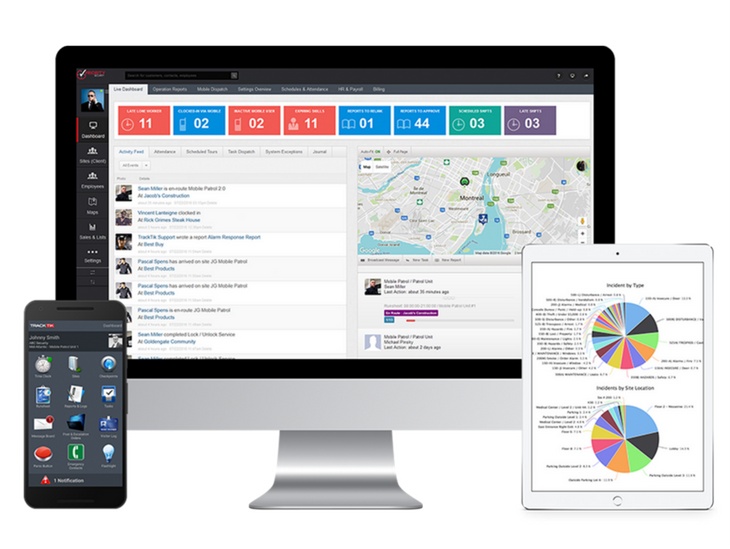
There are two buyers with related appetites. A guarding company wants covered shifts, accurate hours and defensible invoices. An enterprise security team wants visibility across sites and contractors. For the latter, Trackforce markets vendor-independent data ownership: the organization’s operational history can remain its own when the guarding contract changes.
GuardTek concentrates on field operations, including checkpoint proof, client e-reporting, push-to-talk communication and lone-worker protection. Its current offer is EMEA-only. Buyers should pay attention to that geography; a familiar product name does not establish availability in every market.
- Capture the workClock-in, checkpoint scan, incident report.
- Review the exceptionsLate attendance, missed checkpoints, uncovered shifts.
- Prepare the moneyValidate hours against schedules and contract rules.
- Show the clientReports, invoices and a record of service delivered.
03 / THE ACQUISITION LOGICBuying the other half of the job
Trackforce was founded in 2000. Former CEO Guirchaume Abitbol is identified as its founder in contemporary industry reporting. The company’s advertised decades of expertise reflect its accumulated security experience and portfolio; they should not be mistaken for an earlier birthday.
In January 2017, Five Elms Capital invested $7.4 million to support product development and expansion. In September 2019, K1 announced an investment of more than $150 million in the combined Trackforce and Valiant business. Joining field management with Valiant’s back-office capabilities gave the company a more complete view of the work surrounding a guard shift.
TrackTik followed in June 2022. Founded in Montreal in 2013, it brought its own cloud workforce platform. Founder Simon Ferragne became CTO of the combined organization at the time of the acquisition. The sequence explains the portfolio better than a collection of feature badges: Trackforce kept adding ways to connect operational work with business administration.
Neither the investment amounts nor the existence of an acquisition tells a buyer what implementation will cost. They tell us where the company placed its bets.
04 / THE CLIENT CAN SEE ITEvidence that asks for more people
Dardan Security’s experience makes the story more interesting. In Trackforce’s December 2025 account, manual rostering, reporting and invoicing had become bottlenecks as the UK firm grew. Dardan used TrackTik to connect those activities and expose the records to clients. It reported generating 27,000 reports a month.
At Cambridge’s CB1 Estate, Dardan said the resulting evidence helped justify additional oversight and doubled staffing. “Our client saw results and reinvested,” recalled Andrew Barnard, its ESG and compliance manager. Better records supported a larger service, rather than simply a smaller wage bill.
Dardan’s own account of its Cambridge work describes a specialized anti-social behaviour unit and electronic patrol and incident reporting through TrackTik. This is a useful distinction for anyone selling operational software: efficiency can mean putting more effort where the evidence says it belongs.
05 / THE RESPONSE GAPThe camera sees it. Who goes?
The newer partnerships extend the same idea. In April 2025, Trackforce and Immix announced an integration linking event identification and triage with TrackTik dispatch and reporting. In May, Scylla joined the picture, connecting AI video threat detection with guard-response workflows.
A detection system and a workforce system do different jobs. Connecting them is intended to reduce the manual handoff between an alert and a response. These announcements describe a capability and a direction; they do not prove a universal response-time improvement.
The less glamorous Criterion partnership, announced in July 2025 for Canada and the UK, connects payroll and HR through an API. It follows the same economic logic. An alarm should reach an operator. Approved hours should reach the system that pays people. Both journeys lose value when somebody must copy the information by hand.
06 / KEEP THE FIRST DRAFTThe machine may edit. The witness still matters.
ReportPro AI, announced in September 2025, helps enhance incident notes and generate summaries. Its more consequential detail may be the retained history: original text and AI-assisted changes remain available for comparison, with AI content identified.
TrackTik’s policy says the feature is off by default and requires people to review, validate and approve its output. A polished sentence can still describe an event incorrectly. Preserving the first account gives a supervisor something to check against the revision. In a product concerned with accountability, the ability to see the edit matters as much as the edit’s elegance.
07 / THE BUYER’S EXPERIMENTFollow one shift before signing
Trackforce’s business model is B2B subscription software. TrackTik’s current pricing is quoted by protected site and selected modules. That gives buyers a concrete comparison with Belfry, whose website describes per-user pricing and built-in payroll and tax filing. OfficerReports also addresses guard reporting and operational management. Trackforce’s connected-workflow argument is meaningful, but competing security platforms make related offers.
The useful buying exercise is specific: choose a real shift, with its site requirements, pay rules and client reporting obligations. Ask each vendor to carry it through scheduling, attendance, an incident, approval and invoicing. Compare the resulting records and the full scoped quote. The number of attractive screens is a poor substitute for checking where the information stops.
Run one ordinary shift and one awkward exception through the proposed setup. Give each alert an owner. Check the hours, client report and invoice against the original field record.
There are practical conditions. TrackTik’s mobile installation guidance calls for supported phones, appropriate permissions and sufficient connectivity; tablets are not supported. Its Command Center documentation requires configured operation centers, operator permissions and escalation policies. An alert without someone responsible for answering it merely moves the waiting from a spreadsheet to a screen.
Trackforce appointed Scott Kaine CEO in January 2026. Its next chapter still rests on a wonderfully unromantic test: whether information collected at one end of an operation arrives usefully at the other.
The midnight door will still need checking. The opportunity is to stop making the rest of the company check the paperwork three times.