The assistant that learns how you work - then quietly does the work.
TOWN, AT WORK. The brand of a company that began with tax forms and ended up inside your inbox. It does not wait to be asked twice.
Somewhere in San Francisco this morning, an inbox sorted itself. A calendar found a slot three people had been circling for a week. A follow-up that a human kept meaning to send went out, in that human's voice, while the human was still asleep. None of it was prompted. That is the trick Town is selling - not a chatbot you instruct, but a Townie you live with.
Town builds a personal AI assistant that plugs into the tools you already use - email, calendar, Slack, docs, WhatsApp, the desktop, the open web - and learns the texture of how you operate. You give it a name, a face, and a personality. Then it gets to work. The pitch is refreshingly small for an industry that loves the word "revolution": stop being a full-time prompt engineer. Let the software pick up the slack it can already see.
It is led by people who have built infrastructure that millions trust without thinking about it. That history matters here, because an assistant with the keys to your inbox is only as good as your willingness to hand them over.
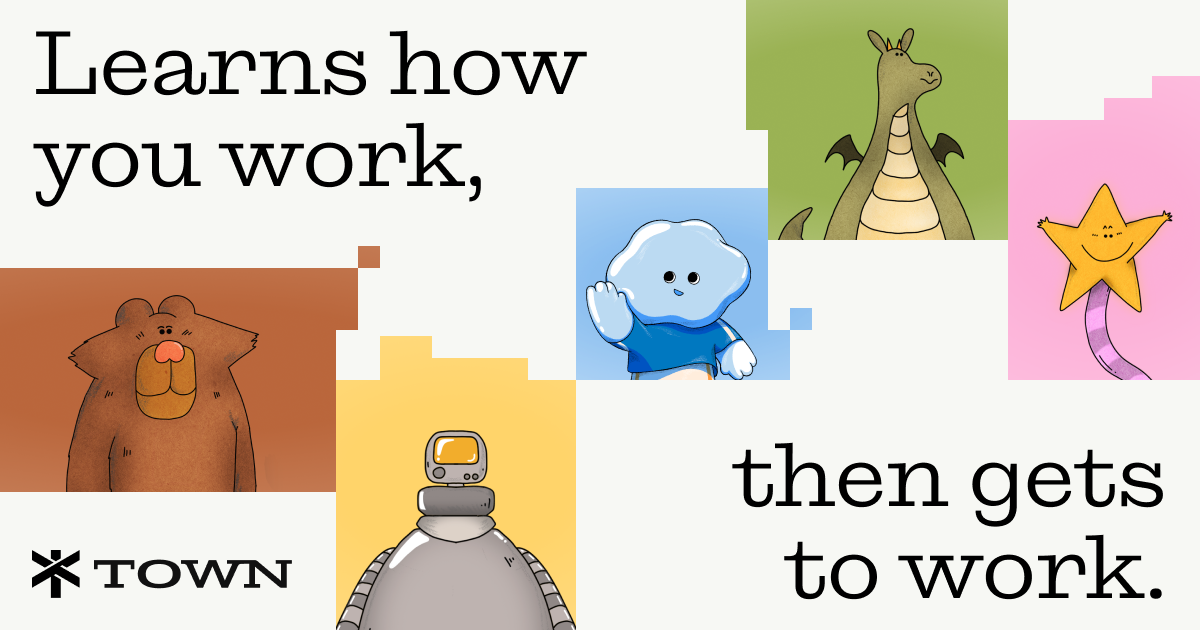
The longer you use it, the more it picks up: your voice, your relationships, your preferences, your routines.- Andreessen Horowitz, on what makes Town hard to replace
Here is the part that amuses the analysts. Town did not begin as the assistant that learns you. It began, in 2025, as a deeply unglamorous and deeply useful thing: an AI-driven tax-and-compliance service for small businesses. The idea was that a corner bakery should get the same tax advantages a Fortune 500 enjoys - a dedicated advisor, paired with AI that chews through documents, hunts deductions, and navigates the regulatory thicket. Within two months of opening its doors, it had helped hundreds of businesses file their FY2024 taxes.
Then something happened that happens to a lot of good vertical products: the founders noticed the engine was bigger than the car. The machinery they had built to read a messy pile of receipts and act on a business's behalf turned out to be the machinery of a general assistant. Between the seed and the Series A, Town widened. Taxes became one capability among many. The assistant became the product.
Today, we're launching Town: the AI assistant that learns you.- Jean-Denis Greze, Co-Founder & CEO
Connect your email and your Townie sorts, drafts and follows up - in your voice, on the relationships it has learned matter most.
Calendar logistics, the back-and-forth nobody wants, the slot that works for everyone. It handles the operationally messy parts of a week.
Recruiting pipelines, summaries, grant processing, follow-ups. Scheduled routines run while you do something else - or sleep.
Gmail, Google Calendar & Docs, Slack, Telegram, WhatsApp, desktop, web. No new home to move into - it meets you where you work.
Former CTO of Plaid, where he ran the engineering behind the plumbing that connects much of fintech. Earlier, an engineering leader at Dropbox. He is the reason "reliability" keeps coming up in conversations about Town.
Previously a director of applied AI at Google, and a designer at Dropbox before that. The product-and-design half of a partnership that has, twice now, decided what Town should actually be.
The seed round arrived stuffed with operator angels - the founders of Quora, Mercury, Plaid and others writing checks. The Series A, eighteen months later, was the institutional vote of confidence: a16z and Forerunner leading, the seed investors doubling down. Money tends to follow products that quietly start working.
Greze and Vincent leave Plaid and Google to start Town.
Debuts as a small-business tax platform - dedicated advisor plus AI. Helps hundreds of businesses file FY2024 taxes within two months.
The tax engine becomes a general assistant. Town builds Townie and runs a private beta.
a16z and Forerunner lead. Town launches the consumer Townie - the AI assistant that learns how you work.
Town competes for the same attention as general assistants like ChatGPT, Claude, Gemini and Microsoft Copilot, and newer agentic players such as Martin and Lindy. Its wager is that none of them know you the way a Townie does - the moat is accumulated context, not the model underneath.
Note: Town has not published an official YouTube channel; product demos currently live on X.
Return to where this started. The inbox that sorted itself before the coffee was poured. The meeting slot that appeared without three rounds of "does Tuesday work for you?" The follow-up that went out overnight, in a voice that was unmistakably yours. A year earlier, those were chores - small, recurring, attention-shaped taxes on a person's day. The irony is hard to miss: a company that began by removing one kind of tax has spent its second act removing the other kind, the invisible levy that admin work charges against a week.
That is the unhurried bet underneath all the funding noise. Town is not promising to think for you, and it is careful not to oversell what it does. It promises something narrower and, if it holds, more durable - to watch how you work for long enough that it can take the boring parts off your plate without being asked twice. The model can be copied. The eighteen months your Townie has spent learning your handwriting cannot. Whether millions of people decide to hand an assistant the keys to their inbox is the open question. Town's two founders have built trusted infrastructure before, and they are betting the answer is yes.
For now, the proof is mundane and that is the point. A morning that runs a little smoother. A week with a little more room in it. Somewhere in San Francisco, the next inbox is already sorting itself - and the person it belongs to is still asleep.