The Dispatch
Everyone else built a library. Personal AI built a memory.
Type a question into the usual chatbot and you get the average of the internet - confident, fluent, and faintly nobody's. Personal AI starts from the opposite end of the telescope. Its bet is that the most useful model in your life is not the largest one ever trained, but the smallest one that actually knows you: your messages, your meetings, your decisions, the way you phrase a "no." Out of that raw material it trains a Personal Language Model - a compact AI, roughly 120 million parameters, that answers from your data instead of the crowd's.
It is an unfashionable idea in an industry addicted to scale, which is exactly why it is interesting. While the headlines chase trillion-parameter frontier models, this San Francisco company - legally Human AI Labs - has spent since 2020 arguing that personal beats general. Not artificial general intelligence. Artificial personal intelligence.
What You Can Actually Do
Teach it once. It remembers for good.
The product is less "ask a robot" and more "raise a colleague." You feed it what you know; it grounds every answer in that, and it answers in your voice.
01 / MEMORY STACK
Build a memory
An automatic digital library from your everyday text, audio, images, decks and spreadsheets - synced from Gmail, Drive, OneDrive, Dropbox and Outlook.
02 / PLM
Train your model
A Personal Language Model learns your data over time and answers from it - not from the average of the internet.
03 / PERSONAS
Deploy a persona
Multi-modal AI personas with optional voice clones, reachable over chat, SMS and Messenger - your expertise, on call.
04 / ENTERPRISE
Put it to work
Sales automation, lead gen, HR, legal, healthcare and customer service - answers come from company data, kept private.
05 / API
Build on it
A Training Studio and developer API to tune and embed models in your own apps - available via Google Cloud Marketplace.
06 / OWNERSHIP
Keep it yours
Privacy-by-design: your data trains your model, and it stays yours rather than feeding someone else's.
The Argument, Visualized
Smaller can be the feature, not the compromise
Personal AI's pitch to enterprises rests on three numbers a CFO cares about - precision, latency and cost. The claim: a model that only has to know one domain can beat a giant generalist on all three. Bars below are illustrative of the positioning, not benchmarked figures.
Answer precision
grounded in you
Cost efficiency
~120M params
Privacy / control
your data, yours
Illustrative positioning based on Personal AI's public materials. Not independent benchmarks.
Who's In The Room
Sold to the COO before the CIO
Personal AI's enterprise marketing cites a roster of large, recognizable names exploring its personas - the kind of logos that suggest the "personal model" idea has left the lab. Individual plans run around $400/year per persona; enterprise plans around $10,000/year per persona with professional services.
AT&TT-MobileComcast
NVIDIABNIWWTAmer Sports
Names referenced in Personal AI's public website materials.
Last Word
Back to those three small dots
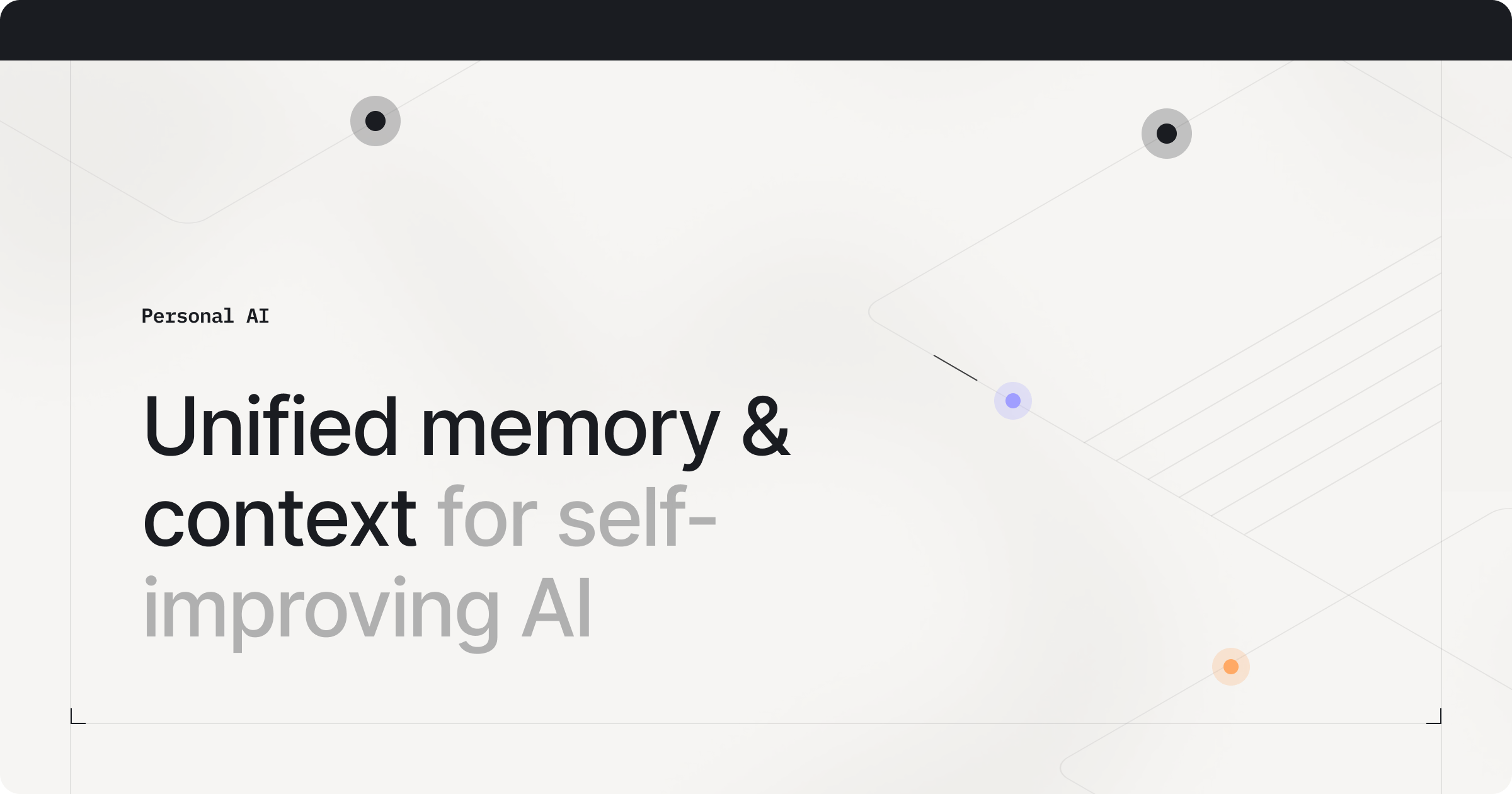
Look again at Personal AI's own picture - the calm cream rectangle, the mono type, the three small dots standing in for a very large idea. It reads like a company that refuses to shout, in a market that mostly does. The dots are the tell: this is a business about small things connected with care, not one enormous brain in the sky.
Whether "personal beats general" wins is still an open question, and the honest version of this story leaves the valuation blank and the Series A unwritten. But the wager is clear, and it is a human one - that the AI worth keeping is the one that remembers what you taught it, answers like you would, and belongs to you. In a year of models that know everything about everyone, Personal AI is quietly building the one that knows something about you.
The Rolodex
Find Personal AI
Sources: personal.ai, Wikipedia (Human AI Labs), Crunchbase, BusinessWire, Frontlines.io, Republic, Zapier, public YouTube interviews.