The candle shop in Touchpoint’s product illustration has a modest request: make a winter-sale email. There is a jar, a flame, a yellow background. Beside it sits a chat window. The distance between the request and the finished layout is the business Touchpoint now wants to occupy. It is a small piece of work, familiar to anyone who has postponed a newsletter because choosing the pictures somehow consumed the afternoon.
- The job: turn a prompt and a website’s brand assets into an editable email.
- The handoff: export HTML, or move the template into Textmagic to send.
- The twist: the name survived a much broader product that Textmagic stopped developing in 2023.
To understand this company-backed product, start with that earlier ambition. The same name once stood for an effort to gather customer communication into a single environment. Today it stands for getting a particular communication ready. The change in scale is the interesting part.
First, they tried to gather everything.
In its 2021 reporting, Textmagic described Touchpoint as a way to combine SMS, email, messaging applications and calls. A development team had grown to 23 people. The company acquired touchpoint.com and worked with Canadian design agency MetaLab on a substantial interface project. This was a bid to build a destination where businesses could manage conversations across channels.
Textmagic had an operating business behind the idea. Founded by Dan Houghton in 2001, the messaging company passed into Priit Vaikmaa’s ownership through a management buyout in 2013. Its history supplied experience in selling communications software to businesses. The Touchpoint proposal extended that experience into a wider product.
Then the economics deteriorated. In November 2023, management stopped development. The later annual report describes a beta product whose maturity would support a lower fee than expected, with slower projected growth. Development had taken longer and cost more than planned, while competitors continued moving. The expected commercial return could no longer carry the project.
“the product is unlikely to meet market expectations prior to launch”
TextMagic management · 3 November 2023
The suspension announcement put cash invested at nearly €6.5 million. Continuing would require an estimated €400,000 each month. The distinction matters: money already spent could not be recovered by approving another month. The forward expense was still a choice.
Stopping had human consequences. Textmagic announced a reduction of 38 team members, while 13 people from the Touchpoint development team would continue on Textmagic. It also planned to integrate some functionality into the parent product. The name and domain were retained for future applications.
The accounting aftermath needs its own label. The reported 2023 loss from discontinued operations was €23.39 million. That figure includes accounting effects; it is not interchangeable with cash invested. Treating both numbers as the cost of building today’s email tool would tell the wrong story.
Then, one email became enough.
In the fourth quarter of 2025, Touchpoint returned as an AI email-design platform. Textmagic confirmed the launch in its January 2026 sales update. The new brief was specific: help businesses produce branded newsletters and marketing emails through prompts. The intended audience includes smaller businesses, marketing teams and agencies without dedicated design resources.
The workflow starts with a website. Touchpoint imports a logo, colors and brand assets, then uses a conversation to generate an email. Users can revise the copy, replace visuals and adjust the layout. People comfortable with HTML can refine the code. A product launch, webinar invitation or cart reminder becomes a starting brief rather than an empty design canvas.
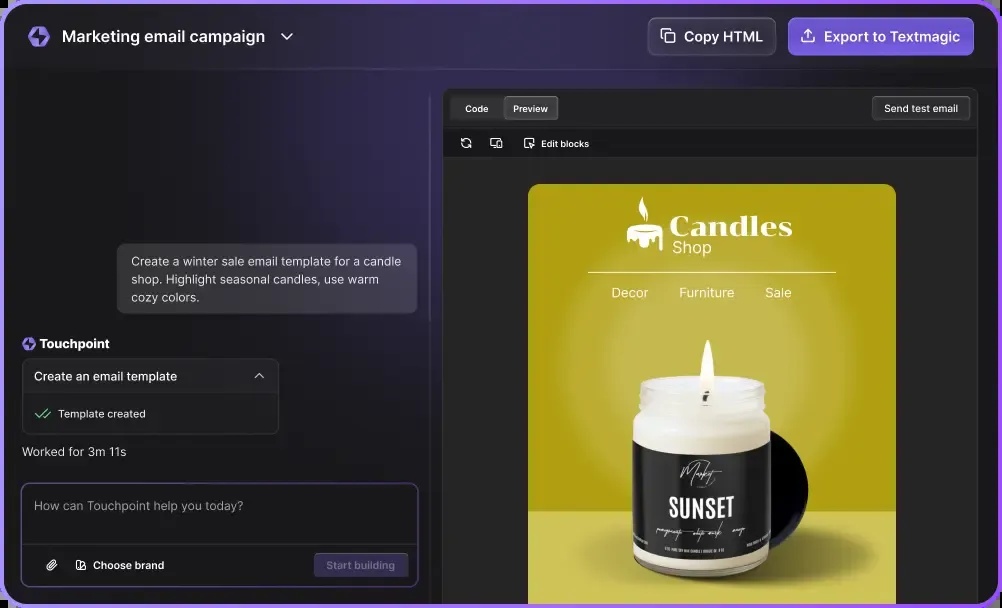
That candle-shop illustration captures the proposition neatly. It shows the request beside the result, with controls for copying HTML and exporting to Textmagic. It is a product demonstration image, rather than evidence of a retailer’s sales lift. Its useful detail is the handoff: the design has somewhere to go.
- 01Bring the brandWebsite assets
- 02Describe the emailAI draft + human edits
- 03Take it to the inboxHTML or Textmagic
The send button belongs to Textmagic.
Touchpoint creates the template. Textmagic handles the campaign after export: recipients, sending and performance reporting. The shared login reduces another small interruption. Someone using a different sending tool can instead take the HTML. This makes Touchpoint a creation layer within a larger communications business.
The market already contains capable alternatives. Stripo offers visual and code editing, testing and export to more than 90 email service providers. RGE Studio, formerly Beefree, emphasizes designing, reviewing and shipping emails together. Touchpoint’s pitch centers on the combination of website-derived branding, conversational generation and a direct route into its parent platform. Whether that combination matters depends on how a team already works.
Its expertise is concentrated in translating a marketing brief into a branded layout. A business that repeatedly stalls between having an offer and preparing the email has a plausible use for it. A team whose bottleneck is list quality, customer research or choosing the offer will still have that work waiting.
Count the drafts before the sends.
The published design plans start at $20 a month for one million tokens and one brand. Pro costs $40 for two million tokens and two brands; Business is $70 for four million and three; Growth is $100 for six million and five. Enterprise pricing is by contact. The site also offers 100,000 free test tokens.
Tokens measure the design allowance. They should not be read as a count of emails delivered. Sending happens through Textmagic, which advertises an introductory 10,000 free sends for new users. For a buyer, those are two different stages of the budget.
A useful experiment is small: bring one real offer, its approved wording, a destination link and the website. Generate a draft, revise it, then inspect the result in the intended sending workflow. Touchpoint’s terms leave review of AI output with the customer. An attractive layout does not verify a price or a promise.
The company’s history supplies a second experiment, this time for builders. Compare the next development bill with the return the product can reasonably earn. Keep assets that remain useful. Touchpoint kept its name, its domain and a place inside an existing business. It now asks for a much smaller assignment: help finish this email.
Try the builder ↗ Plans ↗ Textmagic ↗ LinkedIn ↗ Instagram ↗ Facebook ↗ YouTube channel ↗