A small-business owner has a shipment to send. Somewhere inside FedEx’s resource center is the information that will help. The trouble is finding it: the center once contained more than 900 static pages. A library can be full of answers and still leave its visitor wondering what to do next.
- Ion builds calculators, quizzes, assessments, and guided content without code.
- The buyer gets a result; the marketing team learns what matters to that buyer.
- Templates help with production. Clear questions and careful measurement still require work.
The trouble with 900 pages
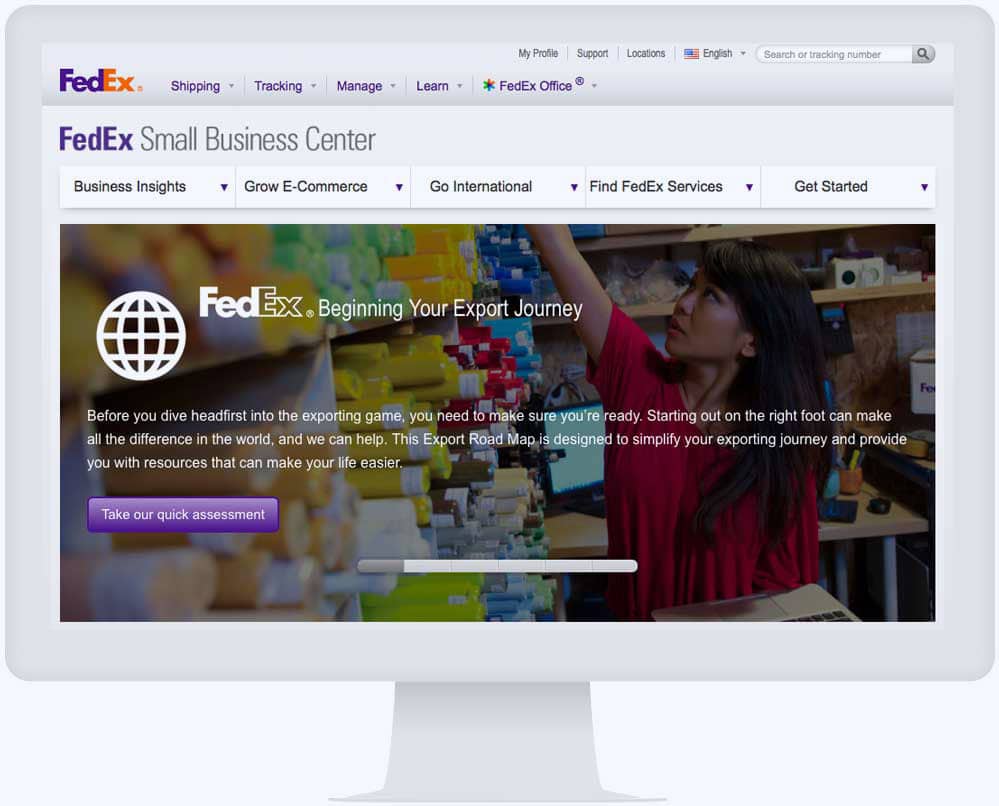
FedEx’s answer was to reorganize information around decisions. Working with Ion Interactive, its team built six experiences, including tools for freight classification, export readiness, and shipping costs. Instead of expecting an entrepreneur to assemble an answer from scattered pages, the content could guide that entrepreneur through a task.
Ion’s published FedEx case reports 136,000 visits, a 151% increase in shipment sales compared with the preceding six months, and an 82% month-over-month revenue increase for the shipment service discussed. These are historical customer-case results, with different comparison windows. They are a reason to examine the design, rather than a forecast for the next company buying the software.
The bet was on usefulness
That design choice explains Ion’s larger history. Founded in 1998, the company’s founders included Justin and Anna Talerico, Scott Brinker, and Christopher Robert. By 2014, Brinker was publicly describing a company-wide pivot toward what he called “marketing apps”: small digital experiences with functionality, logic, and flow.
His diagnosis was straightforward. Publishing had become an arms race. Buyers faced more material than they could reasonably absorb, while another gated white paper gave marketers another contact record. Ion saw an opening for content that helped someone calculate, configure, assess, or choose. A reader could leave with a useful answer instead of another reading assignment.
ScribbleLive acquired Ion in September 2017. The announcement counted more than 50 Ion employees and 250-plus enterprise customers, including Salesforce, Starbucks, Deloitte, and M&T Bank. In December 2019, Rock Content acquired ScribbleLive, bringing Ion into its portfolio. Those historical customer figures belong to their moment, before subsequent corporate changes.
The company’s live privacy policy, revised in August 2026, names Ion Interactive LLC as the service provider. The useful distinction for a buyer is between that current contracting identity and the earlier acquisition story. Rock Content’s funding totals describe the parent’s financing, rather than a separate investment round raised by Ion.
Two people benefit from one answer
The product joins a visual builder to conditional logic, personalization, testing, and reporting. A marketer can start with a template, adapt the brand styling, and decide which answer leads to which result. The output might be a savings calculator, a readiness assessment, an interactive report, or a landing page.
There is a second audience for every useful answer: the team preparing to sell. A download signals interest, but a calculator can reveal the assumptions behind it. Ion’s Sell-Side capability surfaces explicit responses and preferences for sales. Its integrations connect experience data to systems such as Salesforce, HubSpot, Marketo, and Eloqua, reducing the distance between a digital interaction and a conversation.
That puts Ion between creative production and marketing operations. Its expertise includes branded content design, measurement, and data handoffs. A standalone form builder addresses part of that job; a development team can build a custom version. Ion packages several parts together.
Consider the decisions behind a savings calculator. Someone must choose defensible assumptions, explain what the estimate includes, and decide how to handle an unusual answer. Someone must also check that the sales record preserves the context. Those responsibilities survive the move to a visual builder. The advantage of having creation and measurement together is the opportunity to revise the experience when the answers show that customers understood the question differently.
The form was getting in the way
One revealing example came from Rock Content itself. Marketing analyst Pedro Lopes examined an underperforming buyer-persona generator built in Ion. The opening offered both the generator and an ebook. Sales-oriented prompts arrived before visitors were ready. Missing action tags made the journey difficult to diagnose.
Lopes rewrote the copy around benefits, reduced competing offers, softened premature sales requests, and standardized tracking. His account reports 90 conversion actions in the earlier five-month period and 388 in the revised two-month period. Different periods and definitions prevent a clean causal comparison. The transferable lesson is the repair: give the visitor one clear task, then measure the steps needed to finish it.
“Switching to interactive experiences has simplified the customer education process.”Danny Kirkman / FedEx
The price includes the work
Ion sells quote-based Growth, Pro, and Enterprise plans. The published allowances run from one domain, three accounts, and 10,000 monthly unique visitors to three domains, nine accounts, and 100,000 visitors. All three advertise unlimited experiences. Traffic and account capacity, rather than the number of ideas on a whiteboard, become practical purchasing constraints.
The company also offers professional services, adoption support, managed services, and a hosted option. The budget therefore needs to cover both software and the people doing the work. No-code removes some development dependencies; someone still owns the copy, calculations, tracking, integration, and revisions. For an occasional simple quiz, that operating commitment may be difficult to justify.

Give the reader a job worth doing
The customer examples reveal different jobs. DHL used branded templates and testing to coordinate landing pages across markets. Korn Ferry wanted to know which chapters and topics interested prospective clients during a long buying cycle. Purchasing Power wanted educational experiences that helped employees make purchase decisions without adding web-development hiring costs.
These examples suggest a practical boundary. An interactive tool needs a decision with meaningful inputs and a result worth obtaining. If the answer is the same for everyone, a clear paragraph may serve the reader better. If nobody uses the collected responses, the second half of the product’s value goes missing.
Ion faces overlap from Outgrow’s calculators and quizzes and Ceros’s interactive design platform. Its case rests on combining creation, buyer insights, and follow-up. The sensible test is specific: choose one decision customers struggle with, build the smallest useful experience, and track completion alongside lead quality. When an interaction merely delays the answer, another question becomes another reason to leave.